




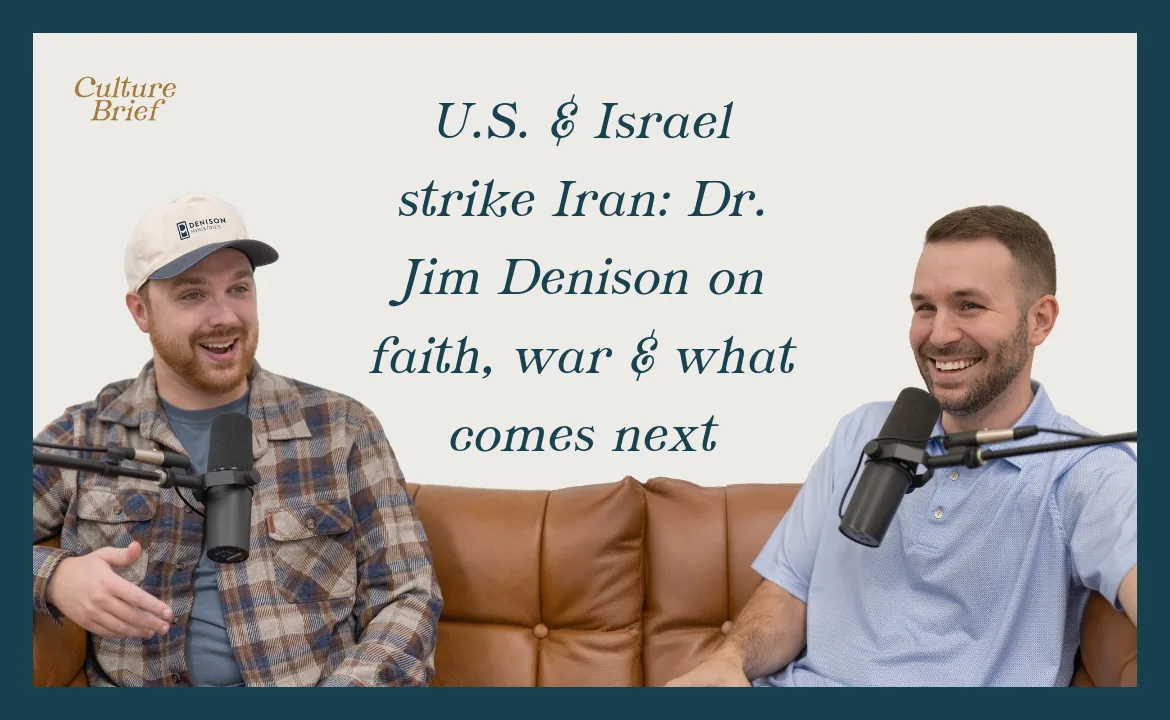
Culture Brief: U.S. & Israel strike Iran: Dr. Jim Denison on faith, war & what comes next | Ep. 59
In this week's Brief: The U.S. and Israel launched simultaneous strikes on Iran in what's being called Operation Epic Fury, and the world changed overnight. We’re joined by Dr. Jim Denison, founder of Denison Ministries and author of The Daily Article to break down the latest updates on the conflict. Dr. Denison is one of the foremost Christian voices on faith and global affairs, especially when it comes to Israel, Iran, and radical Islam.
He helps us unpack the history of Iran's Islamic Revolution, the Sunni-Shia divide, the apocalyptic theology fueling the regime, and the big questions Christians are wrestling with: Israel's role in prophecy and modern day geopolitics, the legality of the strikes, and how far a president can go without Congress.
Plus, Dr. Denison shares how believers should be praying for our leaders, our soldiers, the innocents caught in the crossfire, and for the spiritual awakening in the Muslim world that he says has been quietly growing for decades.
We believe you will find this conversation educational, engaging and uplifting in the midst of a very tense global moment.



Topics
- (0:00) Introduction & Meet Dr. Jim Denison
- (2:29) Rapid Iran conflict rundown
- (5:47) US politics and risks
- (9:56) Iran revolution history
- (13:58) Sunni–Shia divide explained
- (17:48) Why Iran hits neighbors
- (20:24) Iran missile strategy
- (21:43) Christian views on Israel
- (27:43) War powers legality
- (30:55) Conflict vs war debate
- (34:56) How believers should pray
- (39:08) Closing prayer and wrap
Resources
- Send us your thoughts, questions, and topic ideas: [email protected]
- Culture Brief Instagram
- Watch on Youtube
- Sign-up for a Denison Forum newsletter: DenisonForum.org/subscribe
Articles on this week’s top headlines:
- Denison Forum: Ali Khamenei reportedly found dead in Tehran
- Denison Forum: A biblical reflection on the death of Ayatollah Ali Khamenei
- Denison Forum:Possible terrorism in Texas and jihad against Americans
- The Focus: Is America’s war with Iran legal?
- The War in Israel (E-Book)
- Denison Forum: Will the Iran war forge a “very different” Middle East?
About Dr. Jim Denison
Dr. Jim Denison is a cultural theologian and the founder of Denison Ministries. He writes The Daily Article, a widely read commentary helping millions think biblically about the day’s most pressing headlines.
Dr. Denison has studied Islam extensively and traveled to Israel many times, spending decades analyzing the spiritual and geopolitical forces shaping the Middle East. He holds a PhD in philosophy of religion, has taught apologetics at the seminary level, and is the author of more than thirty books, including The War in Israel and Radical Islam: What You Need to Know.
About Conner Jones
Conner Jones is the Director of Performance Marketing at Denison Ministries and Co-Hosts Denison Forum's "Culture Brief" podcast. He graduated from Dallas Baptist University in 2019 with a degree in Business Management. Conner passionately follows politics, sports, pop-culture, entertainment, and current events. He enjoys fishing, movie-going, and traveling the world with his wife and son.
About Micah Tomasella
Micah Tomasella is the Director of Advancement at Denison Ministries and co-hosts Denison Forum's "Culture Brief" podcast. A graduate of Dallas Baptist University, Micah is married to Emily, and together they are the proud parents of two daughters. With an extensive background in nonprofit work, finance, and real estate, Micah also brings experience from his years in pastoral church ministry.
About Denison Forum
Denison Forum exists to thoughtfully engage the issues of the day from a biblical perspective through The Daily Article email newsletter and podcast, the Faith & Clarity podcast, as well as many books and additional resources.
EPISODE TRANSCRIPT
NOTE: This transcript was AI-generated and has not been fully edited.
Conner Jones: [00:00:03] Hi, I'm Conner Jones.
Micah Tomasella: [00:00:04] I'm Micah Tomasella.
Conner Jones: [00:00:06] And this is Culture Brief, a Denison Forum podcast where we navigate the constant stream of top stories in news, politics, sports, pop culture, and this week, geopolitical war. There's so much happening in the world, Micah. This is probably the biggest story we've had to tackle since we started this podcast last year. I mean, we we've tackled some big things, but all out war in the Middle East started with Operation Epic Fury with Donald Trump ordering strikes in Iran. So, you want to just give us a little preview of what we're going to be talking about and who we're talking about it with?
Micah Tomasella: [00:00:35] Well, you pretty much already said it, so I'm just going to jump to our special guest today. We're going to be talking about what's going on in Iran, Israel's part to play, America's part to play, but most importantly, our special guest today is Dr. Jim Denison. He's a cultural theologian and one of the foremost Christian voices on faith and global affairs, especially when it comes to Israel, Iran, radical Islam, and all the parts to play there. Dr. Denison is the founder of the ministry that we get to work for, Denison Ministries, and writes the Daily Article where he helps millions of people think biblically about the day's most urgent headlines. He's traveled to Israel more times than we can count, maybe more times than he can count, studied Islam extensively, and has spent decades analyzing the spiritual and geopolitical forces shaping the Middle East. So he's the author of more than 30 books, including The War in Israel and Radical Islam, what you need to know. Both of which unpack the historical, theological, and cultural realities behind today's conflict. Dr. Denison holds a PhD in philosophy of religion and has taught apologetics at the seminary level. He also serves as the resident scholar for ethics at Baylor Scott and White Health and is a senior fellow with several other Christian organizations. Simply put, when it comes to understanding what's happening in Israel with Iran and the broader Islamic world through a biblical lens, few people are better equipped. So Dr. Denison, welcome to the show, sir.
Jim Denison: [00:01:59] Well, Micah, you're very kind. Thank you so much. I'm happy to be on the show with you on any topic. And especially want to talk about Israel, which I love, and obviously what's happening there because it is of such enormous geopolitical significance. So I'm delighted to be with you. I'm sorry for the topic, but I'm glad to have the conversation.
Conner Jones: [00:02:15] Yes, sir. Thank you. Yeah, we are so glad you're here, Dr. Denison. As you guys know, we quote the Daily Article all the time on the show. So we are just so grateful to have you here and dive into this topic with us. Okay. Just as a quick background before we dive into our conversation with Jim here, we're going to we're going to just hit a high level overview of everything that has happened in the last five to six days. As y'all know, on Saturday, that is when the United States and Israel both at the same time simultaneously launched air strikes on Iran. In that first wave of strikes, they managed to kill the Ayatollah Ali Khamenei, which was a huge deal. Also took out 48 other Iranian leaders. So they basically took out the top level of the regime there in power in Iran and have since continued to take out high-level targets. The US and Israel together have dropped over 2500 bombs and missiles on over 2,000 targets. That is insane. The US has also sunk over a dozen navy vessels and right before we hopped on here, we found out that we had a submarine sink a navy vessel of Iran's off the coast of Sri Lanka with a torpedo. That is the first torpedo kill since World War II. So this is, I mean, this is just a whole another level of war and it's taking place.
Micah Tomasella: [00:03:24] Wow, really? The first one since World War II?
Conner Jones: [00:03:26] That's what I saw right before we hopped on here.
Micah Tomasella: [00:03:28] That's being reported.
Conner Jones: [00:03:29] Wow.
Micah Tomasella: [00:03:30] I saw the video, but I didn't realize it had been what, 80 years since that's happened. Wow. Okay.
Conner Jones: [00:03:35] Yeah, you think about submarine warfare, it's not super common. I guess that yeah. Yeah. So, yeah, that's that's kind of the stage where we're at. And the US has really taken out the majority of their navy, which opens up more protection for the straight of Hormuz and prevents them from being able to attack other targets. But the the war continues on. Iran obviously is firing back. They did not just sit silently in the night. They have launched missiles all across the Middle East at the UAE, Oman, Kuwait, Qatar, Iraq, and especially Israel. Their Hezbollah proxy has also launched missiles at Cyprus at a UK base there. They have drawn in a lot of the region and now European nations into the war by targeting all these places. They also targeted Turkey this morning, which is a NATO ally. So there's a lot to this. It is really kind of just pouring out. I don't even know how to explain where this war is going and it just hour by hour we learn more stuff. Sadly, there have been deaths across the region. There've been over a thousand Iranian deaths killed. That includes soldiers and civilians, including 165 children in a school that was hit by a missile. There have also been six United States military deaths, which is really sad and we're praying for those families. There have been countless civilian deaths across the Middle East from Iranian missile hits as well. Oil ships have been hit. They're in the straight of Hormuz. There is a lot happening here and so much to dive into. Trump himself has said that this war could go on for four to five weeks. Other places in the Middle East have said, well, that's a problem because we only have a week's worth of interceptor missiles left to intercept Iranian missiles. And some of those Iranian missiles are and and really drones, suicide drones are making it through their defenses already. So this is a problem. Secretary of War Pete Hegseth has suggested that there will not be boots on the ground, but he has also not ruled it out. So this could expand to a further ground operation if Trump so decides and if they see that best fit. Here on the homeland, we have threats. Over the weekend, you might have seen that in Austin, in downtown Austin, there was a shooting that a man went into a bar and killed three individuals, injured 14 people. He was wearing a shirt that said property of Allah, and underneath that was a shirt with the Iranian flag. There are people who will rise up potentially here in America because they are angry about this operation Epic Fury. US bases have been put on high alert. Soldiers in the United States have been told to turn off tracking on their phones and not wear their uniforms in public. Politically, for Trump, this has kind of been a tough sell. It's not looking great in polls for this whole operation right now. He ran on the promise, as we've talked about here, Mike and I've talked about many times. He ran on the promise of no more interventionism across the world. No new wars. No more forever wars in the Middle East. And this is kind of maybe not going to be a forever war, but this is a big, big situation, a big operation. Axios even stated this week that no president in the modern era has ordered more military strikes against as many countries as Donald Trump has. He has attacked seven nations, three of which have never been targeted by the US before, Iran, Nigeria, and Venezuela. And he's authorized more air strikes in 2025 alone than President Biden did in his four-year term. Additionally, we've seen the markets kind of struggle to understand how to react to this. Oil prices have gone up, markets have gone down. That never helps the economic position of a administration in the midterms. Multiple polls this week have also shown that nearly six in 10 Americans disapprove of the US decision to take action in Iran and 60% say they don't think Trump has a clear vision or plan of what to do with this whole operation. A lot of mixed messaging from the Trump administration this week. We've seen multiple people say different things. It sounds like they need to really kind of land on a better just messaging platform of what the objective is. Here's the gist of what I've gathered from what Marco Rubio has said, Pete Hegseth has said and what Trump himself has said. It sounds like really the main operation here is to take out a regime and terrorist leadership that were an existential threat to America. They have started doing that already. Also to destroy the Iranian regime's missile industry and annihilate their navy and basically open up the straight of Hormuz to oil trade even while Iran is still there. Ensure that the regime's terrorist proxies can no longer destabilize the region or attack our forces or our allies, especially Israel, and to guarantee that Iran can never obtain a nuclear weapon. And then lastly, it seems like really one of the big things here is to provide a catalyst for Iranians to revolt and to topple the regime there in their own country. This is something that Trump said back in January that he was going to send help when protests were taking place in the streets of Iran and they were killing many, many thousands of protesters there. So this is the help. Israel and the US have said, we're here, we're going to open up the doors for the Iranian people to take on the regime, right? So what are the next steps? We don't know. This is a very fluid situation. It is changing by the hour. By the time we log off of this podcast, things could look different. You just don't know. All that to say, we're so excited to dive into it a little bit more with Dr. Jim Denison here. And so Micah, I'm going to toss it off to you for the first question.
Micah Tomasella: [00:08:25] Well, Jim, before I jump into that first question, was there anything on Connor's rundown that you wanted to comment on? I don't know if I saw like a little head nod there or whatever.
Jim Denison: [00:08:34] No, well done. It's hard to put a list together in that short of period of time and I think Connor did a great job with that. So obviously he's been coached by you, Micah.
Micah Tomasella: [00:08:41] Yes, right. Yeah, thank you. Thank you for recognizing that and noticing that. Connor, good job, bud. No, I think I think the only additional context I would add would be it's hard to get Americans on board with this simply because of what Trump ran on, but also we've been getting four or five different messages from the administration. They just did just need to have one big meeting and get on the same page because there are other geopolitical things at play. There's the China angle as well. There's the oil angle as well, like what they did with Venezuela and then now what they're doing in Iran. Like there are ways to sell this to the American people. They're just not doing a very good job of it. But when you read on what happened, they were given the intelligence that Khamenei would be meeting above ground on Saturday. I think it was some information from Mossad and the CIA was actually able to double check that. And so it seemed like, you know, I was just reading an Axios this morning, this sort of once in a lifetime opportunity to get all of the regime's top guys above ground and vulnerable. And so a decision had to be made to jump into this. And I think maybe it was sooner, maybe it was later, who knew. But we are where we are and now as believers here in America, we're just trying to process through what part we can play, how we can pray through this. Okay, so Jim, my first question for you is for our younger audience who may not be aware specifically of the history that led to this moment. Could you give us a quick refresher on the history of Iran with the revolution in 1979 and then the attacks that they've been responsible for for over the last half century? And what part did Khamenei play in all of it? And why is much of the world celebrating his death as a liberation?
Jim Denison: [00:10:27] Yeah, that's a great question and a great foundational place to start. Obviously, we could spend the rest of the time just discussing that. So I'll try to do this as briefly as I can. So you're referring to what's often called the Islamic Revolution of 1979. Prior to that, under the Shah and previous administrations, Iran had been fairly well placed in alignment with the West, at least for a few generations, relative to oil development, Western companies had been developing oil interests in Iran. There had been a lot of military kind of alliance there against the Russians, against the communists and the threat from the iron curtain, so to speak, and all of that. Well, in 1953, the CIA participated in an overthrow of a popularly elected ruler in Iran and bringing in the Shah, who was very despotic with his own people, very autocratic and very much operated as an autocrat over the centuries. Well, one of the people that tried to marshal response to that was a person named Ruhollah Khomeini. He was a leading cleric. He was exiled for a period of time. He had been very oppressed by the Shah and all of that, and he was kind of a a person fomenting revolution in exile. Well, it all came to kind of a a head, I guess, when the Shah developed cancer. President Carter permitted the Shah to leave Iran to seek treatment, and this gave Khomeini an opportunity to marshal a rebellion, a revolt against the Shah and against the West that led to the takeover in 1979 and the establishment of what they considered to be the Islamic Republic of Iran, which is a very theocratic Shiite, and we can get into that if you like, theocratically run sort of state. And from that time to this, they've been what's been commonly considered to be the largest or the leading state sponsor of terrorism around the world. They have an ideology, I can try to do this briefly, which believes that their version of the Messiah, the Mahdi, as he's called, M A H D I, the guided one, will return at the end of history to dominate the world for Islam. Before that can happen, however, Israel must be destroyed, the West must be pushed out of the Middle East. And so they support proxies that are attacking and terrorizing Israel. They support terrorism against the West, but all of that is part of this apocalyptic sort of ideology or worldview that drives what they do. Well, after the death of Khomeini, Ali Khamenei, who had been his one of his lieutenants, was elevated to supreme leader and has carried on that fight from that time until he was killed this last Saturday. So he rules as a theocratic kind of autocratic sort of leader. He dominates, dominated the country. He dominated the military, he dominated their supreme council, the politics of the day, the elected president really was subservient to him and so he was very much not just a figurehead, but the actual dictatorial leader of Iran trying to lead this worldview that would export their version of Islam around the world and prepare for the coming of their Messiah who would dominate the world for Islam. So that's a short version as best I could try to describe the last several decades.
Conner Jones: [00:13:25] Yeah, thanks, Jim. That's great. Thanks, sir. You know, I was just thinking about on top of that, one of the things that Trump really pitched to the American people is they've been attacking Americans for decades too.
Jim Denison: [00:13:34] They have. They and their proxies.
Conner Jones: [00:13:36] Them and their proxies. They attacked a base in Beirut in the 80s that killed hundreds of Marines. And then the USS Cole was attacked as well, I think in 2000 or 2001.
Jim Denison: [00:13:43] 2001. 2004. Okay.
Conner Jones: [00:13:46] All of that adds up to kind of what Trump is saying, they have been an enemy of the United States for so long. And specifically, Khamenei has been an enemy and even he had a bit of a personal vendetta against Khamenei. He said, I got him before he got me this week. Something that he felt Khamenei wanted to kill Trump himself. So there's a lot to that. On top of everything you were saying about the Islamic ideology, Jim, I kind of want to dive into this a little bit more because you have such a great understanding of how Islam thinks, specifically, maybe the Iranian regime is a whole another like sect. Do they think of Islam differently than much of the Islamic world?
Micah Tomasella: [00:14:20] I know there's the Shia, the Sunni, they think differently and a lot of the Iranian people don't even like the regime. They don't maybe align with the way that they believe it.
Conner Jones: [00:14:29] Right, which is why there's been celebrations, right? So there's so there was mourning, but then for the most part worldwide, you've you've seen demonstrations of celebration.
Micah Tomasella: [00:14:38] Right, you know.
Conner Jones: [00:14:40] Yeah, on top of that, Iran's attacking other Muslim countries. So does Islam permit intra-religious war?
Jim Denison: [00:14:48] And that's a massive issue, by the way. Attacking the Arab world is a massive geopolitical issue relative to how the Middle East is going to align on the other side of this conflict whenever that comes. So the Muslim world is divided primarily into Sunni and Shia. There are some other branches as well, but those are kind of like Catholic and theology, if you want to or and Protestant, if you want to think of them that way. Around 80 to 85% are Sunni, about 15%, or so are Shiite. It goes back to the death of Prophet Muhammad in 632. There were leaders that followed Muhammad all the way until the early part of the 20th century, known as caliphs, who were considered by the Sunni world to be the rightful leaders of the Muslim world, the caliphs. The Shiites, the other minority, believed that Muhammad's son-in-law, Ali, was the proper successor of Muhammad. He was actually the fourth caliph. Shiite means party of Ali. And so it goes back to where the leadership of Islam originated after the death of Muhammad, since he didn't appoint a successor himself. And so the Shiites, as opposed to the Sunnis, believe that the 12th Imam, the 12th, what they consider to be successors of Muhammad, was occluded or guy or protected back in the 10th century, but is still alive and will return at the end of history as the Messiah to dominate the world. Well, the Sunnis don't believe that. They disagree with the Shiites over that. Most of them disagree with the Shiites over the need to destroy Israel to bring about the coming of the Mahdi. Many of them have their own issues with Israel and the Palestinians, but it's not necessarily over that same apocalypticism. And so they see this minority part of Islam dragging the Muslim world into conflict. And Khomeini especially in leading that charge as it were. And so that's why you're seeing a lot of rejoicing in the larger Muslim world because this what they would consider to be a heretic was using this minority view to kind of bring the larger Muslim world into conflict. But then in recent days, as Iran has been attacking Arab states themselves, not just through proxies like the Houthis in Yemen, but themselves, they've brought especially Saudi Arabia into a unified sort of alliance with Israel and the West against Iran. Well, if that alliance lives past this war, that could realign the Middle East in ways that could be significant for generations to come. And so we're going to have to see obviously how all of that turns out. But in Iran itself, there's also something like 40 to 50% of the population are not practicing Muslims. It was a very secular state prior to 1979. That's part of what the revolution was supposed to correct. The Persian Empire, and Iran is essentially Persia, has always been very progressive. It was one of the major empires in world history. The Persian people have been remarkable in their contributions to world history, their artistic contributions, their intellectual contributions, their scientific contributions, very much an advanced society. Persians and Arabs are not the same thing. They're very different cultures, very different histories. Over history, the Persians have dominated the Arabs at various times and so there's always been enmity between the Arabs and the and the Persians and now the Iranians. And if this conflict widens that divide, this could be enormously significant for the future.
Micah Tomasella: [00:18:03] So, Jim, I just wanted to ask just from what you've been reading, what you've been seeing, maybe conversations you've been having too, like what was the reason that you've been reading that Iran would respond by attacking all of its neighbors? But again, what you're highlighting is that they have no issue with that because Iran and the regime views those nations as heretics because they have a different interpretation of Islam. So there's not necessarily like, so they don't really have a problem with that, right?
Jim Denison: [00:18:31] There's three parts, but yeah, excellent point, Micah. From their point of view, there are basically three populations. There are the true Muslims, there are the infidels, which are us, and there are the apostates, which are Muslims that are not true Muslims. Well, there was a scholar named Sayyid Qutb that back in the early part of the 20th century influenced a lot of the Muslim world, Sunni and Shia both, with the idea that it was only the first four caliphs, the rightly guided caliphs that were the pure Islam. And now we need to return back to that and anything that doesn't do that is heretical or apostate. Osama bin Laden believed that even though he's a Sunni, he believed that the Saudi royal family was apostate because they weren't willing to be this puritanical sort of Islam. So there is this idea that if you don't agree with my version of Islam, you're apostate. And therefore, what the Quran says about not attacking Muslims doesn't apply. That in fact, when the Shiites attack the Sunnis, they're really not attacking true Muslims, would be a way they could see this. What they're really doing is attacking US bases, Western bases in Arab lands, in the belief that because somebody like Oman or Saudi Arabia allows Western presence and Western military bases, they are themselves apostate. They're now participating in this war against Islam by allowing Israel or the West to use them to attack Iran. So they don't think they're attacking true Muslims. They think they're attacking apostates that are part of a war against true Islam. And because the Quran requires Muslims to defend Islam, Surah 2 verse 190 and others, they think that they're actually obeying the Quran by defending Islam and advancing the time the Mahdi might reappear in attacking the apostates who are attacking true Islam. Hard for us to understand it that way, but that's the mind by that's the ideology by which a lot of this is being motivated.
Micah Tomasella: [00:20:20] It sounds like Iran is making some enemies of people that could have potentially helped them out a little bit. I think they it seems like they kind of overplayed their hand here and it seems like if they're targeting bases, you see all these hotels in the UAE getting hit and parking lots. They're being wildly inaccurate, it seems like and causing destruction.
Jim Denison: [00:20:35] They have terrible technology. Yeah, that's been true for a long time. We saw this back in some earlier conflicts. Iranian military technology is very much behind what Israel and the United States have. And their guided missiles are just not very guided. And so a lot of the collateral damage is happening as a result of that. But again, in their idea, if Oman or the Saudis or Kuwait, Turkey are going to support the West, that makes everybody in Turkey. It's something they're willing to do. complicit in this thing on some level.
Conner Jones: [00:21:03] Yeah, well, there's also just the theory too that Iran is, while they're aiming for missiles and oil depots in Saudi Arabia and all that, they're hitting strategic places. They're also trying to foment fear among people by hitting big luxury hotels, by hitting international airport terminals. So I don't know. They also have these drones, one of the things that have been been really noticed, they've got these cheap drones that cost 20 to 30,000 dollars that are these one-way suicide drones. But we're sending all of our allies and the US are sending up two, three, four million dollar interceptor missiles to take out these cheap drones. And so they are trying to just launch as many of those as they can to overwhelm the defensive technology and deplete our stock pile, which is something that is very strategic on their part of what they're trying to do. The problem is they don't have a very coordinated effort right now because so much of their leadership has been decapitated. And so even Pete Hegseth said in the press conference this morning, their generals are gone and their successors are gone. So they're just trying to shoe string anything together that they can. Another question for you, Jim, and I think this is a big one that a lot of people have been thinking about. The younger generation, Mike and I's generation, we honestly, we grew up with war on our TV every day. I remember when mom would have on the morning news and it was an update in Iraq and an update in Afghanistan every day for our entire childhood all the way up through our college days. I mean, it was 20 years of a prolonged war in the Middle East. This is something that I think a lot of people have been very wary about and I think that's understandable. Do you think it's okay for us as Americans or even as Christians to feel cautious about further US military involvement in the region? And then beyond that, there's been a lot of talk in the recent years about Israel and its place in the Middle East and its place in the Bible, its place in the modern day biblical, there's the dispensationalism debate and all of that. As Christians, and we think about the Middle East and the region and wars and all that, are we biblically mandated to support Israel in a way that requires political or military alignment? And is there a faithful or theologically grounded way to support Israel while also desiring to avoid another extended conflict that could cost more American lives?
Jim Denison: [00:23:05] That's a good question. Fantastic question. Yeah. Micah, I'm really impressed that Connor, you know, it's been great. I was actually, I was actually the one that was supposed to ask that question, but Connor took it. But anyway, go ahead.
Conner Jones: [00:23:18] Well, okay. Yeah, there is that.
Jim Denison: [00:23:19] Well, well done. Yeah. And you guys know this, but I mean, this is several hours of conversation around such a massive issue with so many different ways to look at this. So I wrote a paper that turned into a book on the war in Israel back after the October 7 invasion. I have a whole chapter specifically devoted to Israel's place in prophetic history and apocalyptic theologies and all that go inside all of that to try to summarize that very, very quickly. One way of answering your question, as you know, known as dispensationalism, is the belief that any promise made to the state of Israel in the Bible must be fulfilled by a literal state of Israel one day. And so in this thinking, the founding of Israel on May 14, 1948 is the fulfillment of prophecy. And God is now on the side of the state of Israel, which should be seen in the same way that you see Israel in scripture. And we therefore, if we're going to be blessed by God, need to be on the side of Israel as well. I remember Jerry Falwell years ago saying, God blesses nations that bless Israel, and he judges nations that judge Israel. And so by that reading, the answer to your question, Connor, would be we should be on the side of Israel whatever it takes, whatever it costs. Yeah, because now we're on the right side of apocalyptic history, on the right side of what God is doing in the world. And that's a very popular belief in America today and outside America as well. That's not my personal position, but that's a very popular position, especially with evangelicals and more conservative Christians today. There's a opposite view of that, which would say that the purpose of Israel was fulfilled in the coming of Messiah. And today Israel plays no larger or different a geopolitical role than any other nation. And so if America is going to do something relative to Israel, it should only be on geopolitical terms. Henry Kissinger said nations don't have allies, only interests. And so we should side with Israel when it's in our interest to do so. They're the only democracy in the Middle East. They're by far our best friend from a military point of view. They're by far the dominant military in the Middle East. If we want oil stability, if we want economic stability, if we want a counter to the Islamic extremism that hates the West, then we want to be friends with Israel and we want to work with Israel to the degree it is to our geopolitical interest to do so. And then you're going to make a distinction between Zionism, the belief that Israel has a right to exist as a people, that the Jewish people deserve a right to exist, and the leaders of Israel today. There are those that would say, just because I believe in the Jewish state doesn't believe I have to agree with everything Netanyahu does or everything the current leadership of Israel does. And so there's the spectrum here, right? From the one that would say Israel's no more relevant to this than any other country, all the way over to, we have to do whatever Israel says in order to be blessed by God. Most are someplace in the middle. I myself don't think the creation of Israel in 1948 is a fulfillment of prophecy, but I do think God continues to use the Jewish people uniquely. I'm not a replacement theologian that just thinks the church replaced Israel and now Israel has no role, but neither do I think that Israel is in the same redemptive posture it was before the Messiah. In Galatians 3, we're told there's neither Jew nor Greek, slave or free, male or female, we're all Abraham's seed and heirs according to the covenant. But I also believe God continues to use the Jewish people uniquely. So my own personal position would be that the Jews deserve a right to their homeland. The Holocaust taught us that they must be able to defend themselves. I don't think I'm therefore obligated to support everything the Jewish government does. And by the way, having been to Israel 30 times, as you mentioned earlier, most of the Jewish people in Israel don't believe that they need to support everything the government does. They have a very healthy debate over what the government is and who Netanyahu is and his popularity and the like thereof and all of that in Israel itself. And so there's a middle position here is what I'm saying that would say I can support the Jewish people without having to support everything their leaders do. So now, if I'm President Trump, I'm going to be making decisions based on what's in America's best interest to the degree that that can align with Israel's best interest as well.
Micah Tomasella: [00:27:18] Great answer, Jim. It's a lot in that, but that's a that's a summary as best I can.
Conner Jones: [00:27:21] It's a complicated issue. It is one of the most complicated geopolitical issues of our time. To know that. And it has been for thousands of years and it still is today. So, yeah, that's a great succinct answer, Jim.
Micah Tomasella: [00:27:31] Well, yeah. I mean, and it's easier to retreat into one corner to choose one side of the other, to pick the loudest voices. I think on many, many issues, if we would take a step back and recognize kind of the credence that maybe both arguments make. I do believe it's a very biblical argument to take the Old Testament and the New Testament and say they're both the inspired word of God. How do we combine all this? How do we look at all the good things Israel's done, but the bad things Israel's done and say, what's the balance here? What's the process we should go through as believers as we pray for the state of Israel and for peace in the Middle East as a whole and just this whole conflict. So Jim, thank you so much. Okay, so another question here. Trump, he launched, you know, Operation Epic Fury without congressional authorization or sustained public debate, which is kind of in contrast to when we went to war in 2003 in the Middle East. There was time taken to get the congressional approval and obviously it was coming off of 9/11 and so it was different circumstances. But the CNN poll that Connor mentioned earlier had 62% of respondents say Trump should get congressional approval for any further action. Your opinion, how far can Trump go without getting approval from Congress? And were these strikes legal? That's just a big debate right now.
Jim Denison: [00:28:41] It is a big debate right now and it's because the very question itself has never been fully defined. The president is the commander in chief and yet Congress has the power to declare war. And so in order and that was by the founder's intent. As we've talked about a lot, as I've written about a lot, the founders understood not only that all men are created equal and endowed by the creator with inalienable rights to life, liberty and the pursuit of happiness, but they also understood that we're fallen. And they'd seen in England what happens with unaccountable personal authority. And so they wanted neither the president nor Congress nor the judiciary to have unaccountable authority. So they created these checks and balances. And so as regards the specific question, on one extreme, the president can do nothing in military terms without congressional approval. Well, if that's the case, how would you respond to an aggressor if it's going to take weeks and weeks to get Congress on board? Wouldn't that embolden your enemies on very significant levels? If you could never have a military response without congressional approval. On the other side of all of that, can you forever skirt the actual language around all of this relative to war itself by calling what everybody else calls a war, a conflict or an armed aggression or some such as that. There's really been no declared congressional war since World War II. Vietnam was never declared a war. Korea was never declared by Congress a war, even though they went on obviously for very very long period of time. I guess the thought was it wouldn't extend as long as it did. Anyway, there's a lot inside that. So that's a massive debate that the scholars are having with the scholars, that the legal authorities are having with each other as regards whether he could have or should have sought approval. As Marco Rubio is saying, we alerted congressional leaders prior to this as has been the case. But had we waited for congressional approval to launch a surprise attack to take out the leadership of Iran, obviously it wouldn't have been a surprise attack. And there just are going to be times when we have to do things in secret for the sake of of America's best advantage that obviously can't require congressional approval first. And so there's this massive balance and I'm seeing various scholars, Sarah Isgur and others that are debating this very point right now on a level I wouldn't have expertise toward. I think it boils down to a belief that as long as this conflict does not go past a certain period of time and doesn't exceed a certain period of scope and scale, it can be seen more as a conflict than as a war. And would not therefore require congressional approval on the degree it would if it continues on past a certain red line and even that's being debated right now.
Micah Tomasella: [00:31:13] Right. Right. I mean, if we're if this thing lasts six months, you know, there's just a lot of different discussion and I think I think the debate will only get more intense specifically if we start seeing more American soldiers die. I think that is going to be the match that lights the powder keg.
Jim Denison: [00:31:33] To this point, Mike, it's pretty partisan. We're seeing Democrats reacting to a Republican president pretty much the same way we saw Republicans reacting to a Democratic president when there have been other military actions that Republicans wanted there to be a war declaration for that sort of thing. But if American deaths start escalating, if boots get on the ground, if Americans start being attacked by terrorist proxies here, by sleeper cells here, in a way that makes Americans feel themselves endangered by this, I think then you're going to see Congress reacting in a in a much more, probably advanced way even than now.
Conner Jones: [00:32:07] Yeah. I think you're right. I even saw yesterday, Senator Josh Hawley of Missouri, who is pretty right-wing and he's a Trump ally. He he started to show he's he's concerned. He came out of a, I guess a briefing that they gave to the Senate staff and all of that and they they basically said there's potential for boots on the ground is what came out of this meeting. And that made Josh Hawley and I think other Republican senators start to say, okay, hold up, we we need to wrangle this in before this gets out of hand and we start committing to another Iraq war style situation here. You're right. There's a difference between a conflict and a war, but you rarely hear the the term, oh, the Iran conflict of 2026. Right. It's it's the Vietnam police action, you know. Right. Literally, that turned into a eight-year war. I mean, just unreal how this can really span out over time and over different presidents as well. So, yes, we'll just have to see what happens. There's going to be lots of debate about this. In fact, your son, Ryan Denson, Dr. Ryan Denson wrote a great article yesterday on Tuesday on his focus newsletter. You can go find that at Densonform.org. We will also link it in the show notes, really breaking down some of the legalese of everything that goes into this and and what the Constitution says about war powers resolutions and everything. I do think Congress is set to vote this afternoon. We're recording Wednesday. I think this afternoon they're having their first war powers resolution vote. If they get 51 congressional members to say yes to that, it moves on to the Senate. So this could turn into something.
Jim Denison: [00:33:33] It could. It's possible. And then obviously, as you mentioned earlier in our conversation, the polls at this point, you know, are if I'm in the White House, something I'm going to be watching with perhaps even greater attention. It's always difficult to initiate a war that doesn't have an obvious existential purpose for those that are conducting the war. And a war of initiative on that level to try to preempt what you believe could be happening to you if you don't do this is always a more difficult thing to explain, whatever the conflict happens to be. And we were attacked at Pearl Harbor, obviously, and Germany declared war on us after we declared war on Japan and such. But this isn't that. And so even though I think there are some very existential reasons why the Iranian leadership is and was a threat not only to Israel, but to NATO and to the West for some reasons we've talked about, it wasn't as clear to Americans that we needed to be in in this space.
Conner Jones: [00:34:28] You're exactly right. And to your point, one thing that Marco Rubio has said this week is, well, if we had waited for Iran to attack us first, then everybody would be mad at the US military and government decision makers. Like if there was a Pearl Harbor style attack from Iran, then it looks bad on the government that they didn't take the action beforehand. So.
Micah Tomasella: [00:34:45] There is an element to this where oddly enough, even though people don't want to see this play out, I think we'll know a lot more after another week, after another couple weeks. You know, it's just been such a barrage to try to take out Iran's defenses and you know, and then are we doing a regime change? Are we not? You know, whatever it might be. I just think there is an element of we have to let this play out and this could be viewed as one of Trump's greatest wins from his presidency or it could be viewed as an absolute catastrophe and it could mark his presidency forever. So, I mean, we'll just have to see how how it plays out.
Conner Jones: [00:35:23] Okay, so Connor, you have one more question for him? I do. Yeah, let's let's kind of, you know, put a bow on this whole thing and talk about how believers should respond. So this is probably honestly the biggest story we've talked about, like I said earlier, since we started the culture brief. We've talked through some pretty heavy hitting stories, Charlie Kirk and Hill Country floods and everything, but this one is going to I mean, this is going to be in the history books for a long time to come. And so there's a lot of weight to this. There's a lot of weight to just life and death and loss of property all across the Middle East. There are people in America who have sons and daughters and moms and dads overseas serving now in a place of more danger and they are nervous and they are worried. And so as Americans, we are 6,000 miles away, most of us, and we're seeing this from afar. But how can we as believers continue to think about this and pray about this situation that seems far away across the world, but is also somewhat close to home because we have so many of our fellow Americans over there. We also have so many fellow Christians in the region and especially in Iran, there is the underground Christian church. There are many Christians. What, Jim, can we be doing as believers to respond? How can we be praying and thinking about this situation?
Jim Denison: [00:36:29] Yeah, thank you for that. That's a great last question. We want to pray biblically, obviously. And so the first thing, 1 Timothy 2 tells us to pray for our leaders. And so we certainly want to be praying for our president, for our military leaders, for all of those that are involved in the leadership of this conflict right now, for those in Congress to have wisdom as well, for there to be absolute wisdom and direction as regards the best way to proceed as we move forward into this very difficult time. Then on a second level, we want to be praying for God to protect the innocent, for there and that's Iranians as well as those in Israel and those around the world. We know that God is on the side of the innocent and the suffering and we want to be praying for God to protect them, for God to protect our soldiers and our troops that are in harm's way and for any innocence that are in harm's way, just war theory would come to bear here as we think about trying to protect innocence in every way that we possibly can. Third, I think we ought to be praying and this is a thing I've been writing about all week in the daily article, ought to be praying passionately for spiritual awakening in the Muslim world. That awakening's been going on for decades now. My dear friend Tom Doyle, who's a missionary in the Middle East, would tell you that radical Islam is Satan's response to the spiritual awakening in the Middle East. That as so many Muslims are seeing visions and dreams of Jesus and turning to Christ in unprecedented numbers, that that's no coincidence that 1979 and the Iranian revolution and the rise of jihadism is at that same period of time as Satan wants us to fear Muslims and to hate Muslims when the Lord wants us to pray for Muslims and to love Muslims at home as well as overseas. During Ramadan, and we're in Ramadan right now, this is especially a time for us to pray for our Muslim friends, for God to help us build bridges to Muslims in our local communities and to be praying for Muslims across the world to turn to Christ. This is ultimately a spiritual conflict, as we've been saying. It's not motivated because Iran wants to conquer land like Hitler wanted to conquer land or Putin wants to conquer Ukraine. This is an ideological battle driven by an apocalyptic theology. So it's ultimately a spiritual battle. And by praying, we're on the front lines. By praying for regime change on a spiritual level as well as a geopolitical level, by praying for awakening in the Muslim world, we're also praying for the pathway that will most end this conflict in the most permanent way as well. So all of that goes together as we pray for our leaders, as we pray for our soldiers and innocents involved, and as we pray ultimately for spiritual awakening to continue in the Muslim world.
Conner Jones: [00:38:55] Yeah, I I I think that's great. Those are fantastic prayer points and honestly, Jim, it would be amazing if you would help us here and just close us out in a prayer for the region and for this conflict. But before we do that, I just want to say again, thank you for joining us and sharing your thoughts and your expertise. I know Mike and I were very blessed by this conversation and I hope the listeners are as well. And y'all, if you have questions, if you have thoughts, you can always send them to us at [email protected]. DM us on Instagram at Culture Brief Podcast. Let us know what you think. We'd love to address your questions next week. We will definitely continue to talk about this conflict or war, whatever it ends up becoming over the next coming weeks and months as it drags on. But yeah, Jim, would you be willing to close us out in prayer?
Jim Denison: [00:39:35] Sure. Happy to do that and thanks for the chance to be with you both. Father God, we thank you that you are the king of kings and the Lord of lords and nothing surprises you, Father. All is in your hand. You see the future better than we see the present. So we're praying, Father, first of all, that you would be glorified in this, that you would somehow advance your kingdom through this conflict, that you would use this in ways that most draw us to yourself. We pray for our leaders, Father, that you would give them wisdom, direction, guidance, counsel. Help them to turn to you, help them to trust in you. I pray for spiritual authorities in their lives to be used, to be influential so that our Congress people and our White House officials and and those leading the military, Father, that they could be led by your Holy Spirit in ways that could advance your kingdom and the common good. Father, I pray for our soldiers. I pray for all those that are in harm's way in Israel, in Iran, across the Middle East and beyond. I pray for your protection. Pray for your guidance and direction and encouragement and your peace for them. Father, I pray for a spiritual regime change in Iran. I pray for spiritual awakening there, Lord. Among that vast population that are atheistic or agnostic or secularist, that they would turn to you. I pray for Shiites to turn to you. I pray for 12ers to turn to you. I pray for those who are waiting for the Mahdi to understand that Messiah has already come and that Jesus, Isa, is now ready to forgive all sin and to offer secure salvation and and paradise with you, Father. Just move in their hearts and lives in that way. Marshall a mighty movement of of intercessors from around the Christian world. Father, I pray for the Iranian church that you would bless them and protect them and embolden them in this season, this unprecedented season for them. I pray God that you would use them as you use the apostles of old to stand boldly for your word and for your truth in ways that could speak the truth in love. So Father, we commit all of this to you. We pray our conversation today will help us as believers perhaps to understand the conflict better, but most of all, to be motivated to pray in ways that could advance your kingdom where we live and around the world. All of this we make as our prayer in the name of Jesus our Lord. Amen.
Micah Tomasella: [00:41:34] Amen. Jim, thank you so much. Your wisdom, your expertise. I know our audience will glean much from it and we sure did. Well guys, thank you so much for joining us for this week's episode of Culture Brief, a Denison Forum podcast. All articles and all videos mentioned will be linked in the show notes. And if you enjoyed today's show, would you please like, please subscribe and rate and review the show and we'll see you next Thursday.
Conner Jones: [00:41:57] See you all then.











 Search