



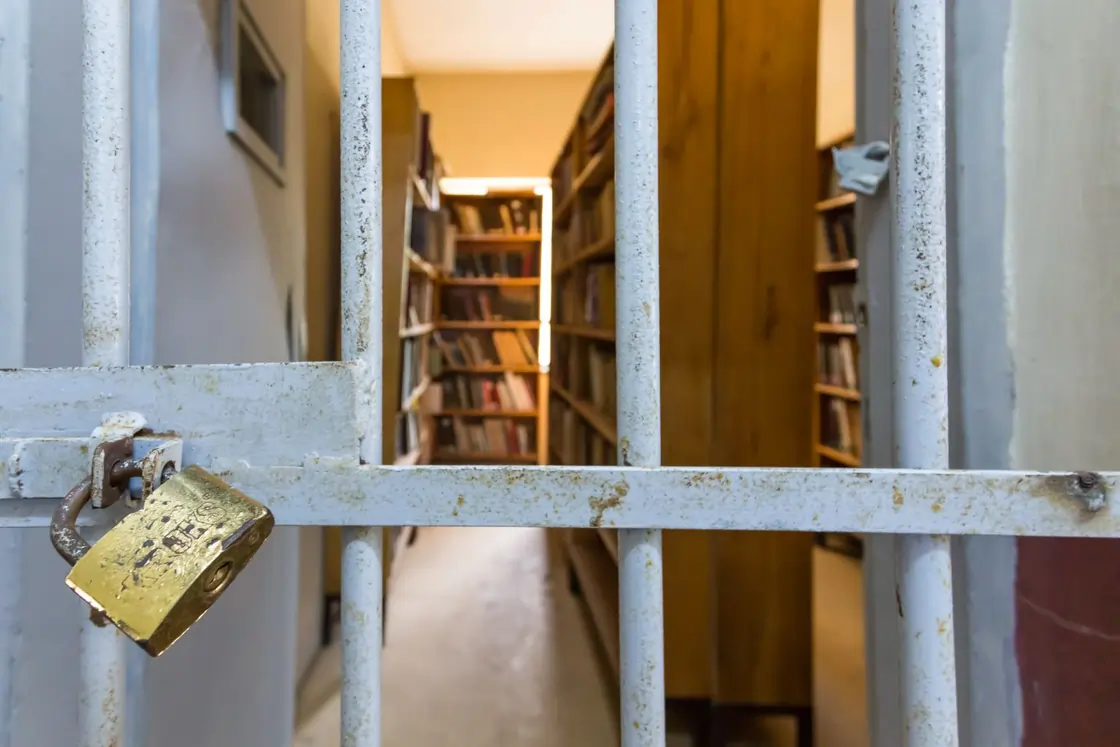
Sinop Fortress Prison in Sinop, Turkey. by epic_images/stock.adobe.com
While the war on drugs has been going on for decades, it may have hit a new evolution in recent years. Synthetic drugs infused into the pages of books, letters, and even photographs have become a growing problem in prisons across the country. And now it looks like they may be making their way beyond those walls as well.
Why it matters: The best way to fight the problem of drugs has long been to address the demand more than the supply. Given that something as benign as a library book can now become a dangerous means of distributing deadly narcotics, that truth is only going to become more relevant. However, the sense of hope, joy, and purpose offered by Jesus means Christians should be uniquely capable of meeting the challenge.
The backstory: “The forefront of new drug trends”
“Today is the most dangerous time in the history of the world to be using drugs. That’s until tomorrow, when there’s a new drug.” That’s how Dr. Andrew Monte, the head of the Rocky Mountain Poison Center, described the state of narcotics as illicit chemists flood the market with increasingly deadly synthesized drugs.
But to fully understand what’s possibly coming to a neighborhood near you in the near future, let’s take a closer look at an area that often serves as a testing ground for new narcotics: prison.
As Azam Ahmed and Matt Richtel describe, “Jails often sit at the forefront of new drug trends. The tighter settings breed creativity, forcing dealers and users to find new ways around the 24-hour surveillance.” And the latest innovation is less about the combination of drugs being used than the vehicle through which they’re delivered.
Dealers have begun spraying narcotics on paper, which users can then smoke to get high. It’s turned books, legal documents, letters from home, and even photographs into drug mules. The paper is then torn into strips and distributed, sometimes worth as much as $10,000 a page.
Moreover, because the drugs are synthesized in perpetually new combinations, many of the previous methods of detection simply don’t work. Dogs can’t identify them, and test strips won’t pick them up. The composition can be discerned in lab tests, but those often take weeks to get back, after which time the drugs may have changed, and the supply chain has likely moved on.
To further complicate matters, dealers have even started using Amazon to smuggle drugs into prisons by signing up as third-party booksellers and then shipping the drug-infused products in official-looking packaging. And there are signs that these tainted pages are already making their way into the rest of the world as well.
Coming to a school near you?
Driven, at least in part, by addicts who were released but still sought these synthetic narcotics, drug-soaked paper has begun to appear outside of prisons. Reports of tainted gift cards, for example, have started popping up in gas stations around suburban Illinois near the Cook County correctional facilities, where the paper drug trade is an especially large problem.
And it makes sense. Synthetic drugs are typically cheaper to produce than cocaine, heroin, or many of the other narcotics that have plagued society, and they are safer to distribute—even if they are far deadlier to take.
As Justin Wilks, the head investigator at Cook County jail in Chicago, described, “When the cops pull you over with a bag of heroin, you have to hide it. But if they pull you over with a manila folder full of paper, no one is going to even give that a second look.”
While the pages often have a sticky texture that can set them apart from normal paper, you have to look fairly closely to find it; far closer than anyone would do without probable cause to suspect that something might be amiss. Consequently, it’s not hard to see a world in which similar products could make their way into schools, libraries, and other such places in the near future.
And, as Wilks warns, “The sky is the limit in terms of what they will come up with. It never ceases to amaze me. I can’t imagine the next thing. I couldn’t have ever imagined this.”
So, how should we respond to such a story?
Supply or demand?
To be honest, as the father of two school-aged kids, my first response is fear. It’s bad enough knowing that traditional drugs are already a challenge to keep out of schools, but the idea that someone could turn a library book—and yes, they still have those—into a deadly poison is disconcerting to say the least.
At the same time, though, the most effective way to fight drugs has always been to address the demand more than the supply. And that’s the case regardless of what form the drugs take.
As Rashad Rowry, a former inmate who used to smoke paper in prison, stated, “A lot of us are facing life in prison, and to leave that behind, even for a minute, is all you want.”
While people outside of jail may not be facing the same future as Rowry describes, that basic impulse to leave your problems behind, even if just for a minute, is what drives most people to use drugs, regardless of age, economics, or any other factor. Understanding that reality is the first step to protecting those around you—and, perhaps, even yourself—from becoming the next victim.
The tragic truth is that many, if not most, of those who use these drugs have lost their lives long before their heart stops beating. When the hope, joy, and purpose for which we were created goes away, something else has to fill that void. And that something is seldom healthy.
Fortunately, that’s not where the story has to end.
Spiritual application: Know your need
Throughout his ministry, one of the most common critiques leveled at Jesus centered on the company he kept. In Matthew 9, for example, shortly after calling Matthew to leave his job as a tax collector and become his disciple instead, the Pharisees asked, “Why does your teacher eat with tax collectors and sinners?” (Matthew 9:11). Christ responded:
Those who are well have no need of a physician, but those who are sick. Go and learn what this means: “I desire mercy, and not sacrifice.” For I came not to call the righteous, but sinners (Matthew 9:12–13).
It’s no coincidence that the people most devoted to Jesus throughout the gospels were those who understood best how much they needed him. It was often the people without purpose, without joy, and without hope who found all three in Christ. And it was those who sought those blessings elsewhere that remained lost.
As Christians, we have been given the privilege of helping others experience the kind of abundant life that only Jesus can give (John 10:10). And that needs to start in our homes and in the communities where the Lord has already placed us.
If we can help people find their hope, joy, and purpose in Christ, they’re far less likely to go looking for it anywhere else. Helping others look to Jesus for those blessings gets a lot easier if they can see us looking to him first, though.
And remember, God’s abundance has nothing to do with money, health, or social standing. Instead, it’s found in the kind of close, intimate relationship with the Lord that transcends every other category of blessing we are so often tempted to trust instead.
So, who do you know that needs to experience the abundant life Christ offers today? Are there any parts of your life where your sense of hope, joy, and purpose are lacking?
The Great Physician is calling you to find those blessings in him.
Will you?
News worth knowing
1. Starlink helps Ukraine make its largest territorial gains against Russia in two years
In February, Elon Musk cut off Starlink service to the invading Russian armies. The Russians had previously relied heavily on Starlink for both live battlefield video streams and communication across the army. While Russia does not use Starlink inside its rightful borders, the technology has become essential to its efforts in Ukraine.
Why it matters
The video feeds from Starlink were one of the primary ways in which the Russians were able to launch drone swarms and missile attacks with impunity. However, since internet access was cut off, Ukraine has reclaimed roughly 150 square miles, marking its most significant gains in more than two years.
What to watch
Will these gains mark a shift in the war? Would losing land be enough to bring Russia back to the negotiating table, but this time in earnest? Or will the Russians figure out a way to mitigate these losses and return to their more aggressive approach?
The Wall Street Journal has more on the story
2. Progress on funding to reopen significant parts of DHS
As airport chaos becomes the norm and significant portions of the Department of Homeland Security remain unfunded, there are signs the fight could be coming to an end soon. A new deal that would fund all of DHS except for parts of ICE—namely, their immigrant removal operations—could garner the necessary support to pass this week. While there are still a number of details to be ironed out, the proposal appears to have the most support of any solution thus far.
Why it matters
The DHS shutdown has always targeted the least controversial parts of the department. ICE received plenty of funding from the One Big Beautiful Bill to remain open and operational throughout, meaning TSA, FEMA, and other services that had nothing to do with immigration bore the brunt of the pain. Getting this deal done would rectify that problem while likely still including some ICE reforms, such as body cameras and greater transparency.
What to watch
While the proposal has the most support thus far—due, at least in part, to the Senate’s desire to go home for its upcoming two-week recess—its success is still far from certain. Will enough Democrats cross the line to reach sixty votes? What further concessions and reforms will be offered in the days ahead? And will Republicans be able to fund the rest of ICE through other means once a deal is done?
Punchbowl News has more on the story
3. The 2026 Major League Baseball season officially starts tomorrow
MLB’s opening day kicks off tomorrow, with the Yankees traveling west to face the Giants, before an 11-game marathon sees the majority of the league start their seasons on Thursday. The Texas Rangers meet the Phillies at 3:15 CST on Thursday afternoon in what is clearly—at least in my slightly biased opinion—the most significant game of the week, so be sure to mark your calendars accordingly.
Why it matters
There’s been a lot of sports content in this space over the last few weeks, and I appreciate your indulgence in doing so. While baseball pales in importance to many of the other issues discussed in The Focus, it brings me joy, and—even if you don’t like this sport or sports in general—finding little reminders that the state of the world is not nearly as dire as the political or global news of the day would have us believe is important. Our faith in Christ should be where we look first for those reminders, but I don’t think our heavenly Father minds when we find joy in other aspects of life as well.
What to watch
One of the biggest storylines for this season is the advent of a challenge system for balls and strikes. I mentioned this in a previous edition of The Focus, but the new changes have received mostly positive reviews. Will that sentiment remain the same once the games start to count?
God is good
The Houston Livestock Show and Rodeo has grown to the point that it now draws nearly three million attendees and generates almost as much economic impact for the city as the Super Bowl. And the Fellowship of Christian Cowboys hosts a Sunday service at NRG each week to help athletes and attendees encounter the gospel amid everything else the Rodeo offers.
Kingdom impact
As Danny Biddy, who leads the services, described, “People just seem to be drawn to that family, welcome, ‘Howdy, how are y’all’ atmosphere.” While many may come as much for the novelty of the service as the message it shares, we should never underestimate what the Lord can do when people give him the chance. And that gospel message is shared clearly and powerfully each Sunday the Rodeo is in town.
Prayer point
Will you pray that God will continue to work in the lives of those who attended the cowboy church this year? And will you pray that he uses the example they set to inspire other believers to be open to a broader understanding of how the Lord might want to use them to reach the lost as well?
Houston Public Media has more on the story










 Search