



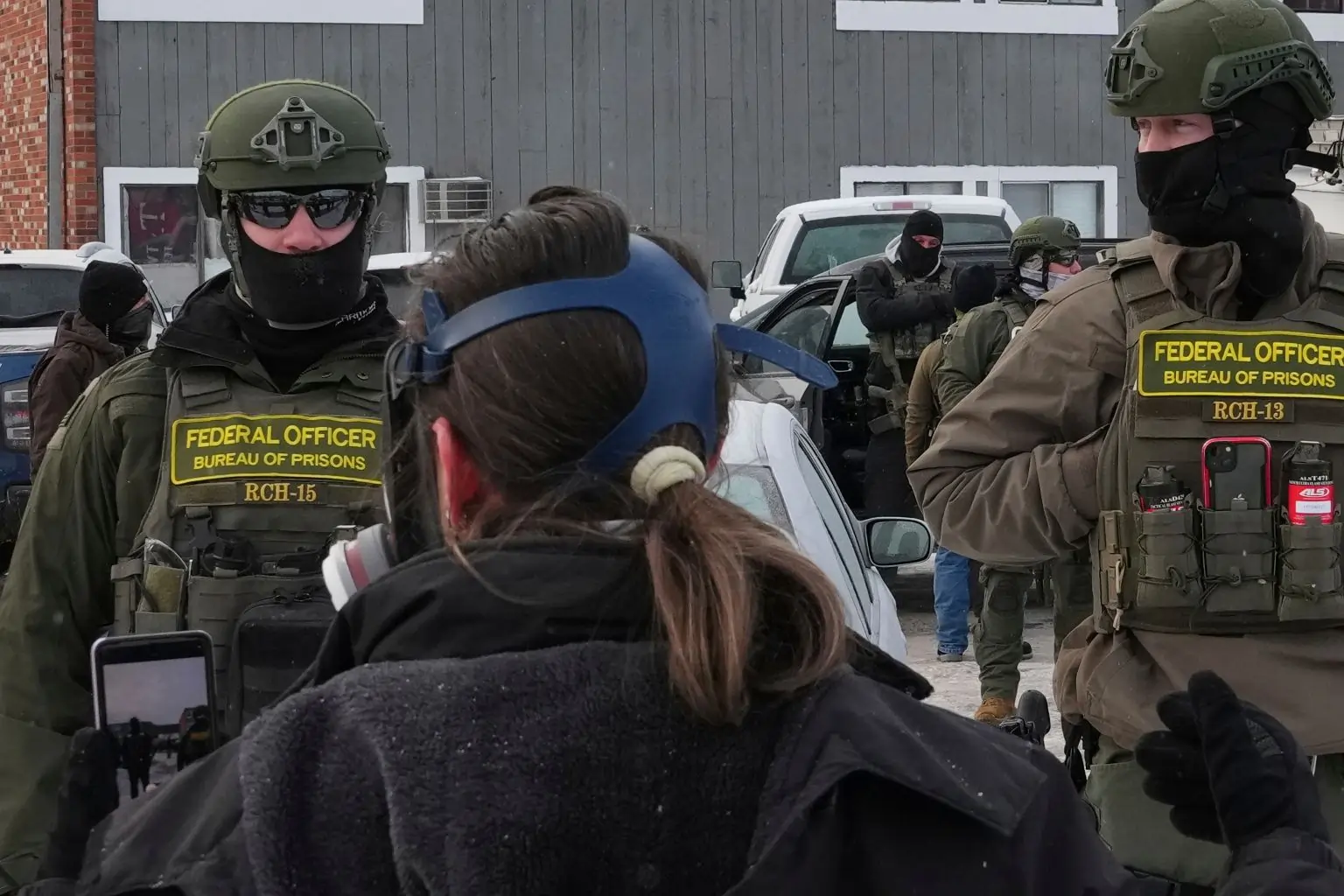
A protester stands in front of federal agents as they work on the scene near an apartment building in Minneapolis, Sunday, Jan. 25, 2026. (AP Photo/Adam Gray)
Alex Pretti was shot and killed by DHS officers while protesting on Saturday morning. His death marks the second such shooting of an American citizen in Minneapolis over the last three weeks and has further escalated tensions over deportations around the country.
Why it matters
Whereas the initial response after Renee Good was killed fell largely along partisan lines, the narrative surrounding Alex Pretti’s death was much more universal. President Trump’s hesitancy to back his administration’s official narrative, coupled with the shift in ICE leadership on the ground, gives reason for hope that many of the valid concerns regarding DHS’s deportation tactics of late could change for the better.
The backstory: Why was Alex Pretti killed?
On Saturday morning, Alex Pretti—who worked as a nurse in an intensive care unit—was filming a Border Patrol agent as he attempted to arrest an Ecuadorian national who was allegedly wanted for domestic assault, intentional implication of bodily harm, and disorderly conduct. It’s doubtful that the protestors knew anything about the man being arrested, which is part of the problem with protesting a policy as broad as deportation.
More details are likely to emerge if/when body cam footage from the officers is made public, but for now, here’s what we know so far about what took place:
- About two minutes before he was shot, Pretti is seen arguing with officers. There is a brief altercation in which he is pushed back onto the sidewalk, but it does not escalate beyond words at this point.
- Roughly a minute later, Pretti enters the street to film as two women aggressively approach a border patrol agent. While it’s not clear if there was an altercation at that time, they were close enough that it would be understandable if the agent expected that they could become hostile. From that point forward, however, the only hostility was from the officer and his colleagues.
- The officer proceeded to push one of the women, who then stumbled toward Pretti and grabbed him by the waist, before pushing Pretti as well. He then moved on to shove the other woman who had previously approached him, knocking her to the ground.
- Pretti stepped between them, making contact with the officer, though not in any way that could be construed as violent or aggressive. From there, the officer repeatedly sprays Pretti and the women with a chemical irritant.
- While Pretti is attempting to help the woman who had been knocked down, the officer continues to spray them and then pulls Pretti to the ground as additional Border Patrol agents arrive.
- During the ensuing struggle, one of the officers saw the gun in Pretti’s waistband—he had a permit to carry the firearm in public—unholstered it, and took it away from the scrum as another yells “gun.” At least two other agents drew their own weapons at that point.
- What happened next is still a bit difficult to nail down, but it appears that the officer who took Pretti’s gun either accidentally fired it or the gun went off on its own, which is a known problem for that particular handgun. Either way, as soon as the first shot goes off, the Border Patrol agents open fire and shoot nine more times at Pretti before stopping.
- Pretti died at the scene.
What happens next?
Ultimately, Alex Pretti didn’t deserve to die, and many of the accusations levied against him in the immediate aftermath of the shooting appear to be completely baseless. He was not, as Department of Homeland Security (DHS) Secretary Kristi Noem described, a “domestic terrorist” who intended to harm officers. Nor was he an “assassin” who intended to “murder federal agents,” as Homeland Security advisor Stephen Miller alleged. If Pretti intended to do harm to any of those officers, he had ample opportunities to do so, yet never wielded anything but a camera phone.
However, a CNN report from earlier today alleges that this was not Pretti’s first run-in with ICE. Reports claim that he suffered a broken rib after being tackled by agents a week ago, though it’s difficult to see how he could have moved as well as he did on Saturday with a broken rib. More information on that altercation is likely to emerge over the coming days, but the story as of now is that he began shouting and blowing his whistle after seeing ICE agents chasing a family on foot. It’s unknown, as of this writing, whether any of the agents from Saturday’s shooting were part of that previous encounter.
Given all the angst and tensions in Minneapolis at the moment, as well as his interactions with ICE a week prior, it seems pretty dumb for Pretti to bring a gun to the protest, and he would most likely be alive today if he’d chosen not to do so. However, it’s also not illegal to bring a firearm when you have a permit for it, even if FBI Director Kash Patel—among others—said otherwise.
Again, Pretti did not deserve to die, and even President Trump appears to be trying to distance himself from the comments of those in his administration who have attempted to justify the officers’ actions. His calls for patience and to allow the investigation to play out are a marked difference from the rhetoric immediately following Renee Good’s death.
At the same time, demands for change continue to grow louder, and not just from those on the left. Several prominent Republicans have called for the administration to re-evaluate its approach to illegal immigration, while recent polling found that 58 percent of Americans believe that ICE’s tactics are too forceful.
And, if the shakeup in leadership that President Trump announced on Monday is any indication, it’s possible that we could see at least some of the changes so many have called for in recent weeks.
Homan in charge
To this point, Gregory Bovino—a Border Patrol official who rose in influence following protests in Los Angeles last summer—has been leading ICE’s activities in Minneapolis. Bovino reports directly to Noem and has largely been charged with carrying out her strategy aimed at boosting deportation numbers by targeting illegal immigrants wherever they can be found.
By contrast, Tom Homan, who Trump designated as “border czar,” was largely in charge of US Immigration and Customs Enforcement (ICE) for the first part of last year, and has advocated for taking a more targeted approach to deportations. Under his leadership, ICE focused primarily on arresting violent criminals and those with final deportation orders rather than chasing numbers.
Last October, those two approaches came to a head, and if the last few months are any indication, it appears President Trump sided with Noem. The result was an elevation of Border Patrol officials in key regions while ICE took more of a backseat.
Now, in the wake of yet another shooting, Trump has changed his mind.
While it appears that Bovino and Noem will remain in their respective positions, the President stated that Homan will be taking over in Minneapolis, “and will report directly to me.” That last part is particularly telling as it effectively elevates Homan above every other immigration official, at least for the time being.
It remains to be seen whether Homan’s presence and the shift in approaches he brings will be enough to quell the unrest steadily growing in Minnesota and around the country. After all, tensions are understandably high, and Homan has not always been uncontroversial in his approach either. However, he has far more experience and has led similar efforts during both the Obama administration and Trump’s first term.
Ultimately, elevating Homan seems like a step in the right direction. Considering how bad things have gotten, even a single step is progress worth celebrating. And the same is often true in our own lives as well.
Spiritual application: The first step to repentance
Christ’s first recorded sermon in the Gospels is “Repent, for the kingdom of heaven is at hand” (Matthew 4:17). Repent is the Greek word metanoeo, which means to change one’s mind or way of action; however, it also carries with it the idea of feeling remorse. So, when Jesus calls us to repent, he’s essentially telling us to recognize the ways we’ve fallen short and choose a better path as a result.
However, knowing that you need to choose a better path doesn’t always make it easy to do so. Repentance is a humbling process meant to change our hearts as much as our actions.
To that end, I’ve often found C.S. Lewis’s perspective on the subject helpful: “If you are on the wrong road, progress means doing an about-turn and walking back to the right road.”
It’s not always easy to see taking a step back as progress, but oftentimes, there’s no other way to go forward. The question then becomes, are we willing to take that first step?
The truth is that we can’t really know how to answer that question until we try. It’s easy to act penitent or ask God to forgive our sins, but to truly repent and turn back to God will often mean making some pretty tough changes.
Jesus promises that it will be worth it in the end, and he’s given us every reason to trust that he’s correct. But he leaves it to us to decide if we’re willing to act on that promise.
So, are there any areas of your life where you’ve asked God to forgive your sins but have yet to truly repent of them? Are you walking down any roads that are taking you further away from the Lord?
True repentance may never get all that easy for us, but the first step is often the hardest.
Are you willing to take that step today?
News worth knowing
1. Democrats in the Senate pledge not to pass funding for DHS
Senate Democratic Leader Chuck Schumer announced on Monday that his party was willing to pass five of the government spending bills needed to avoid a shutdown, but would not fund the Department of Homeland Security (DHS) in the wake of the latest shooting in Minneapolis. Six of the twelve funding bills have already passed, and the remaining six have passed the House. As of last week, they were expected to go through without issue.
Why it matters
Failure to pass the DHS bill would have relatively little impact on ICE, which has already received $75 billion in funding in last summer’s tax bill. However, it would threaten the funding for other DHS programs, from FEMA to the Coast Guard.
What to watch
The Senate has until Friday to pass the remaining bills or risk another partial government shutdown. However, any changes would require sending the bill back to the House for approval, and the House is on recess until Monday. Will the latest changes in Minnesota—more on that in today’s main Focus—be enough to convince Democrats to approve the bill as it is?
The Washington Post Editorial Board has more on the story.
2. China’s top general put under investigation
General Zhang Youxia, vice chairman of the Central Military Commission and second only to President Xi, was put under investigation for “grave violations of discipline and the law.” Xi has been attempting to root out “corruption and disloyalty” among members of the military for years, but Zhang is by far the highest-ranking official to be charged. Zhang is also a longtime friend and confidant of Xi, as their fathers both served together in Mao Zedong’s revolutionary wars.
Why it matters
With Zhang gone, President Xi has now removed all but one of the six generals he appointed in 2022. As one analyst described, the decision “represents the total annihilation of the high command.”
What to watch
The highest levels of China’s government are now without any military officers who have actually led in a war. It’s expected that it could take half a decade or longer to rebuild those chains of command, which could also lower the chances that China will attack Taiwan in the near future. However, predictability is not exactly a hallmark of Chinese governance under Xi, so it would be a mistake to conclude that such an attack is now entirely out of the cards.
Chris Buckley has more on the story for The New York Times.
3. Deion Sanders to fine Colorado Football players
Coming off a 3–9 season that left much to be desired, Colorado Football head coach Deion Sanders has announced a new system that will fine players for missing practices or violating team rules. The fines range from $500 for being late to practice to $2,500 for skipping entirely. A violation of team rules could cost players as much as $2,500, while “public or social media misconduct” could carry up to a $5,000 price tag based on the severity of the misconduct.
Why it matters
As NIL money further blurs the line between college and professional sports, a pro-style fine structure could become commonplace as programs seek new ways to instill discipline and accountability among their players.
What to watch
Will other programs follow Colorado’s example? Will the NCAA allow the new system to continue? How those questions are answered could have a profound impact on the future of college athletics.
Charlie Strella has more on the story for Yahoo! Sports.
God is good
It can be easy for churches to focus the bulk of their attention on the people who show up on Sunday mornings. However, one of the most promising fields for evangelism is among those who are often unable to get there. Over the next few decades, the senior-citizen population in America is expected to nearly double, and they are in desperate need of more people to tell them about Jesus. Fortunately, a number of ministries are popping up to fill the gap, and they’re doing amazing work for the Lord.
Kingdom impact:
As one volunteer described, “God is at work. They’re lonely. They’re bored. They’re curious.” Apparently, that’s a powerful combination when it comes to sharing the gospel.
Prayer point:
As the number of elderly in our society continues to grow, so will the need for more people to minister to them. Will you pray that God will bring more workers to these fields? And will you ask the Lord if he wants you to be one of them?
Amy Lewis of Christianity Today has more on this remarkable ministry opportunity.










 Search