



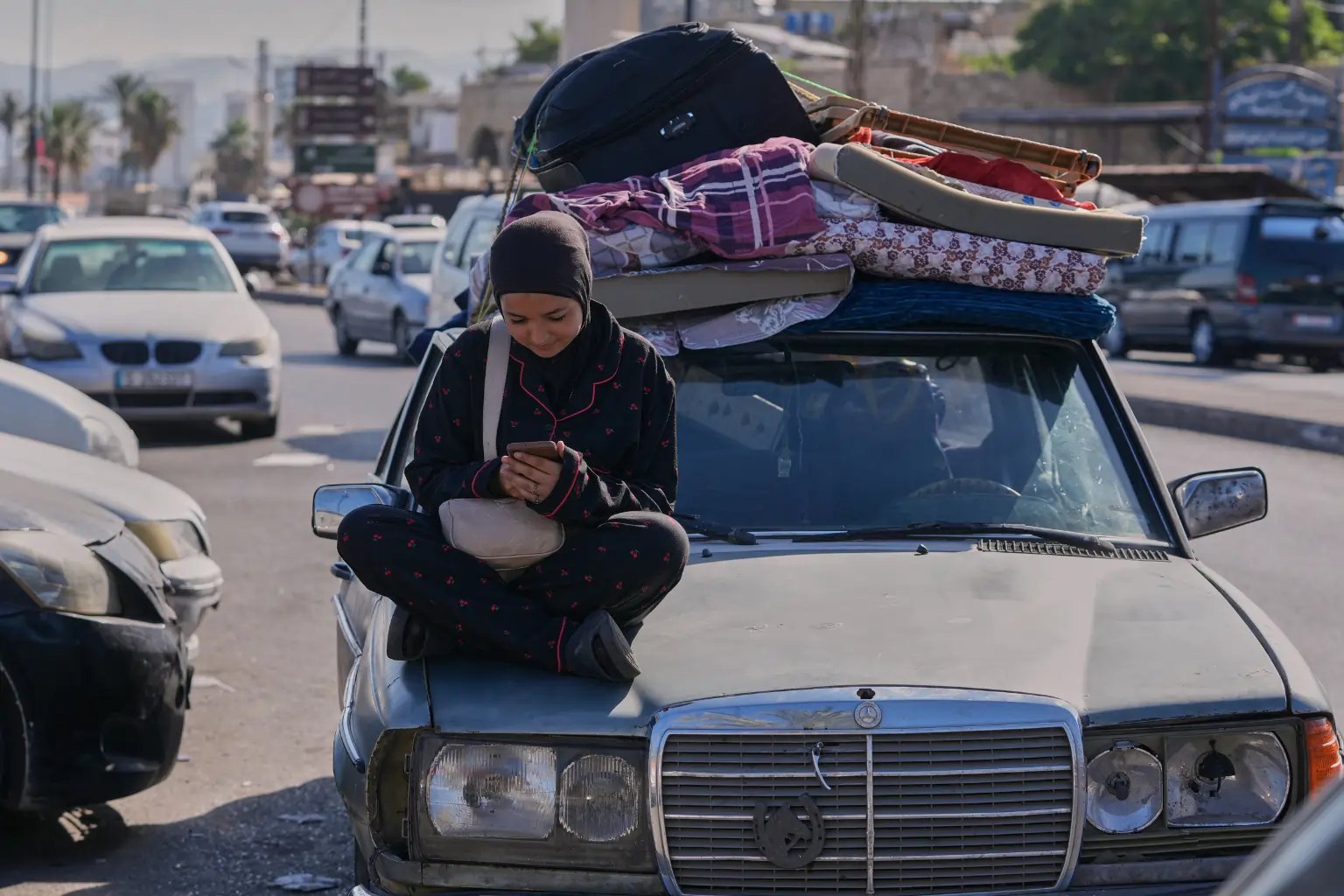
A displaced woman checks her mobile phone as she waits to return to her village following the announcement of an initial ceasefire agreement between the United States and Iran, in the southern port city of Sidon, Lebanon, Monday, June 15, 2026. (AP Photo/Mohammed Zaatari)


NOTE: Breaking news is reporting that the FBI thwarted an explosive drone attack against Sunday’s UFC Freedom 250 event at the White House. As more is known, I will respond with an article on our website later today.
As you know, the US and Iran announced an interim peace deal last Sunday. Much remains to be known: What does the agreement actually say? Will Iran honor its commitments? What about its nuclear program and materials? What about Iran’s proxies? What about Israel?
Nonetheless, any agreement that constrains Iran’s aggression in the region and against the West would be welcome progress. The researcher Tzvi Kahn has compiled a list of forty-five Iranian and Iranian-backed attacks against Americans since 1979. It shows that Iran has been at war with us far longer than we think we have been at war with them.
I was considering this fact when I read David’s assertion:
The Lᴏʀᴅ is gracious and merciful, slow to anger and abounding in steadfast love. The Lᴏʀᴅ is good to all, and his mercy is over all that he has made (Psalm 145:8–9).
In light of all the brutality and innocent suffering in the world, how can it be true that “the Lᴏʀᴅ is good to all”? How can a God who “is” love (1 John 4:8) also be sovereign over a world that is this broken (cf. Psalm 115:3; Matthew 10:29)?
This question has been debated over the millennia, of course. I have often written on it myself. Today, however, a new thought has emerged that I’d like us to consider together.
My back condition and God’s redemption
We’ll begin with my belief that God redeems all he allows. For example, I have a back condition that limits my ability to speak in public as I once did. I don’t believe God caused my condition, but I do believe he is using it to focus me more fully on writing, a ministry which, by his grace, is able to reach far more people than I could reach in person as a speaker.
As Michel Quoist observed, the Lord often leads through limitations. When my back hurts, I feel little resentment toward God for not healing me since I can see his redemption in my circumstances.
I suppose some measure of good can be found in even the worst suffering. The horrors of the Holocaust helped prompt the US and others to support the founding of the State of Israel in 1948. Hamas’s brutal October 7 invasion led to an Israeli response that severely limited the terrorists’ ability to wage further terrorism. Vaccines using mRNA technology developed in response to COVID-19 hold promise for treating cancers and other diseases.
But I would never suggest that any of this explains or outweighs the Holocaust, October 7, or the pandemic. How, then, am I to trust a God who allowed them?
Logical answers I am unwilling to accept
I understand that perpetrators of evil misuse the free will that is indispensable to our being human and not automatons. But God sometimes intervenes to prevent or limit innocent consequences of misused freedom, as when he liberated Peter from Herod Agrippa I’s prison (Acts 12:6–11) and then intervened to cause Herod’s death (vv. 20–23).
If King Herod in AD 44, why not Ayatollah Ruhollah Khomeini in 1979?
However, if God intervened every time, then wrong choices would have no consequences and thus not be true choices, removing the free will required for us to love him and others. If he did so only with the “big issues,” leaving others so as to respect our free will, who decides which issues deserve his intervention? The Holocaust and 9/11 are obvious choices, but what about my back condition and your personal challenges today?
In addition, we cannot know all the times God has intervened to spare us from threats we did not know existed.
I know of no way to reason myself to a logical answer I am willing to accept. I can stop believing in God’s existence or perfect character, or I can decide that he causes all that happens, including horrific suffering, for reasons I cannot fathom and must not question.
Notably, the Bible does neither. Its writers obviously do not reject God in the face of suffering, but neither do they simply accept all that happens. They express very honestly their questions and struggles with God and his ways. Then, however, they turn from seeking God’s answers to seeking God himself.
Why God wants us to argue with him
Now to my new thought: God redeems the first by using it to encourage the second.
Prayers expressing anger with God are still prayers. Asking God “why” positions us sometimes to hear his answers but always to experience his presence. This is one reason God invites us to “reason together” (Isaiah 1:18a); the Hebrew word means to “argue it out.”
When we do, note what happens next:
Though your sins are like scarlet, they shall be white as snow; though they are red like crimson, they shall become like wool. If you are willing and obedient, you shall eat the good of the land; but if you refuse and rebel, you shall be eaten by the sword (vv. 18b–20).
Arguing with God positions us to experience God. When he hears our anger and feels our pain, he loves us and seeks to draw us to himself. If we respond in faith, he cleanses us and blesses us. If we persist in rebellion, we forfeit his best and experience the consequences of our rejection.
So, let’s ask God our hardest questions as honestly as we can. Then let’s sit with our Father and wait for his response. We may hear his voice through his Scriptures and Spirit; we may see him respond in our circumstances; there may be silence (cf. Psalm 46:10; 62:5).
But even in that silence, there is his presence.
And in his presence is our peace.
Quote for the day:
“In goodness and sovereignty God permits evil, punishes evil with evil, brings good from evil, and redeems from evil.” —J. I. Packer
Our latest website resources:
- Could your faith survive “Disclosure Day”? What if aliens were real?
- Who is your king? Idolatry, allegiance, and the call to place God on the throne
- World Cup preview, SpaceX IPO, helicopter shot down, Knicks-Spurs & UFC at the White House
- Brendan Sorsby and the value of facing consequences: Why accountability and integrity still matter
- Why the World Cup captivates—and divides—the globe












 Search