



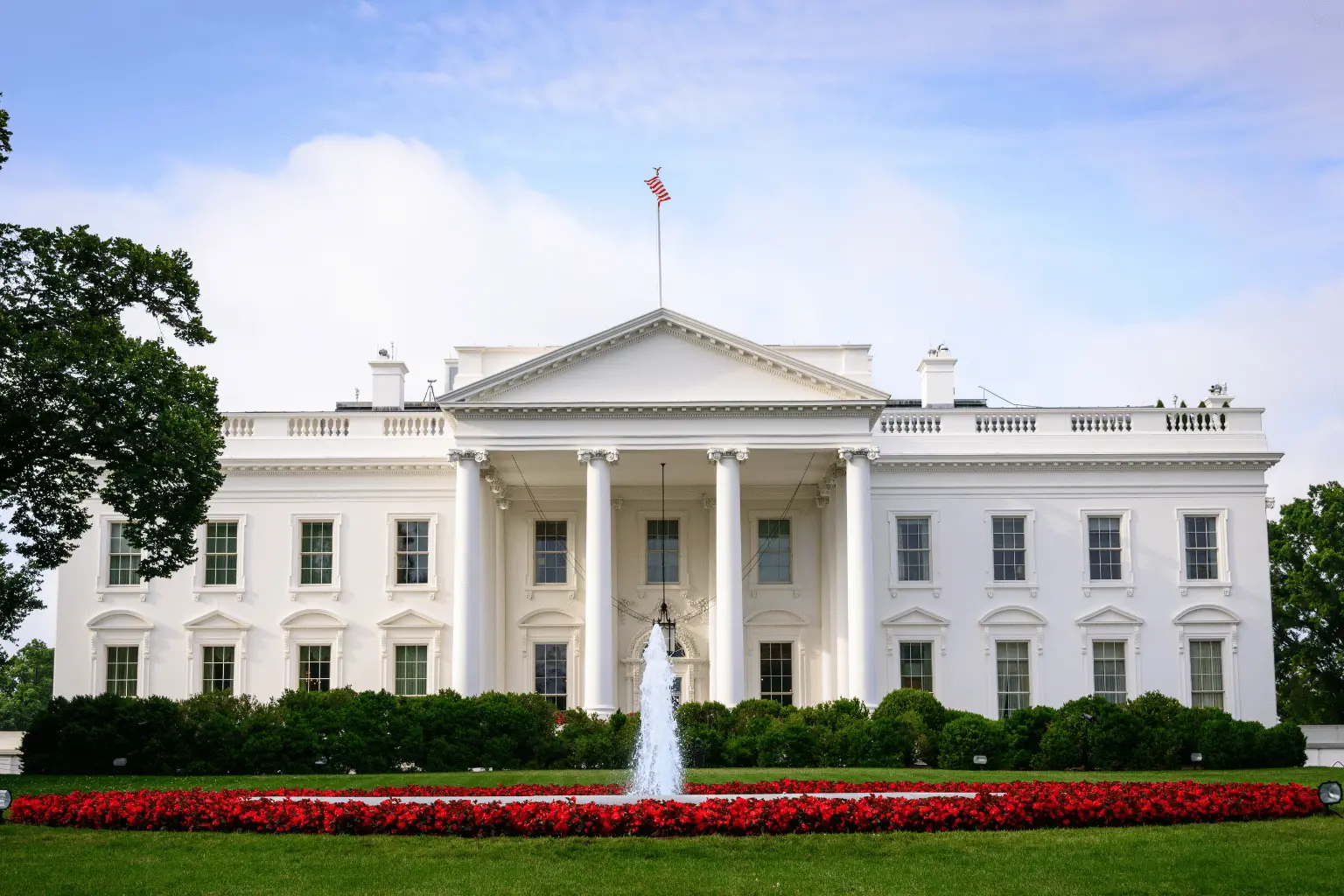
The White House. By ZackFrank/stock.adobe.com.


Last July, the Trump administration announced plans to construct the White House State Ballroom, explaining that President Trump and other “patriot donors” would supply the $200 million needed to build the structure. On Wednesday, Mr. Trump raised the estimated cost to $300 million. Demolition of the East Wing was finished yesterday to make way for the new ballroom.
As always seems to be the case with political stories these days, what you thought before you heard the news likely governs what you think of it now. You can applaud Mr. Trump for funding this addition entirely with private donors, or you can claim that the money is coming from “companies chasing favors.” You can agree with an administration spokesman’s prediction that Mr. Trump’s “long-needed upgrades will benefit future generations of future presidents,” or you can complain that the White House is “not his house.”
In a recent poll, 92 percent of Democrats said the US is going in the wrong direction, but only 24 percent of Republicans agreed. This sixty-eight-point partisan gap is the widest recorded in the history of such polling. Unsurprisingly, two-thirds of Americans believe our political system is too politically divided to solve our nation’s problems.
Here’s a solution you may not have considered: reading.
“Print changed how people thought”
Cultural commentator James Marriott reports that by the beginning of the eighteenth century, the expansion of education and an explosion of cheap books sparked what became known as the “reading revolution.” Reading was described as a “fever,” an “epidemic,” or a “craze,” resulting in what Marriott calls “an unprecedented democratization of information; the greatest transfer of knowledge into the hands of ordinary men and women in history.”
People read newspapers, journals, history, philosophy, science, theology, and literature. Books, periodicals, and pamphlets abounded. And, as Marriott notes, “print changed how people thought.” He explains:
The world of print is orderly, logical, and rational. In books, knowledge is classified, comprehended, connected, and put in its place. Books make arguments, propose theses, develop ideas. “To engage with the written word,” the media theorist Neil Postman wrote, “means to follow a line of thought, which requires considerable powers of classifying, inference-making, and reasoning.”
Historians have linked this explosion of literacy to the Enlightenment, the birth of human rights, the beginnings of the Industrial Revolution, and, notably, the arrival of democracy.
For example, Thomas Jefferson was convinced that only educated citizens could make the American experiment in self-government succeed. This is why he proposed a system of broad, free, public education that was radical for the day and founded the University of Virginia.
For citizens to elect leaders effectively, they must understand the issues of the day, assess potential leaders appropriately, and hold them accountable upon election. Leaders must concurrently understand the times and be able to lead and communicate with clarity and reason.
“Politics in the age of short-form video”
Today, however, reading is in free-fall.
Marriott notes that reading for pleasure has fallen by 40 percent in the last twenty years. In the UK, more than a third of adults say they have given up reading altogether. Literacy levels are declining or stagnating in most developed countries.
What happened was the smartphone, which delivers content you hear and/or see but seldom read. This content appeals to our emotions much more than to our minds.
Historians have observed that pre-literate “oral” societies are mystical, emotional, and antagonistic in their communications. Our post-literate society is returning to the same; according to Marriott, “our discourse is collapsing into panic, hatred, and tribal warfare.”
As a result, he writes, “Politics in the age of short form video favors heightened emotion, ignorance, and unevidenced assertions.” He warns that “the rational, dispassionate print-based liberal democratic order may not survive this revolution.”
“The chief authority on which our faith is built”
We have focused this week on the urgency and power of seeking a daily, transforming relationship with the living Lord Jesus. As we seek him in prayer, accept and share his passionate love for us, and reject the private sin that impoverishes our souls, the Spirit restores us to the “image” of the Creator in which we were made (Genesis 1:27). In this way, our Father molds us to “become like his Son, so that his Son would be the firstborn among many brothers and sisters” (Romans 8:29 NLT).
A key factor in this process is the word of God, which is “living and active” (Hebrews 4:12) and thus “profitable for teaching, for reproof, for correction, and for training in righteousness, that the man of God may be complete, equipped for every good work” (2 Timothy 3:16–17).
Tragically, the decline in literacy that is afflicting our culture is afflicting our churches as well. Biblical literacy has been declining for years. A recent American Bible Society report found that only 39 percent of Americans read the Bible even three or four times a year.
Wheaton College New Testament professor Gary M. Burge warns:
To disregard this resource—to neglect the Bible—is to remove the chief authority on which our faith is built. We are left vulnerable, unable to check the teachings of those who invite us to follow, incapable of charting a true course past siren voices calling from treacherous islands such as TV programs, popular books, and enchanting prophecies displayed on colorful Web sites.
“Did not our hearts burn within us”
So, here’s a simple invitation: seek to meet Jesus in his word every day. Not just to read the Bible, but to hear the voice of its Author as he speaks to your soul. Not just to have a “quiet time,” but to be changed by the Spirit.
We are not finished reading the Bible until we read ourselves in its light and align in a new way with its truth.
Jesus wants to teach his word to our minds and use it to change our hearts. When he encountered two people on the road to Emmaus, he “interpreted to them in all the Scriptures the things concerning himself” (Luke 24:27). They said later, “Did not our hearts burn within us while he talked to us on the road, while he opened to us the Scriptures?” (v. 32).
When last did your heart “burn” within you?
Quote for the day:
“My conscience is captive to the Word of God.” —Martin Luther
Our latest website resources:
- Rare earth minerals, Louvre jewelry heist, “No Kings” protests & a World Series preview!
- What is cultural apologetics and why is it critical for today’s culture?
- Hostages come home, Super Bowl halftime debate, Nobel Peace Prize, MLB playoffs & NBA and NHL are back!
- Understanding the AI Bible, assisted suicide, congressional term limits & free speech
- Ask Jim: Should Christians celebrate Halloween? What happens when we die? Does demon possession still happen today?












 Search