



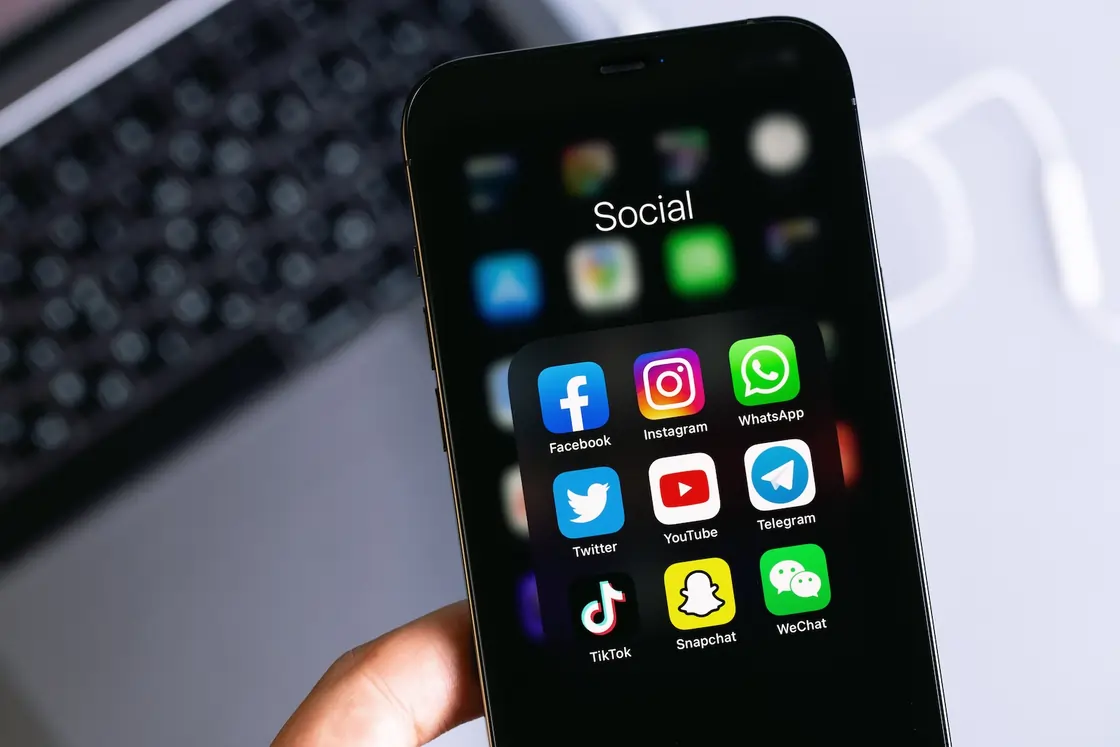
showing social media mobile apps (Facebook, Instagram, WhatsApp, Twitter, YouTube, Telegram, TikTok, Snapchat) on screen macro interface smartphone iPhone in hand. Moscow, Russia - January 16, 2021/stock.adobe.com
Earlier this month, the U.K. parliament announced its intent to follow Australia in banning social media for everyone under the age of 16. The controversial decision is making international headlines as governments around the globe consider how to adapt to the ever-changing digital landscape.
The bill, which was passed under the since-resigned Prime Minister Keir Starmer, represents a significant stance on the value of online social platforms. The ban will likely go into effect in early 2027 and will encompass sites like Facebook, Snapchat, X, Instagram, TikTok, and even YouTube. Live streaming, online gaming communication, and AI “romantic companion” chatbots are among the other platforms facing various forms of restrictions for minors.
An official government press release from June 15 opened with, “Children will be given back their childhoods thanks to government action to ban social media platforms from offering services to under-16s, with less time for scrolling and more time for play.”
The harmful effects of social media on adolescents are undisputed. A 2023 study found that 93 percent of U.K. teens aged 12 to 15 used social media regularly. 48 percent of U.K. teens (57 percent of female teens) claimed an addiction to social media. Very similar numbers persist across Europe and North America. High social media usage amplifies anxiety, depression, low self-esteem, and sleep deprivation.
Public reception
Despite the clear dangers of social media, the ban certainly has its opposition. Detractors are quick to criticize the bill as anti-social and anti-education. The ban does limit access to communication tools, but messaging services like WhatsApp and Signal will not be blocked. Education-specific social sites will also be protected.
YouTube contains a plethora of educational content appropriate for all ages, which would be inaccessible to those under 16. Government officials see this less as a concern and more as an opportunity. Companies can now build educational platforms that are age-appropriate and safe for the under-16 audience.
Some disavow the bill based on the burden it will place on adults to “prove” their age to social media sites. Others argue that the proper approach would be to go after tech giants like Meta and Google to demand safer sites with fewer addictive features.
On the other hand, the U.K. government, in its press release, produced statistics that revealed nine in ten parents and two-thirds of young people are in favor of the ban. Online interactions involving parents, especially those who have seen the harmful effects of social media on their children, appear to represent this overwhelming support.
Perhaps the biggest question regarding the ban is its enforceability. In Australia, ensuring compliance with its own law instituting a social media ban has proven challenging. Virtual private networks (VPN) and lying to bypass age verification are simple solutions for a teenager seeking access. Four out of five Australian teens continued to use social media three months after the December 2025 ban took effect.
Age-verification technology is still evolving and may alter the U.K.’s ability to enforce its law. Without a trusted form of digital ID, it is hard to imagine an effective enforcement of the ban. In the United States, 27 states have introduced varying levels of age-verification laws to restrict access to pornographic sites, which, in some cases, has prompted companies to stop operating in those states completely.
Congress is also considering a child online safety bill dubbed the KIDS Act, but as the proposed language stands, the law would not be a blanket social media ban. The bill, which focuses on adding parental controls and data privacy protections for children and teens, could pass this year, but it faces several hurdles before being signed into law.
A Christ-centered perspective
In a paradoxical way, our hyper-digital connection has made us more disconnected than ever. The effects of social media are far-reaching, well beyond teen usage.
In some ways, it has become our most modern drug by stealing time, damaging our brains, and killing productivity. It is antithetical to human flourishing, a biblical concept that finds its origin in the cultural mandate (Genesis 1:26-27) and is fleshed out across the Bible through God’s desire for justice and righteousness.
Thinking about the conversation from a biblical perspective begins with evaluating the proper role of government. On the one hand, the church and the parents within it, not the government, are responsible for training its adolescents to walk in wisdom and discipline and to abstain from harmful habits. The government is not a substitute for Christ’s bride.
The government, however, has a responsibility to protect its citizens from that which is harmful and evil (Romans 13:3-4; 1 Peter 2:13-14). God has appointed governments for this specific purpose, though, like all human institutions, corruption and sin often prevail.
For many, this law brushes against the fine line between protection and overreach. Are parents being stripped of their responsibility to shepherd their children? State-level laws prohibiting parents from having a say in their child’s education or gender confusion have certainly crossed over the fence in recent years. Many fear the snowball effect of government intervention in other places. Perhaps drawing a hard line against any such government “protections” for children is the most consistent stance to hold.
Yet parents largely agree that social media for minors is a problem worth tackling. The idea of restoring “normative” childhood is unifying. So, how should we evaluate this case?
As Christ-followers, we should desire virtuous laws, especially those that guard the hearts and minds of children and promote human flourishing. Assessing the law in its immediate context is critical. If the ban is not truly enforceable, its contribution to human flourishing is nullified. While there may be a more effective way to combat the social media crisis among youth, we can pray that laws like this serve as a launching pad for a larger movement to strengthen the next generation socially, emotionally, academically, and even spiritually.
For each of us that utilize it, social media is a stewardship issue. How we steward our time and our online presence reflects our faith. We each get to set an example, both in the content we post and the content we consume, for those around us. As we consider how to protect younger online users, do not neglect your own heart and mind; instead, choose to glorify Christ daily in your use of technology.











 Search