



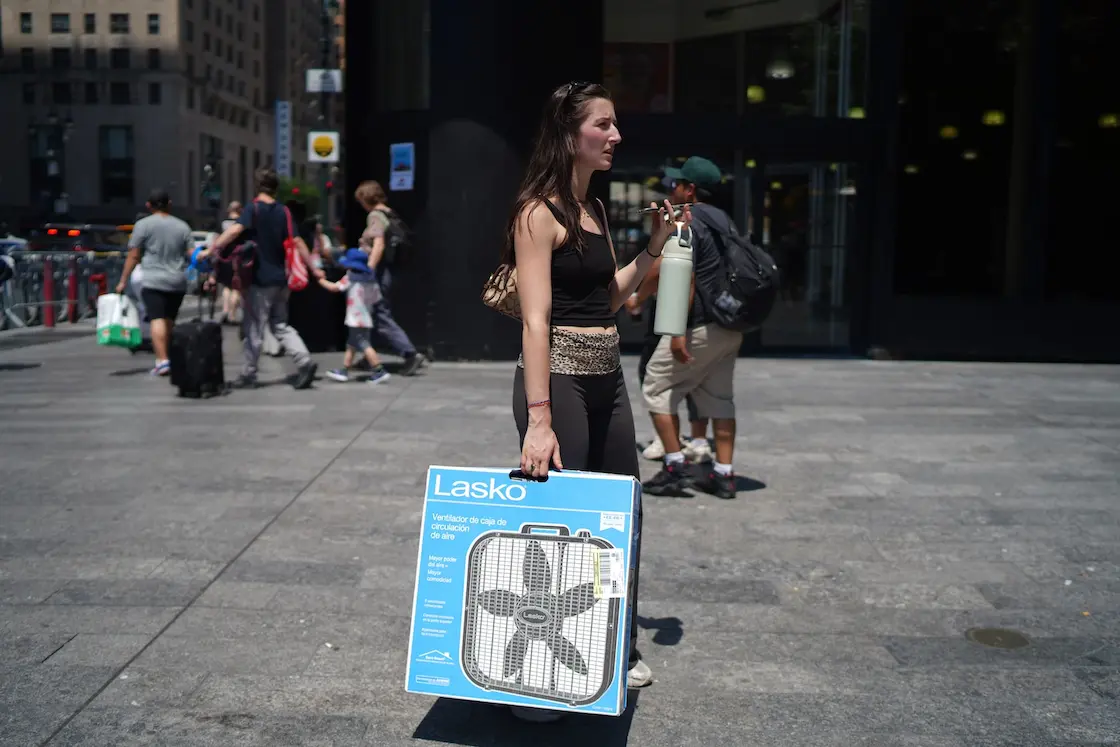
A woman carries a portable fan during an extreme heatwave in New York on Friday, July 3, 2026. (AP Photo/Ryan Murphy)
Last week, New York City Mayor Zohran Mamdani posted on X that New Yorkers should set their thermostats to 78 degrees during the coming heat wave. Because it’s so hot outside, he wrote that “the power grid is working overtime to keep us cool.” So any easing of the demand for power puts less pressure on New York’s grid. He ended his post: “A stable grid means the AC stays on, and lives are saved.”
Yet his suggestion of “78 degrees” sparked considerable backlash.
Various Republican pundits took to social media to comment on his plea, linking the request to raise the temperature while it’s hot outside to socialism, communism, and third-world country behavior.
Between the lines, the chief complaint seemed to be that asking an individual to sacrifice for the sake of the collective represents overarching government principles often opposed by conservatives. It was painted as if Mamdani had committed a great evil by suggesting that we inconvenience ourselves to support the needs of the masses.
Mamdani is a Democratic Socialist. The request for New Yorkers to keep their temperatures at 78 degrees to avoid overwhelming the grid wasn’t a mandated government policy. It was a social media call to action framed around protecting the power grid from a blackout.
I think it’s dangerous and unhelpful, in fact, to link socialism with “sacrificing a little for the sake of others.” Afterall, sacrificing individual comfort is actually a deeply Christian practice, as we’ll explore below.
To be clear, this is by no means an argument for the merits of socialism either. Because what Mamdani pleaded for on social media was not socialism. Actually, it’s an act of helping others, and Christians would do well to remember that we, as individuals, are not the center of the universe.
Getting Comfortable With Uncomfortability
My household entered an energy-saving program this summer in which, during the peak energy-use hours of 2pm to 7pm on weekdays, electricity costs are much higher than normal. In return, our energy costs are a little cheaper in other time frames.
That means we are incentivized not to use AC and other energy-guzzlers from 2pm to 7pm on weekdays. So our thermostat is often set around 78 degrees at that time, even though Oklahoma summers can reach 80, 90, or 100 degrees outside.
And as someone who works primarily at home… I’m miserable during these hours! I hate being hot. It’s physically uncomfortable as well as awkward for our schedule.
For instance, we often wait to turn on the oven until after 7 p.m., leading to a late dinner. And laundry has to wait until after 7 p.m. too, risking wet clothes too close to bedtime.
So I sympathize with all who don’t want the discomfort of 78-degree AC! Though what I can’t quite square away is the Christians who say, because I’m uncomfortable, I don’t want to follow this suggestion.
Once again, what Mamdani requested was about protecting the community. It’s about realizing that, in some cases, my individual needs pale in comparison to what a whole city needs and can handle. A power outage would be a much worse outcome for everyone than a 78-degree home.
His recommendation, in fact, is in line with the current administration’s Department of Energy guidelines, which recommend turning your thermostat to 75 to 78 degrees in a heatwave. And it should be recalled that back in 2015, Texas Republican governor Greg Abbot also issued an appeal for Texans to save energy during extreme heat, including advising that thermostats be set to 78 degrees or higher for the same reason: not overwhelming the grid.
I believe that Christians should be the first in line to get a little uncomfortable in order to protect others, especially the more vulnerable among us. But rarely does that impulse come naturally to us. So, how can we get more comfortable with being uncomfortable?
Who Do We Belong To?
Dr. Alan Noble, in his book You Are Not Your Own, diagnoses our society with a bad case of personalized individualism: “we are each our own, we belong to ourselves.” While beneficial in some ways, this movement to radical individualism has led to subjective morality, identity crises, rampant anxiety, and the breakdown of community.
What is lost, and indeed what remains the remedy, is the biblical idea that we belong to God. Not to ourselves. And when we come back to this truth, our worldview changes profoundly. As Noble writes:
And this belonging to Christ necessarily entails belonging to His body, the church, and to our families and neighbors. An anthropology defined by our belonging to God is diametrically opposed to the contemporary belief that we are autonomous, free, atomistic individuals who find our greatest fulfillment in breaking free from all external norms. Our selves belong to God, and we are joyfully limited and restrained by the obligations, virtues, and love that naturally come from this belonging.
It’s not all about us. It’s about God. And when we belong to God, we, in many ways, belong to one another. We see other image-bearers as “in this together” even when they are different. We have obligations to do good toward others, even when it’s inconvenient.
Paul writes in Philippians 2 that we “must have the same attitude that Christ Jesus had” (v. 5). He then delivered a beautiful poem about how Christ came to humanity to put others before himself.
Being born a human demonstrated a profound humility. And of course, dying on a cross was humble obedience. In the same way, we should have this attitude too.
Though if we back up, Paul already gave us a practical application of this attitude:
Don’t be selfish; don’t try to impress others. Be humble, thinking of others as better than yourselves. Don’t look out only for your own interests, but take an interest in others, too. (Philippians 2:3–4, NLT)
We take our eyes off of ourselves and look to the interests of others. That’s our call as Christians. That’s our command. That’s how we think and act like Jesus himself.
I fully understand how hard it is to ignore our wants in deference to the needs of others. And I know it gets very dicey when governments are suggesting how we can be good neighbors. Nonetheless, in whatever situation we find ourselves, it’s an important Christian principle to think less of our own situation and more of what the whole community needs.
Even if that means getting a little sweaty!










 Search