


AP Photo/Mark Schiefelbein
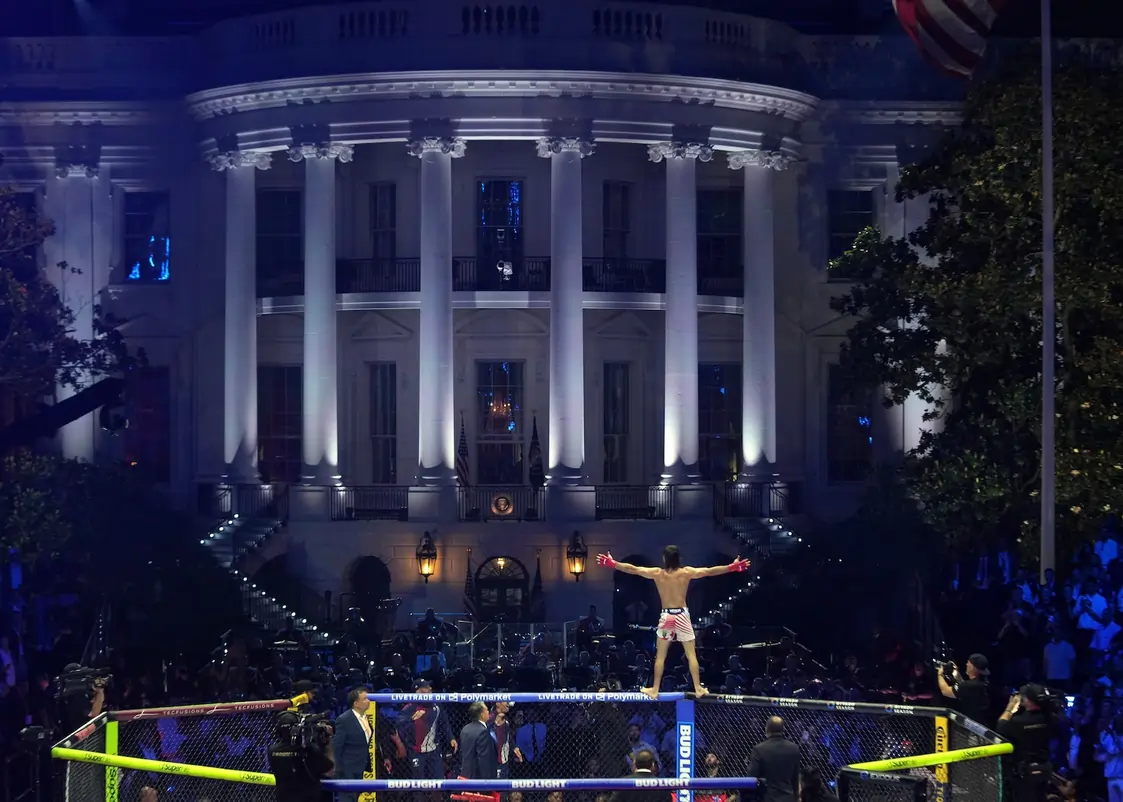
The FBI stopped an explosive drone attack against Sunday’s UFC Freedom 250 event on the White House South Lawn, officials told Fox News Digital Tuesday morning. Five people were in custody as of Monday; investigators have identified twenty-three people as part of a potential network of plotters.
The attack allegedly would have used explosive-laden drone aircraft to strike buildings in the vicinity of the event, which was attended by around 4,300 people, including 1,200 active-duty service members. The drone attack was intended to incite panic and drive the fleeing crowd toward a sniper team poised to pick them off. A “second wave” of attackers then allegedly planned to storm the White House gate.
The bureau first learned of the plot on June 10 and worked with partners to secure probable cause for an arrest in Cincinnati, taking one suspect into custody. A review of one suspect’s iPhone then identified at least twenty-three Signal users discussing pre-operational activity. Some of those involved allegedly planned to travel on June 12 or 13 to Fredericksburg, Virginia, to prepare for the attack.
One suspect allegedly told investigators the goal of the group was to target “capitalist elites,” “billionaires,” or politicians who received donations from the American Israel Public Affairs Committee (AIPAC). The investigation included at least twelve FBI field offices.
FBI Director Kash Patel said, “Thanks to the rapid action of this FBI, our partners, and the Department of Justice in a multi-state operation, multiple individuals are now in custody and allegedly planned attacks were stopped cold.”
Why do terrorists target civilians?
It is a sign of our times that such news does not shock us as perhaps it once did. There was a day when Americans felt themselves immune from terror attacks that plagued other parts of the world. Vast oceans on our east and west, forests to the north, and deserts to the south protected us in ways landlocked countries in Europe were not.
The Japanese attacked Pearl Harbor, killing more than 2,400 Americans, but that tragedy, while horrendous, occurred two thousand miles from the mainland. Then came 9/11 and all that has transpired since, showing us that in our modern age of travel and technology, new cohorts of enemies can attack us in new ways.
Here’s a point we should not miss, however: 9/11 and the terrorism that has followed have been directed not at our military but at our people.
Like Hamas’s horrific invasion of Israel on October 7, such aggression is not military action against military opponents. This is not war in a conventional sense, fought by soldiers against soldiers. It is an ongoing threat against civilians who are unequipped to defend themselves.
Why do terrorists target innocent citizens in this way?
The danger of asymmetrical warfare
For radical jihadists, part of the answer is that there are no “innocent” citizens in the West. They allege that, because we pay taxes and otherwise support our government and military, we are all complicit in perceived aggression by the West against Islam.
We don’t yet know much about those behind the alleged plot against the White House event, but if they were not Islamic jihadists (and even if they were), their strategy points to a dimension of this story worth contemplating.
In short, we now live in a day when any of us can be the target of terrorism.
“Asymmetrical warfare” is a type of warfare in which the two sides differ significantly in military power and capabilities. In the Vietnam War, for example, the North Vietnamese were fighting against the global superpower might of the US. Rather than attack us army against army, they utilized guerrilla tactics designed to neutralize our superior firepower and outlast our willingness to fight. We see the same with terrorists who employ improvised explosive devices, ambushes, sniper attacks, and urban warfare.
Why no protection is perfect
There is another factor at work here: you and I can be targets of terrorism for reasons that have nothing to do with us.
In one sense, it makes no sense to attack spectators at the White House event. Killing them would not harm other “capitalist elites,” “billionaires,” or politicians receiving AIPAC donations. I cannot imagine that the attack, even if successful, would have changed US policy. If anything, as with Israel’s response to October 7, it would only have hardened our resolve to defeat terrorists and terrorism.
But to terrorists, civilians are the target available to them. They attack us because this is what they can do in defense of their cause. So long as such groups have grievances against America, Americans will be in danger.
We can and should be grateful for those who work to defend us each day. But as the nearly successful assassination attempt against Donald Trump in Butler, Pennsylvania, showed, no protection is perfect because no people are perfect.
The best way to deal with the fear of death
In most areas of life, the best way to counter our fears is to take steps to prevent what provokes them. If we are afraid of lung cancer, we should not smoke. If we fear heart disease, we should exercise, eat healthy, and have regular checkups. If we harbor financial fears, we can work effectively while spending wisely.
But with death itself, things are different. We should obviously take steps to protect ourselves where we can, but as today’s conversation shows, no protection is perfect. We are unlikely to be victims of a terror attack, but we can all die in car accidents or from fatal diseases. Tomorrow is promised to no one.
As a result, the best way to deal with a fear of death is to prepare to die.
If we are certain that Christ is our Lord, we can be certain that the moment we depart this life is the very moment of our translation into paradise. Jesus was clear: “Everyone who lives and believes in me shall never die” (John 11:26). When we take our last breath here, we take our first breath there. We close our eyes here and open them there. In just a moment, we are with our Father forever.
We can also walk so closely with Jesus that we are ready to step into even closer fellowship with him. When we confess sin immediately, stay obedient to God’s word and will, and practice spiritual disciplines that position us to experience the abundant life of Christ, we feel ourselves ready for eternity today.
“The rest of the River was but shallow”
Such readiness empowered early Christians to face the threats of their day with contagious courage. Paul could testify, “For me to live is Christ, and to die is gain” (Philippians 1:21). When these are our only options, there is no way to lose.
In Pilgrim’s Progress, we read of Christian and Hopeful as they approach the river of death and are told, “You shall find it deeper or shallower, as you believe in the King of the place.” Upon entering the water, Christian begins to sink and cries out in fear.
Hopeful responds, “Be of good cheer, my Brother, I feel the bottom and it is good.” Christian soon finds solid ground to stand on, and “the rest of the River was but shallow.”
So it can be for us all, by the grace of God.












 Search