



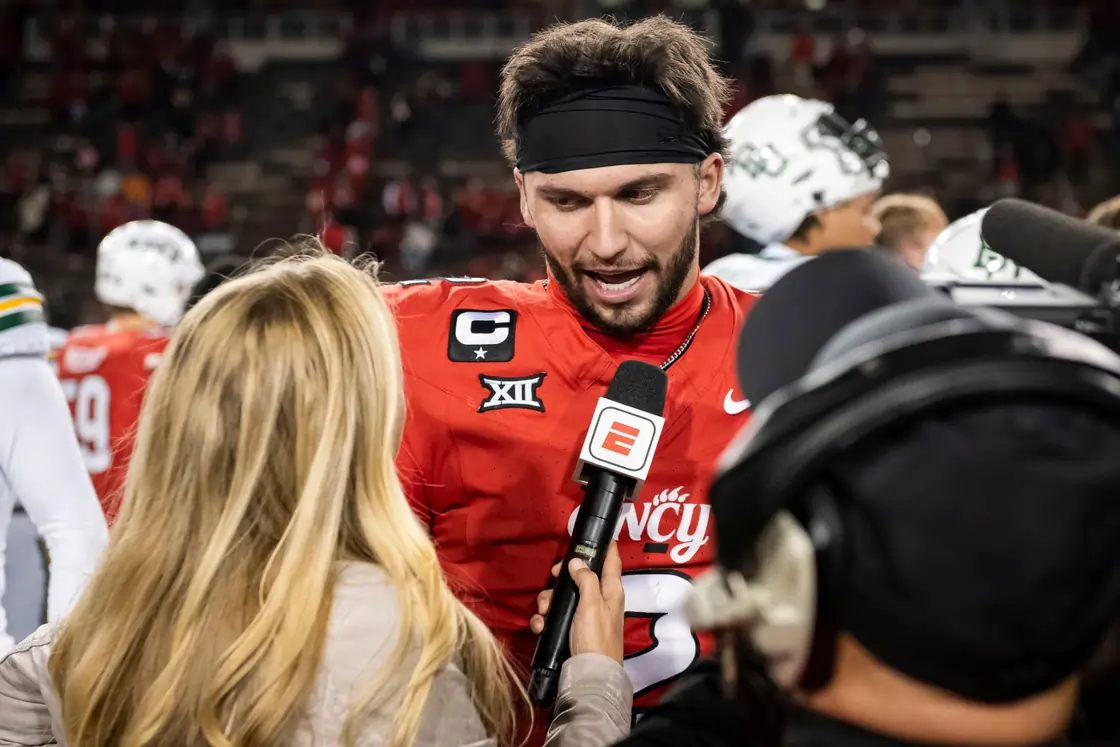
FILE - Cincinnati quarterback Brendan Sorsby (2) is interviewed after a NCAA college football game against Baylor, Oct. 25, 2025, in Cincinnati. (AP Photo/Tanner Pearson, File)
Texas Tech quarterback Brendan Sorsby is at the center of a whirlwind this week in what may turn out to be one of the most pivotal gambling storylines in American sports history. In an extreme infraction of NCAA rules, Sorsby made thousands of bets worth upwards of $90,000, many of which were placed on his own team in his two years with the Indiana University football team.
However, unlike the mythologized events of Shoeless Joe Jackson and the 1919 White Sox, or the blacklisting of Pete Rose from the Hall of Fame, Sorsby’s football career may continue on without a hitch.
On Monday, Lubbock County Judge Ken Curry granted Sorsby a temporary injunction against the NCAA, pending his trial, allowing him to continue practicing and competing with Texas Tech. His trial is set for February 8, 2027, roughly two weeks after the 2027 National Championship game. Should the injunction stand, Sorsby will miss just the first two games of the season.
Outrage from all angles
In a rare event, voices across the diverse landscape of College Football have united against Judge Curry’s ruling. Sorsby himself, as well as Texas Tech, is also taking the brunt of public frustration. The Big Ten, one of the two most significant leagues in college athletics, is planning a call with the conference Athletic Directors to consider a ban on scheduling Texas Tech across all sports.
Independently, Nebraska and Georgia have announced their intent to avoid the Red Raiders in future scheduling. In Texas Tech’s own conference, the Big 12, tensions are high, with questions of how to handle games against Sorsby and his squad this Fall. The Big 12 does have the power to sanction Texas Tech and pressure it to restrict Sorsby from playing, should it choose to go after a member institution.
The ramifications go far beyond Texas Tech, a program that unknowingly inherited this scandal when it signed Sorsby out of the Transfer Portal in the winter. The NCAA, for example, was once a mighty governing body, able to crater an athletic program with the snap of a finger (such as SMU football in the 80s).
Now, the NCAA is unable to punish its own athletes for breaking the most universally accepted rule in sports: do not gamble on your own team.
Judge Curry is also facing scrutiny after stating that Sorsby’s defense made a convincing case that the young quarterback would face irreparable harm if not allowed to compete this season—a new precedent with untold downstream consequences. Sorsby was planning to enter the NFL Supplemental Draft later this summer had he been deemed ineligible.
The NCAA submitted an appeal to Monday’s ruling, but it is unclear if anything will emerge prior to the season kicking off.
What happens next?
The proposed solutions vary. Can leagues govern themselves apart from the NCAA? To what extent will Congress intervene to prevent a landslide of similar cases? They are currently considering a major collegiate athletics reform bill.
Will collective bargaining for players finally arrive? Does a united front against Sorsby and Texas Tech change the tone? Or will money prevail again? Because after all, a lot of eyes will tune in to see this story unfold on the football field each Saturday this fall.
But what about Brendan? The Lake Dallas High School graduate made a name for himself at the University of Cincinnati the last two seasons, and considered declaring for the NFL draft, but chose one last hoorah at the college level instead, this time in Lubbock. A multi-million dollar NIL deal helped secure his decision.
As details emerged about Sorsby’s gambling earlier this spring, it became clear that he had an addiction. In a statement to the NCAA, Sorsby mentioned his indulgent use of betting apps, stating, “I now realize the apps controlled me and I did not control them.”
Sorsby has since completed a 35-day treatment program in Arizona. I recently wrote about the Las Vegas-ification of America and how young men like Sorsby are the most vulnerable population when it comes to the risks of online betting.
Sorsby’s betting history violates a chief desire of sports fans: to trust the integrity of the game. His disregard and dishonesty demand accountability and consequences. But, if the NCAA cannot provide it, and the judge, the school, and the league choose not to provide it, where will it come from?
Consequences matter
All of us are accountable to God (Romans 14:12; Hebrews 4:13). And for all of us, the consequences of our sin bear themselves out eventually, even if not immediately evident. Ultimately, consequences are a critical part of justice. A lack of serious consequences in sign-stealing scandals within the last decade involving the Houston Astros and the Michigan football program has set dangerous standards for those who destroy the protective guardrails of fair competition.
For the believer, facing the natural consequences of our sin is part of our sanctification–the process of becoming more and more like Jesus (Philippians 1:6; Hebrews 10:14). We are refined through discipline, and our desires begin to align with the Lord’s, directly affecting our decision making and leading us to righteousness (Proverbs 3:12; Galatians 6:7). Without those consequences, we relish in our sin rather than run from it.
Redemption is an important part of the story, as well. Sorsby can be freed from his gambling addiction and rebuild his reputation without being reinstated as if nothing ever happened. For the believer, redemption is at the center of our gospel belief.
Dead in our trespasses, someone had to pay the price (Romans 6:23). Ultimately, Christ’s work on the cross redeems us. Our redemption came at a cost.
Finally, integrity matters greatly. The integrity of Sorsby, Texas Tech, and Judge Curry are all under the microscope for scrutiny right now. Of course, this puts the integrity of the game itself in view. We are called to lead lives marked by integrity. Every representative of Christ has a responsibility to reflect Christ everywhere they go.
Integrity is not just perfect honesty, but also owning it when we fall short and accepting the repercussions. That measure of integrity is certainly lacking from the Sorsby circumstance. For the believer, this looks like genuine repentance from our sin, and seeking forgiveness from God and those we have sinned against. We will continue to fall short of being that perfect representative, but how we respond when we fall short matters greatly.
A lot can happen between now and Labor Day weekend, when the season kicks off, and new elements to the story seem to be added by the hour. It is right to desire accountability and integrity to prevail. There are several organizations and individuals who can make a decision to ensure a more justified outcome, but a sacrifice (pride, money, wins, unity, etc.) is required.
When you inevitably come to a crossroads of integrity and opportunity in your own life, choose integrity for the sake of the One who already made the ultimate sacrifice.













 Search