


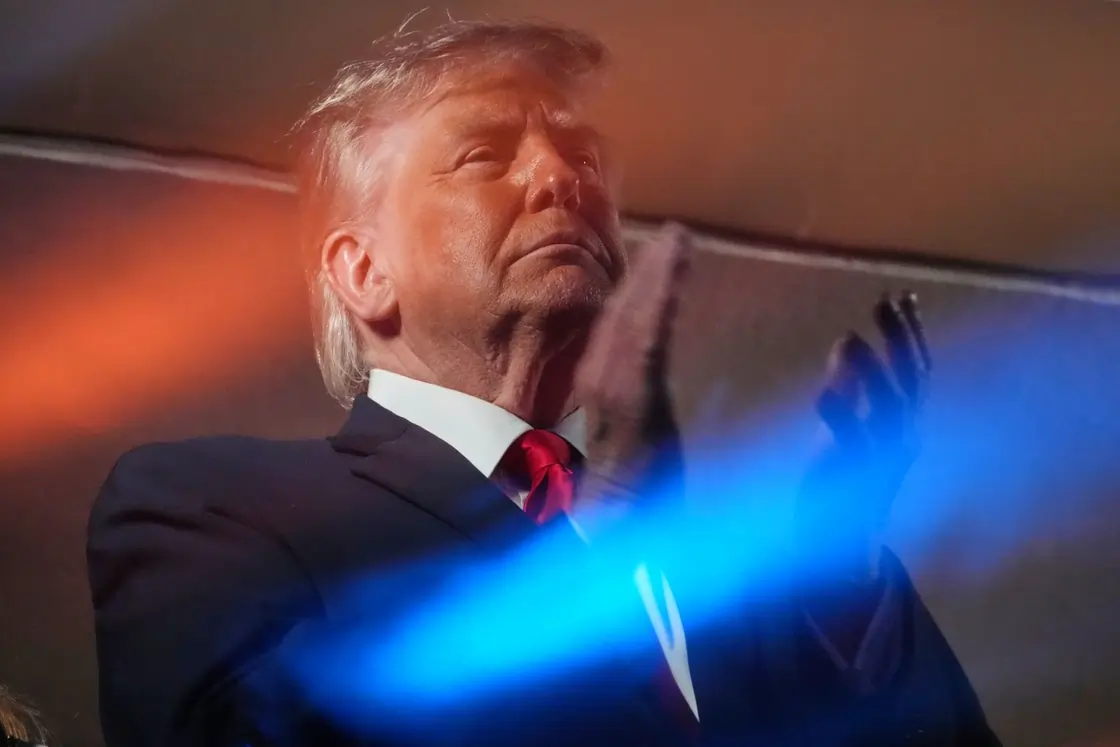
President Donald Trump attends an NBA Finals playoff basketball game between the New York Knicks and the San Antonio Spurs at Madison Square Garden in New York, Monday, June 8, 2026, with Kai Trump. (AP Photo/Mark Schiefelbein)
The San Antonio Spurs won their NBA championship playoff game against the New York Knicks in Madison Square Garden on Monday night. As usual, those of us who watched the game on television were joined by a plethora of celebrities who were there in person, among them Tina Fey, Ben Stiller, Timothée Chalamet, and Spike Lee.
As the New York Times reports, “Knicks games serve as an opportunity for celebrities to flash status and style as much as anything else—like power.”
Of course, the most famous celebrity of all was there as well.
Donald Trump made history as the first sitting president to attend an NBA Finals game. As you might imagine, security was tight. But what interested me was the crowd’s reaction: during the singing of the national anthem, the arena’s video board showed the president. The crowd began booing loudly as Mr. Trump saluted.
Criticizing George Washington
As I watched, I thought of all the places in the world I have visited where such a scene would be impossible. Imagine crowds booing Vladimir Putin in St. Petersburg, or Xi Jinping in Beijing, or the Cuban president in Havana. I’ve not been to North Korea or Saudi Arabia, but I would assume that the same prohibitions against such displays against their dictators would be enforced.
I found myself grateful to live in a country where we can express our personal sentiments toward our leaders. This is not new: as Joseph Ellis’s marvelous biography of George Washington reports, even the Father of our Country faced significant public opposition and criticism during his second term over the Jay Treaty, a diplomatic agreement with Great Britain that averted war but sparked intense political division within the country.
At the same time, I found myself saddened to live in a country where personal sentiments are often unbiblical. Scripture teaches us to “be subject to the governing authorities” (Romans 13:1) and to “honor the emperor” (1 Peter 2:17). This does not mean placing human authorities above God: Paul and Peter were eventually martyred for preaching the gospel. Nor does it mean that our authorities are always people of high character; the authorities in view here were Roman emperors known more for immorality than for morality.
Nonetheless, the Bible calls us to respect those in authority—if not the person, at least the position. This is just as true when Democrats are in office as when Republicans are. It was just as unbiblical for people to slander Joe Biden as for them to boo Donald Trump.
And so we find ourselves in an odd dichotomy: we live in a country where we are free to express our feelings about our leaders, but one that lacks an inherent moral compass to guide such expressions.
This is true not just with regard to booing the president but for an entire spectrum of moral choices.
“A rule which is not tyranny”
It cannot be otherwise in a secular republic where all religions and none are to be given equal freedom. This is why the Founders were so adamant that the religion and morality their democracy could not produce were indispensable to its flourishing.
What was true then is still true today.
What has changed is that we now live in a society where the very concept of objective morality is itself dismissed by many. Our “post-truth” culture insists that all truth claims are subjective (which is itself an objective truth claim). This is an impossible foundation upon which to sustain a country or even an individual life.
Because we believe that all truths are personal, we have personalized morality with regard to the origin of life (abortion) and its end (euthanasia). We have redefined marriage, gender, and sexual morality. Legalized polygamy and prostitution are next. Genetic alterations that will change the human species are in our future as well. Not to mention generative AI without social or legal guardrails.
In The Abolition of Man, published in 1943, CS Lewis foresaw such a day and warned: “A dogmatic belief in objective value is necessary to the very idea of a rule which is not tyranny or an obedience which is not slavery.” When we have no objective values, we are subject to those who can impose their values on the rest of us. In autocracies such as China and North Korea, the “golden rule” is simple: “He who has the gold makes the rules.”
A prayer I need to pray daily
Two conclusions follow.
First, leading as many people as possible to transforming faith in Christ is the most patriotic way we can serve our nation. Short of a moral and spiritual awakening, the future of our democratic experiment is in question. Evangelism and ministry are not “imposing” our personal values on others—they are sharing the gift every soul needs most.
Second, we must be the change we need to see. I cannot live with biblical morality apart from the power of the Spirit. Nor can you. Staying submitted to him from the beginning of the day to its end is therefore crucial to our lives and flourishing (cf. Mark 1:35; Ephesians 5:18).
William Temple, archbishop of Canterbury, authored this prayer now in the Anglican Book of Common Prayer:
Almighty and eternal God,
so draw our hearts to you,
so guide our minds,
so fill our imaginations,
so control our wills,
that we may be wholly yours,
utterly dedicated unto you;
and then use us, we pray you, as you will,
and always to your glory and the welfare of your people;
through our Lord and Savior Jesus Christ. Amen.
I pray these words every day because I need to.
Will you join me today?










 Search