



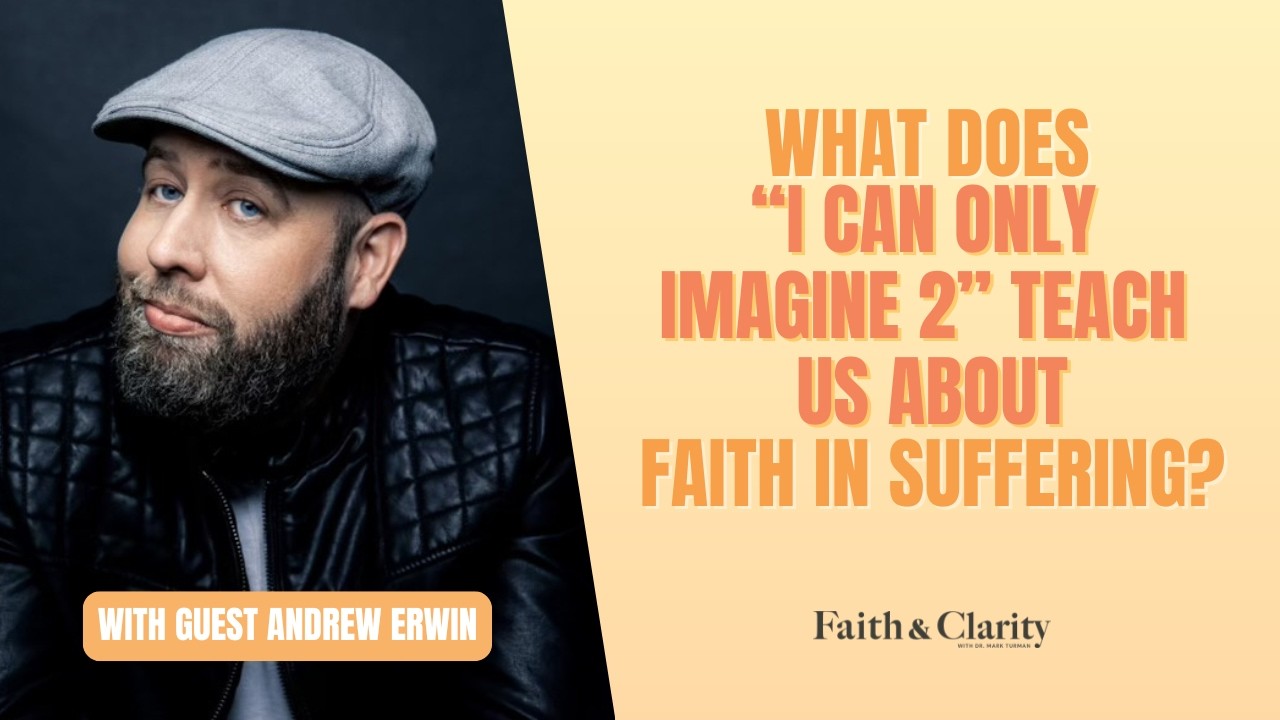
In this episode of Faith & Clarity, Dr. Mark Turman sits down with filmmaker and Kingdom Story Company co-founder Andrew Erwin (I Can Only Imagine, Jesus Revolution) to talk about storytelling, faith, and the power of film to share God’s truth. Andrew reflects on how the Erwin brothers found their voice through underdog stories, the unexpected success of I Can Only Imagine, and how faith-based films have grown in both craft and impact.
They also discuss I Can Only Imagine 2 and the deeper themes it explores—gratitude, grief, and trusting God when “happily ever after” feels uncertain. The conversation closes with a practical encouragement for believers to see films as opportunities to invite others into meaningful conversations about faith with courage and hope.



Topics
(0:00) Introduction
(3:34) From “Woodlawn” to “I Can Only Imagine:” the breakthrough story
(8:44) Andrew’s origin story
(14:04) Global impact: Film as a modern “Romans Road”
(16:02) No more “cheesy” faith films
(21:13) Why make “I Can Only Imagine 2”
(27:51) How faith films has changed
(33:21) Wrap-up
Resources
- Trailer: I Can Only Imagine 2
- Website: I Can Only Imagine 2
- Ask Us Anything: [email protected]
- Subscribe to a Denison Forum newsletter: DenisonForum.org/subscribe
About Andrew Erwin
Andrew Erwin is a director, producer and co-founder of Kingdom Story Company, the premier destination for films of faith that ignite a rush of hope.
Andrew has directed and co-directed feature films like I CAN ONLY IMAGINE, I STILL BELIEVE, AMERICAN UNDERDOG, and I CAN ONLY IMAGINE 2 (2026), among others, and is one of just five directors (along with Steven Spielberg and Rob Reiner) to receive three A+ Cinema Scores.
In partnership with Lionsgate, Kingdom Story Company’s films have consistently opened in the top ten at the box office, earning the coveted A+ CinemaScore® rating six times. Prioritizing faith, inspiration, and positive impact in storytelling, notable Kingdom Story Company films include the 2023 hit JESUS REVOLUTION, ORDINARY ANGELS, UNSUNG HERO, WHITE BIRD, THE BEST CHRISTMAS PAGEANT EVER and SARAH’S OIL.
Andrew also hosts “The Storytellers Podcast,” which explores the transformative power of storytelling through the lens of faith, and features conversations with artists, directors, actors, and other creative thought leaders. Guests have included Mel Gibson, Dennis Quaid, Roma Downey, Candace Cameron Bure, Jonathan Roumie, DeVon Franklin, and more.
About Dr. Mark Turman
Dr. Mark Turman serves as the Executive Director of Denison Forum, where he leads with a passion for equipping believers to navigate today’s complex culture with biblical truth. He is best known as the host of the Faith & Clarity podcast and the lead pastor of the Possum Kingdom Lake Chapel, the in-person congregation of Denison Ministries.
Dr. Turman is the coauthor of Sacred Sexuality: Reclaiming God’s Design and Who Am I? What the Bible Says About Identity and Why it Matters. He earned his undergraduate degree from Howard Payne University in Brownwood, Texas, and received his Master of Divinity degree from Southwestern Baptist Theological Seminary in Fort Worth. He later completed his Doctor of Ministry degree at George W. Truett Theological Seminary at Baylor University in Waco.
Before joining Denison Forum, Mark served as a pastor for thirty-five years, including twenty-five years as the founding pastor of Crosspoint Church in McKinney, Texas. Mark and his high school sweetheart, Judi, married in 1986. They are proud parents of two adult children and grandparents to three grandchildren.
About Denison Forum
Denison Forum exists to thoughtfully engage the issues of our day from a biblical perspective, helping believers discern today’s news and culture through the lens of faith. Led by Dr. Jim Denison and a team of contributing writers, we offer trusted insight through The Daily Article, a daily email newsletter and podcast, along with articles, podcasts, interviews, books, and other resources. Together, these form a growing ecosystem of Christ-centered content that equips readers to respond to current events not with fear or partisanship, but with clarity, conviction, and hope. To learn more visit DenisonForum.org.
EPISODE TRANSCRIPT
NOTE: This transcript was AI-generated and has not been fully edited.
Mark Turman: [00:00:01] This is Faith and Clarity. We're glad that you're with us as we talk about things that matter to equip and strengthen you in your walk with Christ and your witness for him. Uh, today we're going to tell a story about stories. And uh, a little bit further on than that, we're going to talk about the intersection, what you might have thought, might actually call the collision between gratitude and grief. Uh, we're doing that in a very unique way as God invites us to not only know his story, but to become a part of his story. And uh, we're going to do that today with a very special guest. Uh, we have today Andy Erwin, who is a storyteller, a director, producer, and co-founder of Kingdom Story Company, which is a premier destination for films, movies of faith. Uh, you will know his work. He has directed or co-directed hit future feature films such as I Can Only Imagine, I Still Believe, and Jesus Revolution, and one that I recently got to see, uh, that I highly recommend called Sarah's Oil. Uh, he is also the host of the Storytellers podcast, uh, and is just doing a great job for God, uh, using the power of faith to tell stories. So Andy, welcome to the Faith and Clarity podcast.
Andrew Erwin: [01:17] Mark, good, good to be with you, man. I really, uh, appreciate the time and, uh, you get me talking on stories and I'll talk to you all day long.
Mark Turman: [01:24] Absolutely. Well, I think all of us, uh, love a great story, especially when it comes to life on a movie screen. Uh, hasn't been a lot to watch, uh, in the last five years after COVID. Uh, so we appreciate the work that you have done and that you continue to do. So, uh, I thought, well, I'm talking to a storyteller. So, uh, I need to ask, hey, what story do you want to tell today? Um, the story I thought we might tell is that, you know, God loves to tell his story to us, then he loves to tell his story through us in very unique ways. Uh, and if that lines up with what you're about today, I think we might have a good conversation.
Andrew Erwin: [02:03] I love it, man. I, I, I, uh, totally agree with that. I think that, you know, God has to kind of create his story in you before you have something to communicate to the world. And I think, um, you know, with filmmakers, it's really interesting because a lot of, you know, filmmakers, they find their voice, uh, in their late 30s, early 40s. And, uh, you know, I think, uh, you know, along the way, you're learning your craft and there's always this eagerness to kind of get out there and tell your stories right away. Um, and, you know, kind of that, that ambition of a young man, but God has this path of allowing life to give you your message and to go through enough hardships to give you something to say and communicate. And then there's this intersection that happens, uh, you know, usually in your, in your late 30s to where that life message, uh, kind of collides with your ability to know how to tell it. And that's usually when you find, find your ultimate story and that's where it gets fun. And, um, for us, you know, that was, that was the first movie I can imagine, that was, I was age 40 when that one, uh, came out and, uh, you know, it was eight, nine years ago and, uh, when we made that. And so, uh, it was just amazing to see that that, that's where we found our voice and that's where that collision happened with us. And, uh, it took a long time to kind of get there, uh, and all of a sudden just God kind of gave us our story to tell.
Mark Turman: [03:25] Yeah, and it's just been beautiful to see that. You know, I, I have a theory that, uh, you know, we all admire, uh, actors and musicians and athletes and we love to see their stories played out in front of us. We vicariously kind of engage with them that way, but, uh, it's even more exciting when you kind of find your own story and you get to start telling it well, right?
Andrew Erwin: [03:48] Yeah, yeah. And when you get to tell your own, it's something that's deeply personal. Um, you know, where we found our voice, uh, we were doing a movie called Woodlawn and it was the movie right before I can only imagine. And, uh, financially it was, it was not successful. It was, you know, it, it ended up staying in the red. But, uh, story-wise, it was where we found our kind of stories, uh, to tell. And, uh, and so we fell in love with the idea of true stories and telling underdog stories. Uh, that also that movie Woodlawn seated the idea in my brother to do Jesus Revolution. Uh, you know, because we kind of talked about the end of the revolution there, uh, at that little high school in Birmingham, Alabama, but, uh, John always wanted to back up and tell the beginnings of it and that's why he and Brent McCorkle stepped into doing Jesus Revolution years later. Uh, but, you know, we were told, go once more around the block. You found your story to tell, you found your voice, find something that has that DNA. And that's when, uh, Bart Millard from Mercy Me, his story for I can only imagine came across our desk. And, uh, it had been developed for about five years as a feature that they couldn't really figure out what to do with it. And so Cindy Bond, the original producer brought it to us and showed us the script. And, uh, and I was on the a radio show in Tampa and the host was asking me off, uh, the air, uh, and he said, uh, what, what story are you looking at next? I said, Bart Millard's story with I can only imagine. And he said, oh my goodness. He said, I was at the Ryman that night when Amy Grant pulled him up on stage and gave him his song back. It's the most magic thing I've ever seen in music. I was like, wait a minute, I don't, I don't know this story. Back that up. And so, uh, so I called Bart and I'm like, did this happen? He's like, oh yeah, bro, I forgot to tell you that. That's the most magic night of my life. And I was like, lead off with that story, you idiot. And, uh, and so, uh, so that's where we kind of found the end of the movie and we're like, okay, Amy Grant pulls him up on stage, gives him his song back, he sings the song, and then we create this elusive moment that never really actually happened in real life, but everybody wants that moment for your father to stand in approval and give you, uh, a thumbs up of a job well done. And so, uh, to be applauded for by your father. And we gave that moment to the audience and it just was a magic ending to that. And so when that little movie came out and every studio had passed on it, we had done it independently and at the last minute, Lionsgate came on board to help us put it in theaters. And this little $7 million film, we were all predicted to do 2 million opening weekend. And, uh, and it came out and it did 17 opening weekend and went on to do 86 million worldwide. And, uh, and it was just this moment where we stepped back and we were just like, oh my gosh, God prepared us for this story and for so many years and it made sense. And that fueled everything that we've done since.
Mark Turman: [06:38] Yeah, and just kind of stood the movie industry on its ear in a very big way. Yeah, and some of, some of our audience will remember, uh, I got to talk to your brother about Jesus Revolution, uh, a few years back and we had a great conversation around that. I want to, I want to pull back and talk about your story and how God is telling his story through your story, um, as an artist and as a director. Um, I have a theory, uh, that I wonder if you would comment on, which is that there's something of a famine of awe, uh, of wonder, of enchantment in our culture that we've, we've trivialized everything so much that nothing really takes our breath away, um, the way it used to. And that's what I loved about the first movie and, uh, I'll tip my hat that that's, that's what people will have the opportunity to with I can only imagine too, which we'll talk about that in a minute, but talk about, talk about your sense of mission and your calling as an artist and how that kind of lines up with your calling as a believer, um, and this kind of broad question, uh, Andy, which is, do you believe that art will save the world?
Andrew Erwin: [07:47] Uh, I, I, I believe that stories will save the world. I think stories are always connected to the heart of God. He's told his story that's so intricately woven from cover to cover in the Bible. And Jesus himself was a master storyteller. If you want to study great storytelling, watch how he used parables to really emotionally hook the audience in. This idea of a vicarious emotional journey and the idea of emotional jamming. If I can make you feel something for any period of time, whether it's three minutes in a song or two hours in a movie or 800 pages in a book, if I can move your heart emotionally and make you feel something, you will go back and seek out answers. And so he would tell us parables and then the true followers that would find good ground, good soil for the seed would come back and be like, what in the world did that mean? And he'd be like, let me tell you the rest of the story. And so, uh, you know, I think for us, finding that moment, uh, and I believe those stories have the, have the ability to to change the world. So, you know, right now it might be movies, but that might, you know, transition to some other art form, uh, in the future, uh, of storytelling. You know, when the printing press came out, uh, the Gutenberg Bible was the first thing printed and gave the Bible back to the people. And so, uh, you know, that, that art form continues to mold, but, you know, film is only 120 years old and, uh, it continues to really surprise people how those stories can change people's lives. Uh, I'll tell you more about why I think it can in a minute. But as far as my personal journey, it started, um, at, uh, uh, you know, I, I went to a, you know, I grew up as a studio rat. My dad was, uh, in the media growing up. He was a news anchor for Channel 11 in Dallas and went on to have his own little independent TV show and radio show. And so I grew up around it. Uh, you know, the studio allowed us to, um, use the equipment from, uh, from midnight till 4:00 a.m., uh, as teenagers if we agreed to work off the books to help them with some of their TV shows during the day, probably broke a lot of child labor laws. But, uh, uh, that was where we kind of fell in love with this idea of telling stories behind the scenes. But I grew up in Birmingham, Alabama, and there was nobody from Birmingham that was doing movies at that time. And so, very, very few. And so, you know, everybody when we tell them our ambition of what we want to do, they'd be like, isn't that cute? That's a cute little idea. And, uh, and so we, uh, uh, but I went off to a Bible college in New York and that Bible college had a camp where 500 kids a week would come to this little island in the middle of upstate New York. And, uh, uh, it was a little, it's in one of the big lakes up there. And, um, there's nothing more honest than 500 high schoolers to watch your little film shorts each weekend. So we do these film shorts for the kids. In fact, the first one we did was a Knights of the Round Table deal. And, uh, and it, it ended with like pyrotechnics on stage and it was like King Arthur and it was like this whole ordeal. We thought we were doing, you know, a precursor to Lord of the Rings. And, uh, and, and so it got to the end of it and we thought like I'm already accepting my Oscar in the back of the audience. And, and, and it gets to the end of it and it's crickets. Just nobody talks. And this one little 12 year old on the front row is like, is that it? And it's so scarred me for life that to this day, John, my brother can't sit through one of our films. Like if one of our films is playing, he's out in the hallway pacing because he's convinced that this guy's going to show up as a 42 year old man and be like, is that it? And so, uh, so it's always, it was a, it was a, it was a bumpy, bumpy beginning. Uh, uh, you know, I think, uh, you know, for us in that, uh, we just kind of continued to be a hobby that grew out of control. Years later after we were doing music videos, uh, you know, uh, well, let me back up. There was a missions conference at that school. And they, they had this missions conference, they had people speak. And at the end of it, they said, you know, who wants to be a missionary? And so I raised my hand and walked forward. And the, the guy that I talked to after that really had a lot of wisdom. He's like, Andy, is this what you want to do? And I was like, not at all. I just feel like in order to, in order to be a good Christian, I've got to go be a missionary. And he said, Andy, what, what's in your hand? And I said, a video camera, but I don't know how God could ever use that. And he's like, Andy, give God what's in your hand and let him figure out how to use it. Wow. And so that was kind of a beginnings for me of saying, okay, God, all I've got is this little camera. I don't know how you could use that. But it's yours. And so fast forward a few years later, we were doing music videos and, uh, my brother and I, uh, a lot of Christian music videos, a lot of, uh, country, rock, a bunch of other stuff. We did a lot of music videos for a band called Skillet. Um, and, uh, in fact, we, we got good at blowing things up. Uh, you know, if we couldn't figure out how to end a music video, we just blow something up. Uh, I think the last music video we did, the treatment for it read, the band comes out, things blow up, it starts to rain, more things blow up, uh, it stops raining, everything blows up. And they loved it. They loved it. They're like, it's epic, it's amazing. And so I think that that little music video has like a half a billion views on YouTube. But, um, uh, all that say, we just kind of got used to being hired guns and we were just, you know, we were there to, to just, you know, tell other people's stories. And it was the movie Courageous by the Kendrick brothers that had done Fireproof and went on to do War Room and the Forge. Uh, Stephen, Stephen Alex Kendrick, uh, asked my brother if he would do the action stuff on the movie Courageous, which was a police movie. And so I was still off doing music videos on my own. And on the set, Alex Kendrick said to John, John, what's your purpose? What's your calling? And John said, I'm here for a paycheck. And he said, John, it's time for you and your brother Andy to get off the sidelines and tell your stories. And John's like, we don't know how to do what you guys do. You do really, you know, kind of lessons for the church. You know, these you're preachers. We're not preachers. And he said, John, don't try to be us. You guys tell your stories and tell them. You know, God called, you know, Peter to the Jews, Paul to the Gentiles, but the gospel went out both ways. And so go, go tell your gospel, you know, your gospel story in your own way. And, um, that's where we kind of, it led us to do all of our different movies. And, you know, ultimately on Imagine, that was the moment where it all kind of collided and we're like, oh my gosh, this is the kind of stories that we tell. Uh, but it really started with that idea. You know, I think when the movie came out for the first Imagine and it was kind of setting the world on fire for just a weekend, I sat in that food court in, in, uh, uh, uh, Dallas, uh, Texas was in Plano, Texas. And we're, uh, uh, we're sitting at the food court and the movie was playing next door and was just absolutely blowing up everywhere. And, uh, nobody knew who I was. The crowd was just walking by me. And it was like God brought back that moment in Bible college where it's like, what do you have in your hands? And I was just like, I had tears in my eyes. I was like, God, how cool to have a front row seat to seeing you got you change a lot of lives, uh, you know, from a video camera. And that little movie went out around the world. And so, you know, the thing about films and why I come back to your other part of your question about does it, does, does a story, does art have a chance to change the world? And I believe it does. I mean, I think, uh, that story went around the world on autopilot. There's distribution mechanisms internationally that take a film out on autopilot. So if it opens big in the US, it goes out on distribution methods around the world. It's the Romans road of our current, you know, generation that, you know, in the New Testament, the way the gospel went around the world is these roads were created by the Roman Empire for both commerce and war. And they were used, you know, to do their thing. But then the early church, those roads were what paved the path for the gospel to go out around the world. And so it's kind of that same thing is like this distribution mechanism gets the message out so quickly and in places where you could literally be arrested in the streets for preaching the same message. You know, places like Saudi Arabia or China, these stories go out. And so I can only imagine went into China and was not censored at all. So it was translated into Chinese with Chinese actors. And it was just amazing. So one of the stories that came back, uh, was from Australia. This lady posted it on social media. She said, my son and I decided to go see I can only imagine the theater in Australia. It got to the end of the, the credits and the lights came up and there was another woman sitting at the end of the row. And she said, I, I, I turned and I said, are you, are you okay? The woman was in tears and she turned and said, uh, are you guys Christians? And the woman and her son said, uh, yes, we are. Are you? And the woman sitting by herself said, I'm not, but whatever happened to Dennis Quaid in that movie, I want to happen in my life. And they walked over beside her, knelt down and she gave her life to the Lord. And so it has the ability to change lives and change lives have the ability to change the world.
Mark Turman: [17:10] Yeah, that's awesome.
Mark Turman: [19:14] How do you keep a, a faith film from becoming cheesy? Because some of them have been.
Andrew Erwin: [19:41] Yeah, you know, you know, we've all come out of the cheese. I mean, I was a part of the cheese for years too. Um, and I think the things that you've seen differently, especially in the past five years, is you've seen faith film find its voice. Um, you know, I, I, I think because we atrophied for so long, um, if you look at the history of the arts, like we talked about, you know, Christianity led the, the world in art, the arts for, you know, almost 2000 years. You know, you look at, you know, every, um, you know, cathedral in Europe or look at every painting from the Renaissance, you know, the Gutenberg press, the Gutenberg Bible was the first thing on the printing press that was printed. Uh, the radio, the radio evangelist that have used those for years, uh, television, all these things. And then you look at the history of film and you look at, you know, um, you know, movies like Ben Hur and the Robe and the Ten Commandments, all these great movies. Uh, and somewhere in the 1960s, the church decided that, uh, you know, film is evil and, and that movie theaters are bad and we kind of abandoned it. So we didn't have our seat taken away from us at the, uh, at the table. We gave it up. We like to said, here, you can have our seat. And as an industry, the business absorbed that seat at the table and we were on the outside looking in. So after Mel Gibson did the Passion of the Christ in 2004, uh, there was a group of us that were like, hey, we want to do that, but none of us knew how. The art form had literally atrophied in the faith community. And so we all got in the game not knowing what we were doing. I think the difference for it and the answer to your question is that, uh, you know, I think for years, uh, we felt like Christians, uh, were uncomfortable with conflict and tension. And because of that, we wanted to get straight to the hope of the answer. But what it turned into was almost a Pfizer ad. It's like, it's like a, an ad for like some sort of pill that's going to do all this good in your life. But as they're reading all the side effects for how it can kill you, uh, all the shiny happy people look at the camera with sunshine behind them and have no problems. And then it says, you know, so it's, it, it felt like a sales pitch, uh, you know, for the side effects of being like, to be human means that you're going to have hardship. I mean, the Bible promises that over and over again. Jesus said it. It's like, if you're in this world, you're going to have problems. And, uh, I think as the audience taste developed and as filmmakers, we learned our voice and like you said, as better and better actors got pulled into the mix, we got comfortable with tension and we became a lot more nuanced with understanding what it is to have classic Joseph Campbell hero's journey storytelling. And, uh, I think as we learned the craft, the stories got better and better, which meant that then it attracted better and better talent. You know, so when Dennis Quaid signed on to the first I can only imagine, it was life changing for us because up to that point, there hadn't been a whole lot of A-list actors that had been a part of this thing. And, uh, and so, you know, and it's extended like our desire and our mission has been to reach what we call the benevolent skeptics, the people that are outside the church walls that they are not hostile to Christianity, they just don't know they need it. So it even extends to, uh, you know, how we cast our films. So, uh, like on the movie American Underdog that we did on Kurt Warner's story, uh, you know, uh, the, the, uh, the girl that played, um, Brenda Warner, uh, is a girl named Anna Paquin. She's an Oscar winner. She's the youngest Oscar winner in the history of the Oscars. She won it at age nine for the piano. And, uh, when she read the script, she said, I love the script, but can we talk about the elephant in the room? I'm not a person of faith. It's not something that I believe and my, my, my life, my message is kind of at times, uh, uh, counterintuitive to this story, but she's like, I love the script. Is it a problem for me playing a Christian? And I said, Anna, absolutely not. As long as you can fight to understand and correctly portray, uh, the faith of the person that you're playing in the film. And she said, well, I would do that with any, uh, story that I tell. And I said, well, who wouldn't want to cast an Oscar winner? And so, uh, she came in her first day on the film is like, you know, talks about, you know, being born again. How do you become born again? What does that mean? It's a relationship instead of a religion. All these things and she did it beautifully. So I think you've seen the value go up and it become more of a safe place for really, really good, uh, you know, actors like Oscar winners and everything that want to come be a part of it because I think we're learning how to do the craft a lot better and to make it safe for people, uh, from all of their backgrounds, whatever they believe to come in and be a part of telling a story that ultimately points to what we believe is true.
Mark Turman: [24:47] Yeah. Oh, that's awesome. That's awesome. So, uh, I can only imagine two comes out on February 20th. Uh, this podcast will, uh, be ahead of that a couple of days. Uh, so you're taking a chance. Uh, anytime you make a sequel, right? You're taking some kind of a chance. Uh, in the preacher world, people like me say, you know, if I don't feel, if I don't feel it, I don't preach it. Uh, what made you want to tell this story and take this kind of a chance, uh, with a sequel to I can only imagine?
Andrew Erwin: [25:20] Uh, yeah, Mark, I think, I think that, um, for this one with the sequel, I was actually very much, uh, uh, against it. Like I was like, I don't want to do a sequel. I was like, because I've seen too many sequels that they worship the original film and then they destroy it. And so, uh, I just, uh, I wanted to have a reason to go back. And so after the first movie came out, we got pitched everything from sequel ideas, uh, to a TV series to even a Broadway play. And I was like, no, to all of it, no. And until this one came along 10 years later, and, um, Brent McCorkle that co-directed Jesus Revolution with my brother, and then Cindy Bond, who was the original producer for I can only imagine, came to me and they said, do you know the story of the song Even If? And I was like, well, I love the song Even If. It's Mercy Me's second biggest hit and it's, it had a massive moment. And I was like, uh, you know, what, what, I don't know the story. What's the story? And they proceeded to tell me the story of what happened in Bart's life after success. And it spoke to me because I, I just think, especially in Christianity, we don't know what to do when life gets hard again. We feel like, uh, how did I mess this up? You know, what did I do to make God abandon me or where's God in suffering or struggle? But you look at the church that's thriving around the world, it's the persecuted church. People that go through hardship understand deeply the real meaning of the gospel and it's a privilege. And so the idea for this story was if the first movie was a father son story of a Bart as a son towards his dad, this one's a father son story, but as as Bart as a father towards his son. And it asked the question, you know, uh, what happens if your happily ever after breaks? And if, you know, you get everything you ever dreamed of, but the crowd stops applauding, they go home and life goes back to being hard. Where's God in the the hardship? And it just deeply impacted me. It brought me to tears. And I got to the end of the pitch and Brent said, it's kind of like the spiritual sequel to I can only imagine. And I was like, no, that's the actual sequel. I can get that green lit tomorrow. And if you want to, I would love to co-direct it. And, uh, and so we set out to tell the story together. Um, and really this movie is about that tension between grief and gratitude. And it ends with every bit as much hope as the original. But hope by itself is more of an emotion. It's a belief. But gratitude is like lived in. It's hard fought for. And, uh, and this song, even if, is really about, you know, God's in the fire and it's beautiful. It's Shadrach, Meshach and Abednego facing the fiery furnace said, uh, we believe that God is able to deliver us from the flames, but even if he doesn't, we won't bend our knee to anyone else. And, uh, and so I just think that DNA of that story infuses this one. It ends at Red Rocks at one of the most sacred music venues I've ever been to. And it absolutely delivers. The first movie was our highest testing film we've ever had. It scored a 96 with the test audience. This one scored a 97. And so the audience is in for a big surprise. I can't wait for people to see it.
Mark Turman: [28:44] Yeah, and and having a chance to pre-screen it, it's just it is everything in that and more. Um, Andy, I heard you talking to Bart Millard and Tim Timmons who this story revolves around on your storytellers podcast. Uh, they talk about some of the things that happened in the production of the movie. Uh, it made me want to ask you, what do you think you're going to remember five years from now about the experience of making this story come to life?
Andrew Erwin: [29:12] You know, with this one, Mark, I I I think the thing that I love the most about this one is I feel like sometimes in this society, you get so focused on the what of what we're trying to do that, um, I found on this one that God is a lot more obsessed with the how. And, you know, he'll, he'll, he'll multiply, he'll multiply any two loaves and five fishes. It's like, it doesn't matter. He, he can make something beautiful out of nothing, but it's how you do it. And and on this one, coming into this story, we just came in, uh, it had deeply moved us, this idea of gratitude, and we brought that to the day-to-day. And there were just so many instances on set where how we did what we did as a group, just God was just in it with us. And it was beautiful and it was redemptive. One of the moments that was the most special for me, uh, was when we filmed at Red Rocks. And so, you know, that venue is iconic. It was the only one that we wanted to film at. We fought really hard for it. It took us a while to get approval. We got it only for one night. And so we did it as a blended concert, uh, slash film shoot. And we only had three hours of film time to be able to shoot the last 20 minutes of the movie. And on paper, that was impossible. 8,500 people in the stands, uh, stayed and it was just, it was a moment. But when we started shooting that, just everything went right. And it just, there's, there's footage of me on my Instagram where I'm losing my mind. Somebody was filming me. I didn't know it. And I was just cheering out loud because it just everything just came together perfectly. And it just, I mean, it was a grace of God because there's no way on paper that should have worked. But it was a movie moment that I we were living in real life. And I just was full of joy and gratitude that how cool to go back to a story that you didn't know needed to be told more and that was more of the story to tell and you get to finish the journey and being back on set with Dennis Quaid sitting, you know, across that campfire from Bart, uh, and just looking at him and just being like, 10 years ago, we started this journey and now we get to finish it together. Uh, just brought tears to my eyes and I just the the making of the movie was the most special thing I've ever been a part of.
Mark Turman: [31:33] Yeah, well, it it is absolutely awesome, uh, to just see the story and to see what happened. Like I said, I love that what happens when your happily ever after, uh, gets shattered a bit. What what what comes after that? Yeah, just love that. Hey, I know, I know you need to get on to other things, but before you go, uh, tell us anything you want us to know about how the movie industry, particularly faith films have changed since the first one and why is it important that Christians go particularly on open weekend? Why is that important to the overall, uh, mission that you guys have in films that that matter around faith?
Andrew Erwin: [32:12] Mark, that's a softball pitch, man. I really appreciate that one. Uh, you know, as far as how it is changed, you know, there was a group of us that we all got in film together around the same time, about 20 years ago. Uh, and none of us were really knew what we were doing. We were all figuring it out as we went. And I literally could end any dinner party, um, you know, in in in Hollywood, they would ask me, what do you do? And I'd be like, I do faith film or I do Jesus films. And like they would, they'd be like, get a fake phone call, be like, I got to take this, I got to leave. It was like, your phone's not ringing, man. It's not. And they just kind of run out the door and never look back. I just be sitting in there and they'd never come back. I'd be like, oh, I guess the meeting's over. Um, to go from that and us all struggling to kind of find our voice, uh, but that group to see God bless it and we've all found our voice in proximity within the past, you know, five to 10 years. Uh, you have, you know, Dallas Jenkins that's doing the chosen now. Uh, my brother has gone on to do the House of David series, which I'm a huge fan of. And then he's got his, uh, uh, movie on George Washington that's coming out this summer that would be fantastic. Um, then, you know, uh, Alejandro Monteverde went on to do Sound of Freedom. You got Devon Franklin, you've got, uh, you know, you've got John Gunn, you've got Brent McCorkle, there's just been a list of people and then the Kendrick brothers obviously that kind of inspired us to start. Um, but something in the past five years has shifted. I think in a time of insecurity within the industry, the film industry, they really needed audiences they could depend on. And Christians consistently over and over again voted with their tickets. And they're like, these are the kind of stories that we want. And it's been a kind of a flywheel, if you will, of, uh, of synergy where they spent money on the product. Hollywood saw the value, so they invested more money back into the product. And so, you know, our budgets have consistently gone up, which has allowed us to get better talent, which has allowed us to go after bigger stories. Uh, and every time that one of these movies works on a large scale, it creates an opportunity to five more that are in the same vein. Um, so I just think that the Christian audience, that core audience, and that's it was I was talking to somebody on the set the other day. I was on a a major motion picture that my friend is acting in and so I was stopping by the set last Saturday. And he's like, you know, what what kind of stories do you do? And I said, and again, back to that beginning of being able to clear a room, I just said, I do faith film. And I said, I'm really proud. We used to be, uh, considered cheesy at first, but now we're kind of become counter culture with our stories of hope and redemption. And he looked at me and he said, he said, I love that you didn't even apologize for doing faith film. He's like, that's really punk rock. And he's like, we need to work together sometime. And this was a big actor. And so, I I think, um, it's a moment right now where the audience is realizing the power of their voice and use it well. And that's why I'm passionate about every time that we create a product at Kingdom, whether it's me directing or not, we try to find stories that are a theatrical event that have to be seen on the biggest screens possible. Uh, and what what it creates is a communal event and that is a tool for the church for evangelism for us to be able to invite those people that are the benevolent skeptics in our world and the church doing what the church does. And so what we do is we tell a parable, true story or fictional, we tell our story on the screen, uh, that creates that moment that the seed is planted. Then the church does what Jesus did with the second part is when the people come back and be like, tell me the rest of the story, then they get to step in and fill in the gaps. And so the Bible says that God calls some to plant the seed, some to water, some to harvest. We're seed planters. But then the church water and harvest the heck out of that thing, man. And so there's a moment coming in theaters. We're going to be out in just a few few days on the 20th. Uh, and so, uh, buy your tickets now, make it a moment and see what God does.
Mark Turman: [36:22] Yeah, and take somebody with you if you can. Yeah, it's a a great moment. I love, I love the, you you brought that thing full circle. I don't only know if you know it, uh, or realized it, but, uh, a shout out to the Kendricks. I think the first, uh, faith film I saw from them was called Flywheel. And I still remember it. Uh, It was. Yep. It was Flywheel. Yep. And, uh, It was. So, and, uh, worth, worth going and checking out. Yeah, yeah, a full circle moment. Yeah. So, uh, I can only imagine two comes out February 20th. Buy your tickets now, take some friends, go back to the movie, get a big old bucket of popcorn, and you're going to have a really, really meaningful, inspiring, hope-filled moment. Uh, and we all live in that tension between gratitude and grief. Uh, sometimes we get stuck in the grief and we don't spend enough time in the gratitude. Uh, this will bring you around to that. Uh, just want to thank you, Andy, for taking some time, uh, and I hope our people will go and talk this up and go and be a part of it. And thank you for the mission that you're on and thank you for the way you're planting seeds. It's making a big, big difference. And, uh, I just love to be a part of, uh, these stories and how God's using them. Want to thank our audience for being a part of Faith and Clarity. Uh, if it looks a little different today, I'm, uh, recording from Howard Payne University in Brownwood, Texas, deep in the heart of Texas, if that's what you're wondering about the back screen behind me. A little shout out to Howard Payne for hosting us today. We'll see you next time on Faith and Clarity.







 Search