



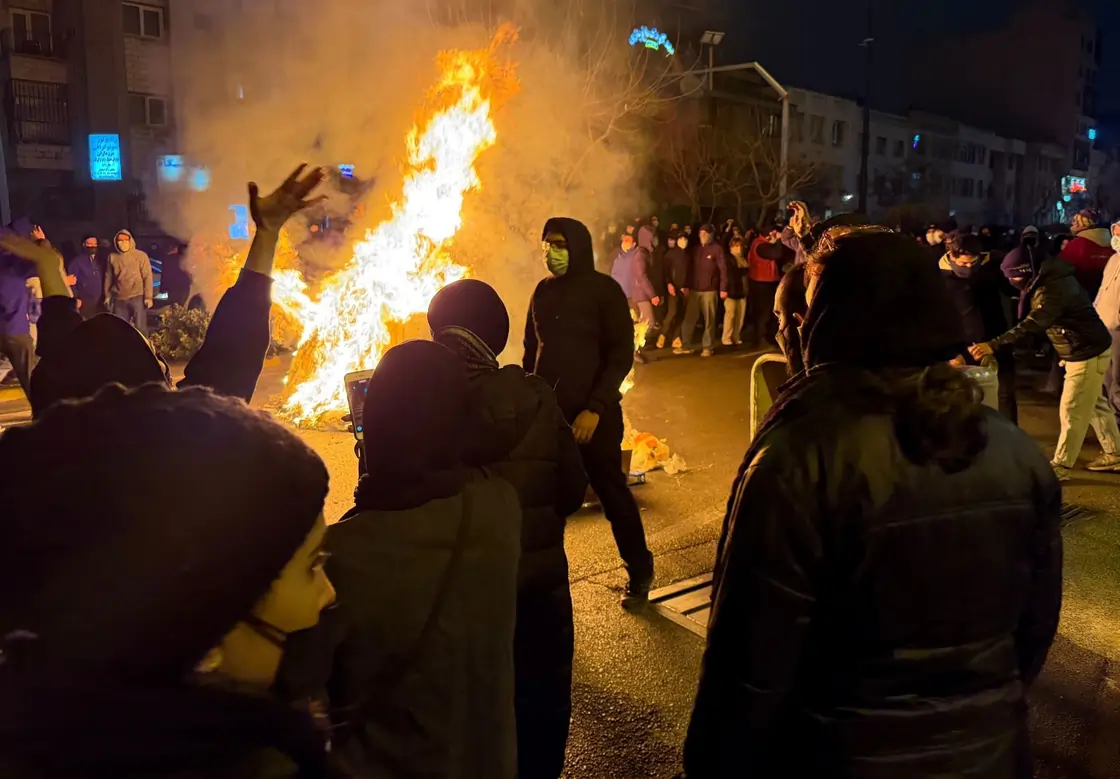
In this photo obtained by The Associated Press, Iranians attend an anti-government protest in Tehran, Iran, Friday, Jan. 9, 2026. (UGC via AP)
Protests in Iran have grown to the point that several world leaders suspect the regime may fall. We are just now beginning to learn the scope and scale of what standing against the government has already cost the Iranian people. Will their sacrifice lead to lasting change?
Why it matters: The government in Iran has long been a thorn in the side of the Middle East, including many of the nations with whom President Trump has attempted to form alliances over the past year. Will he follow through on threats to intervene? As of this writing, that question remains unanswered; however, the degree to which the government’s standing has already suffered and the economic damage inflicted on the Iranian people paint a picture of a situation that cannot last for much longer.
The backstory: Why these protests are unique
While the government of Iran has earned its reputation as a corrupt and repressive regime, protests like the ones that began in late December are more common than you might expect. The results have been mixed, but some have yielded real change.
In 2009, for example, the Green Movement saw hundreds of thousands of Iranians take to the streets in protest after President Mahmoud Ahmadinejad was re-elected in a rigged election. For the most part, Ayatollah Khamenei has since kept his thumb off the democratic process (or at least been less overt in exercising his influence).
Similarly, after a woman was killed by the “morality police” in 2022, the ensuing “women, life, freedom” protests resulted in the government no longer enforcing its strictest dress codes for women. Other demonstrations, such as those in 2017 and 2019 over fuel prices and water shortages, proved less effective.
So, where do the current protests fit on that spectrum, and what chance do they have of accomplishing real change in their country? The answer might surprise you.
An economy in shambles
When people began to march at the end of last year, they didn’t gather in the remote regions of the country or across the poorer districts. Instead, the protests began in Tehran’s old market, known as the Grand Bazaar.
As Roya Hakakian describes, the Bazaar is “a powerful institution with a long tradition of political activism, and the seat of the country’s wealthier and more religiously conservative classes.” When the Islamic Revolution overthrew the previous government in 1978, the Ayatollah was funded by the Bazaar. That symbolism is not lost on the current regime.
Moreover, the protests have since grown to encompass representatives from every generation and class across the country. As such, those rising against the government and calling for change represent a broader segment of the Iranian people than has been seen in decades. And the reason why so many have been willing to risk the regime’s wrath is that they feel as though they have far less to lose than before.
The level of economic collapse that Iran has experienced in recent months is difficult for many in the West to fully comprehend.
Sanctions from both the UN and the United States have driven up food prices by as much as 70 percent. Moreover, Iran’s primary currency—the rial—is essentially worthless, with current estimates placing its value at approximately 1.5 million rials to 1 US dollar.
As a result, there are essentially two entirely separate economies in Iran. The first is available exclusively to the government and relies on the ability to barter with oil and hard currency—such as dollars, euros, etc.—to trade on the global market. Even then, however, much of Iran’s hard currency is currently frozen, meaning it has limited options outside of oil that it can effectively utilize.
The people, meanwhile, are locked out of even those markets, forced to rely on a form of money that loses value every day and a government that can’t even afford to provide consistent access to water, electricity, or food.
The situation has gotten so bad that Iran’s president, Masoud Pezeshkian, has openly acknowledged the severity of the problem and expressed sympathy with the protestors. He has also tried to lay the blame on American sanctions rather than the regime, but just admitting that the protestors have a point marks a massive departure from how the government typically handles these uprisings.
So, where are things likely to go from here?
What happens next?
As of this writing, President Trump has not decided if the United States will attack Iran directly. He warned that if the regime attempted to use violence to stop the protests, he would step in, and all reports indicate they have done just that.
While the numbers are difficult to ascertain, given limited communication in Iran—the government turned off the internet last Thursday—the latest reports put the death toll at 12,000, with some estimates going as high as 20,000. That number far surpasses any other protest since the 1979 Revolution, and it’s not over yet.
That level of violence would certainly seem to pass the red line that Trump established in his initial remarks on the protests. But while he has not yet launched missiles, he has taken steps to further cripple the already crumbling economy.
On Monday, he announced a 25 percent tariff on goods from any country that maintains commercial ties with Iran. That announcement is significant given that the only legitimate pathways to recovery for the nation are the removal of sanctions or help from a foreign power—China or Russia, most likely.
In the past, Iran could count on their allies for some help. However, given the current tensions between China and America, as well as Russia’s ongoing war with Ukraine, the regime seems to be truly isolated in a way that hasn’t been the case for quite some time. As a result, making a deal with the US seems like the nation’s only path to stabilization.
Iran’s leadership has reached out to re-engage in those negotiations, but Trump announced earlier today that any further calls had been cancelled. Instead, he told any US citizens currently in Iran that “it’s not a bad idea to get out,” while encouraging the protestors to “take over” their country’s institutions and to “Save the names of the killers and abusers. They will pay a big price.”
If the current trajectory continues, that price could be more than the ayatollah and his government can bear.
Spiritual application: “Now is the day of salvation”
One of the most consistent themes throughout the Gospels is Christ’s call to repent while you still can. However, it was a hard message for many in the crowds to accept. In fact, one of the primary distinctions between those who believed in Jesus and those who either ignored or rejected him was the degree to which they understood this sense of urgency.
The “sinners and tax collectors” with whom Jesus was often criticized for meeting embraced his offer of forgiveness and repentance because they understood the degree to which they needed it (Matthew 9:9–13).
Far too often, however, we fail to heed the same warning. We know the sins for which we need to repent, but we think we can wait just a little bit longer. Or we understand where we’re most tempted but believe we’re strong enough to resist.
The writing has been on the wall for the Iranian government for years. They just refused to see it. Now, they’re facing what could very well be the end of their time in power and, for some, the end of their time on earth.
While the sins and temptations you and I will face today are likely not life-threatening, we would do well to learn from their mistakes and heed Christ’s call to repentance now rather than risk the possibility that the cost of those sins becomes more than we can bear.
So where do you need to repent today? Is there a sin you’ve ignored or a temptation you’ve tested?
As Paul told the Corinthians, “Behold, now is the favorable time; behold, now is the day of salvation” (2 Corinthians 6:2).
Will that be true for you?
News worth knowing
1. Federal prosecutors to formally investigate Fed Chair Jerome Powell
On Sunday night, Federal Reserve Chair Jerome Powell confirmed that federal prosecutors have launched a formal investigation in relation to testimony Powell gave last June regarding the renovation of the Federal Reserve buildings. The project has cost $2.5 billion, and President Trump has repeatedly criticized Powell for the price tag and slow progress.
Why it matters
While President Trump has denied any involvement in the charges, most find it difficult to believe he has not given at least tacit approval to the investigation. In addition to the building project, Trump has routinely criticized Powell and the Fed’s refusal to lower interest rates as quickly as he would like, and many see the investigation as his attempt to make sure the next Fed Chair—Powell’s term ends in May—is more amenable to his instructions. Given that the Fed is designed to be an independent regulatory body, the investigation blurs some very important lines.
What to watch
Senator Thom Tillis, who serves on the Banking Committee, announced after the investigation was made public that he would “oppose the confirmation of any nominee” for the Federal Reserve until this matter was resolved. Any holdups in that process could directly impact the speed at which Trump can get the rate cuts that he desires.
ABC News has more on the story
2. President Trump tells credit card companies to cap interest rate at 10 percent
The notion of capping credit card interest rates has drawn bipartisan support in Congress for a while now, but nothing of substance has come from it. Now, President Trump is calling on credit card companies to regulate themselves and cap interest rates at 10 percent for one year starting next week.
Why it matters
As of the third quarter of last year, Americans owed $1.23 trillion in credit card balances, with the average household carrying a debt of $10,563. The Consumer Financial Protection Bureau argues that credit card rates have stood “far above the cost of offering credit” for years, meaning companies should have room to lower rates to some extent while maintaining their margins.
What to watch
The Bank Policy Institute and the American Bankers Association warn that capping interest rates could lead companies to cut off access to those most likely to incur debt. As a result, if President Trump can convince these providers to voluntarily lower their rates, it could lead to a short-term gain while forcing many people to look to even more predatory alternatives for financing. We should have a clearer understanding of how this will unfold by this time next week.
CBS News has more on the story
3. US military launches airstrikes against ISIS in Syria
On Saturday, the US military struck ISIS targets in Syria for the second time two Iowa National Guard soldiers and their American interpreter were killed last month. The attacks occurred as US Special Envoy for Syria, Tom Barrack, met with the country’s new leadership in Damascus to discuss the future of US/Syrian relations.
Why it matters
That the attacks occurred at the same time as the US Special Envoy was meeting with Syrian leadership represents either a tacit approval from the Syrian government for American intervention or the belief that US forces don’t need any such approval in order to launch these strikes. Either way, they serve as a reminder that America is unlikely to move on from that fight entirely anytime soon.
What to watch
Are these attacks on ISIS in Syria intended to eliminate the terrorist organization’s presence in the country or simply remind it not to attack Americans? The degree to which US forces launch further attacks could indicate which goal they have in mind.
Fox News has more on the story
4. Americans lose more than 300 hours of sleep each year to “revenge bedtime procrastination”
A survey of 2,000 Americans found that 96 percent admit to intentionally staying up late, even knowing that it will negatively affect their sleep and overall health. Termed “revenge bedtime procrastination,” this decision is made for a variety of reasons, but the most common is the attempt to find some time for themselves. 63 percent of respondents (and 100 percent of parents of small children) admit to making this trade.
Why it matters
It takes, on average, three days to get back on schedule after a late night. Given that most respondents admitted to having a “revenge bedtime” at least every other night, it leaves most of us constantly sleep-deprived and unable to catch up.
What to watch
73 percent of respondents claimed that they were actively trying to improve their sleep to start 2026. If you are one of them, how long can you keep that resolution going? (I lost that fight around January 2nd, so I’m hoping it’s going better for you.)
God is good
Nigeria’s 2019 Discrimination Against Persons with Disabilities Act is intended to ensure that individuals with special needs have access to education in public schools. The reality, however, often falls far short of those goals. The country has just under 1,200 special needs schools, but a reported 5 million children with disabilities. However, Nigeria’s Christians are stepping in to help fill the gap through church-run schools and ministries, providing an education for those capable of receiving it and vocational skills for those who cannot.
Kingdom impact:
While Nigerian Christians are most often in the news for the rampant persecution they face—with some going so far as to call it a genocide—this story is a powerful reminder that the Lord is still using his people in remarkable and practical ways to make a real difference in their country. Their example should remind each of us that our circumstances don’t limit our usefulness in God’s kingdom.
Prayer point:
Will you join me in praying that God continues to do remarkable work through these programs? Then, will ask the Holy Spirit to reveal any ways in which you’ve allowed your circumstances to limit what God can do in and through your life?
See Emiene Erameh’s article in Christianity Today for more on the story.






 Search