



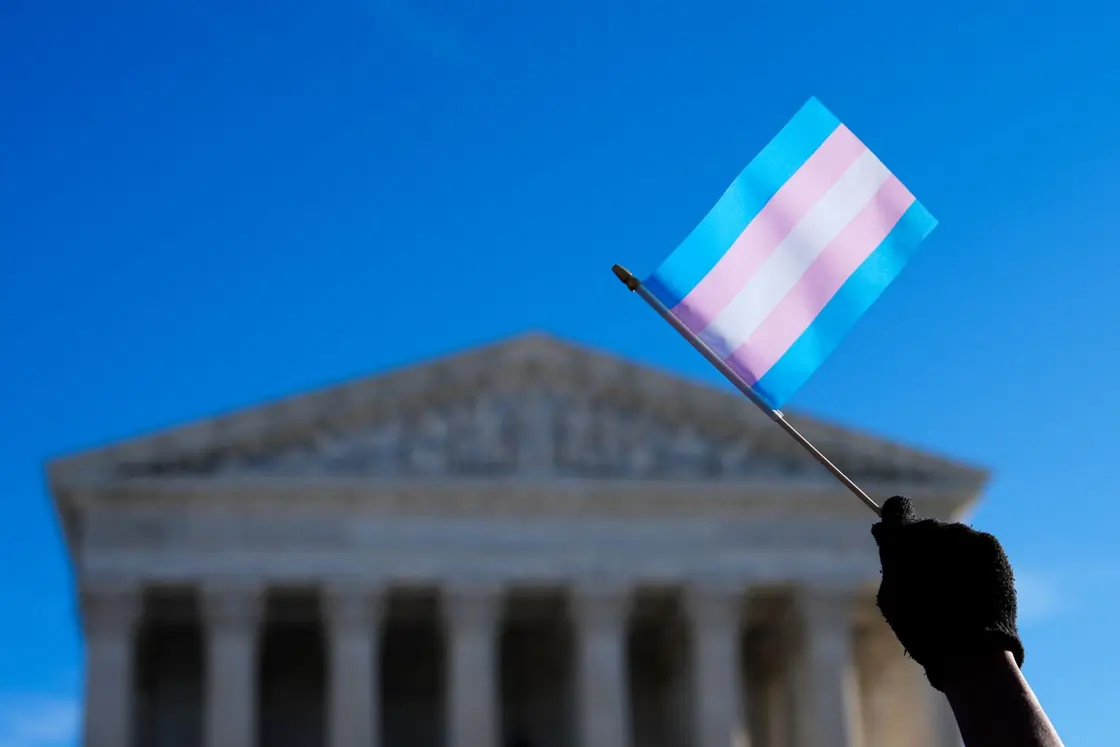
Protesters wave transgender pride flags outside the Supreme Court as it hears arguments over state laws barring transgender girls and women from playing on school athletic teams, Tuesday, Jan. 13, 2026, in Washington. (AP Photo/Julia Demaree Nikhinson)
While arguments over transgender care for minors have divided the culture for more than a decade, recent court rulings and threats of government intervention have sparked a number of changes in the scope and scale of treatments offered.
Why it matters
The reasoning behind an increasing number of hospitals, therapists, and physicians choosing to withhold surgeries and other treatments from minors suffering from gender dysphoria is tied almost entirely to the legal ramifications of continuing those. What does that mean for those of us who stand against those treatments for moral, ethical, and scientific reasons? How we choose to respond to this news could go a long way toward determining whether these changes reverse if the legal threats subside.
The backstory: Why the medical community is divided
In the News worth knowing section of last week’s Focus, I mentioned a court case in which Fox Varian was awarded $2 million in damages after she filed a malpractice lawsuit against the therapist who encouraged her to begin surgically transitioning into a man and the surgeon who performed the double mastectomy. She detransitioned three years later and, in May of 2023, she filed a medical malpractice suit against both her surgeon and her therapist.
While Varian’s decision to detransition is hardly unique among those who struggle with gender identity, she is the first to win in court against those who guided her down that path. But, with almost 30 more lawsuits waiting for their day in court, she is unlikely to be the last.
All of that helps explain why, in the days since the verdict, both the American Medical Association (AMA) and the American Society of Plastic Surgeons (ASPS) have issued new guidelines advising doctors not to perform any transition surgeries before the patient is nineteen. The ASPS was first to make the change, and stated that they found “insufficient evidence” that surgery makes a materially beneficial difference to those suffering from gender dysphoria, and the AMA echoed that conclusion.
By contrast, the American Academy of Pediatrics (AAP) and the World Professional Association for Transgender Health (WPATH) both argued that it should be up to the individual, their family, and their doctors to make the decision without much thought given to the age of the transgender individual. In their official statement, WPATH stated that the organization “stands firm in its commitment to advancing evidence-informed clinical guidelines to help improve the lives and well-being of transgender people around the world.”
But is that really what they’re doing, or does the evidence point in a direction they’d rather not acknowledge? Let’s take a closer look.
“An area of remarkably weak evidence”
While organizations like WPATH and the AAP want to argue that they are following the evidence in supporting the possibility of minors surgically transitioning, that is only true if you’re very selective with what you classify as “evidence.”
As I’ve covered in previous articles, most of the research on the efficacy of these surgical procedures has been conducted in the hopes of verifying a study from the Netherlands in the 1990s and early 2000s. That study, which was released in 2011, found that children with persistent gender dysphoria experienced fewer depressive symptoms and improved behavioral and emotional states after receiving puberty blockers.
The problem is that no study has been able to replicate those findings. In fact, the only consistent findings are that puberty blockers can negatively impact bone growth and result in fertility loss in children who take them. And those who have chosen to transition surgically have not fared any better.
As a result, the National Health Service in England stopped prescribing puberty blockers outside of clinical trials, while most other European nations—including the Netherlands, where that initial study was conducted—have denounced these treatments as “an area of remarkably weak evidence.”
The simple fact is that America has been one of the few Western countries unwilling to admit the truth about these procedures. Fortunately, that appears to be changing.
“This is not the decision we wanted to make”
Currently, more than half of the states in the US have banned or restricted gender-transition interventions in minors. And after the Supreme Court upheld Tennessee’s right to do so last year, the expectation is that more may follow.
President Trump has also taken steps to greatly limit the availability of these surgeries and medical interventions for minors. Shortly after taking office, he signed an executive order that threatened to pull Medicaid funding from hospitals that performed these treatments. That threat, coupled with court proceedings such as the Fox Varian verdict, has led hospitals to begin regulating themselves, even in states where these treatments are still permitted.
Children’s Minnesota became the latest when they announced last week that they would “temporarily pause” many of their treatments for patients with gender dysphoria under the age of eighteen. While they still plan to offer “supportive care, mental health services, and guidance regarding both medical and non-medical treatment options,” those options will no longer include “pharmaceutical or surgical interventions.”
In their announcement, the hospital was clear that these changes were not made on ethical or moral grounds:
This is not the decision we wanted to make. This is the decision we had to make to protect our hospital and our providers. We stand firmly behind the fact that gender affirming care is evidence-based, safe, and lifesaving for transgender and gender diverse youth.
Again, they’re being highly selective when it comes to the “evidence-based” part, but the larger truth is that they’re making this decision despite not changing their views on the merits of these treatments. That reasoning is profoundly important for understanding where this issue stands today, where it may go in the future, and how God might be using these court cases to accomplish what a more ethics or morality-based argument has not.
So, in light of these changes, what would a Christian response look like?
Spiritual application: Two ways Christians should respond
In thinking about a Christian response, we need to start by remembering that the individuals struggling with their identity are more than just a statistic. Whenever we’re debating these kinds of hot-button cultural topics, it can be very simple to forget that we’re talking about real people whom God loves and for whom Jesus died.
As we discussed in “What does the Bible say about transgenderism?,” that doesn’t mean affirming their misguided beliefs or ignoring the evidence that clearly seems to point against taking physical steps with life-long consequences to address what is most often a mental health issue. Loving people as God commands means wanting his best for them, even if they may not consider that stance very loving.
At the same time, Scripture is also clear that we are meant to speak the truth in love, modeling our approach after the example of Jesus (Ephesians 4:15).
When Jesus cared for those who were hurting or had become so identified with a lifestyle that was counter to God’s will for their lives that they couldn’t see another way, he started with grace and understanding. He never crossed the line of affirming their sin, but he also did not make that sin the foundation of their identity.
As we think about and discuss the issue of treatment for those struggling with their gender identity, it’s vital that we follow our Lord’s example.
You have a part to play
The second aspect of how we should respond to the shifting landscape of transgender treatment is by continuing to work for more than a legal solution.
Government orders and the decisions of the courts on limiting many of these life-altering procedures for transgender minors are welcome; however, they will only make a real difference if that space is filled by treatments that can actually help these individuals to get better. While it is overly simplistic and naïve to say they just need Jesus, there is an element of truth to the idea that finding a new identity in Christ is the best way to combat the identity struggles at the root of so much pain in those who claim to be transgender.
Parker Jones outlined several examples of individuals who found that kind of freedom in an article for Denison Forum earlier this year, and their stories should give us both hope and confidence in the power of the gospel to bring real change into the lives of those struggling with this issue.
As Christians, we have the privilege of sharing that gospel with the people who desperately need what only Jesus can truly give. But to do that well, we have to start by loving the individual rather than judging them and then continue by not ceding that responsibility to the government or any other authority that might appear to have a quicker solution.
So, will you pray for the opportunity to help someone find that kind of freedom in Christ? Even if their struggle is not with gender identity, all of us are tempted to define ourselves by something other than who God made us to be, and that means all of us know someone who needs to hear—or maybe just be reminded of—the truth of the gospel. That person may even be you and, if so, this is a great time to embrace a new or restored identity in Christ.
Let’s start now.
News worth knowing
1. Israeli Prime Minister Benjamin Netanyahu to meet with Trump this week
Israeli Prime Minister Benjamin Netanyahu was originally scheduled to meet with President Trump next week for the launch of the Board of Peace. Those plans changed, however, as uncertainty in Iran continues to weigh heavily on Israel and the rest of the region. The two leaders are expected to discuss next steps following Steve Witkoff and Jared Kushner’s meeting with Iran’s foreign minister last Friday.
Why it matters
While Netanyahu has frequently referred to Trump as the best friend Israel has had in the White House, the two have not always been on the same page when it comes to Iran. Israel and the US agree on their general goals for negotiations; however, Netanyahu has long feared that the Trump administration may be willing to settle for terms that represent more of a compromise than the absolute dismantling of those programs.
What to watch
Israel has reserved the right to act unilaterally if it is unhappy with whatever agreement Iran eventually reaches with the United States. Should that be the case, is the threat of independent action a bluff, or would Israel truly consider striking Iran even after a peace with the US is reached?
ABC News has more on the story
2. “Unredacted” Epstein files shown to Congress still hid key names
The Justice Department agreed to allow lawmakers to review the unredacted Epstein files following a request from the House Judiciary Committee. However, when representatives went to view the documents, a number of names remained redacted, and other files were missing.
Why it matters
Both Democrats and Republicans in Congress have argued that the Department of Justice has not acted in accordance with the Epstein Transparency Act by keeping back millions of documents and redacting others in ways that violated the law. While millions more documents have already been released, the DOJ’s approach has done little so far to quell accusations that the government is protecting criminals for political or personal reasons.
What to watch
Reps. Thomas Massie and Ro Khanna, who authored the initial bill and are privy to names that have not been released, have threatened to share some of those names on the House floor if they are not unredacted. Massie told reporters that one of the men named is “pretty high up” in a foreign government, while others are well-known from other circles. How much longer will Massie, Khanna, and others wait before taking a more aggressive approach?
Axios has more on the story
3. TrumpRX has now launched
Last year, President Trump and his administration negotiated several agreements with pharmaceutical companies to lower the prices of their products in the US. TrumpRX is the primary vehicle through which these savings will be offered.
Why it matters
TrumpRX listed 43 drugs at launch, with savings between 33 percent and 93 percent off the list price, depending on the product. However, roughly 85 percent of Americans have some form of pharmaceutical insurance with copays that are still lower than TrumpRX on a number of these medications. As such, the greatest benefits are largely for those who do not have insurance and for those who need medicines insurance doesn’t cover. The latter category—namely, weight loss and fertility drugs—offers the greatest benefit, and could make a marked difference for many Americans.
What to watch
How quickly will more medications be added? More importantly, will the products most needed make the list at some point? To date, Ozempic is the only top 10 best-selling prescription drug from 2024 to be offered through TrumpRX. Will the administration be able to convince these companies to offer the medicines Americans rely on the most at a similar discount?
The Tangle has more on the story
God is good
Health Secretary Robert F. Kennedy Jr. announced recently that more federal funding would be available for faith-based addiction treatment services. The department is seeking a more holistic approach to caring for those struggling with addiction, with Kennedy stating “faith-based organizations play a critical role” in combating the disease.
Kingdom impact
In addition to potentially greater resources and funding for faith-based addiction recovery programs, a number of federally funded secular homeless service providers have already reached out to Christian organizations in the hope of establishing partnerships. Such collaboration could open the door not only to help more people struggling with addiction but also to share the gospel with others dedicated to the work as well.
Prayer point
Will you join me in praying that God gives these organizations the wisdom, discernment, and resources necessary to navigate this transition well? Please also pray that God will work through these programs to bring salvation and freedom from sin as well as freedom from addiction to those who enter these recovery programs.
The New York Times has more on the story











 Search