



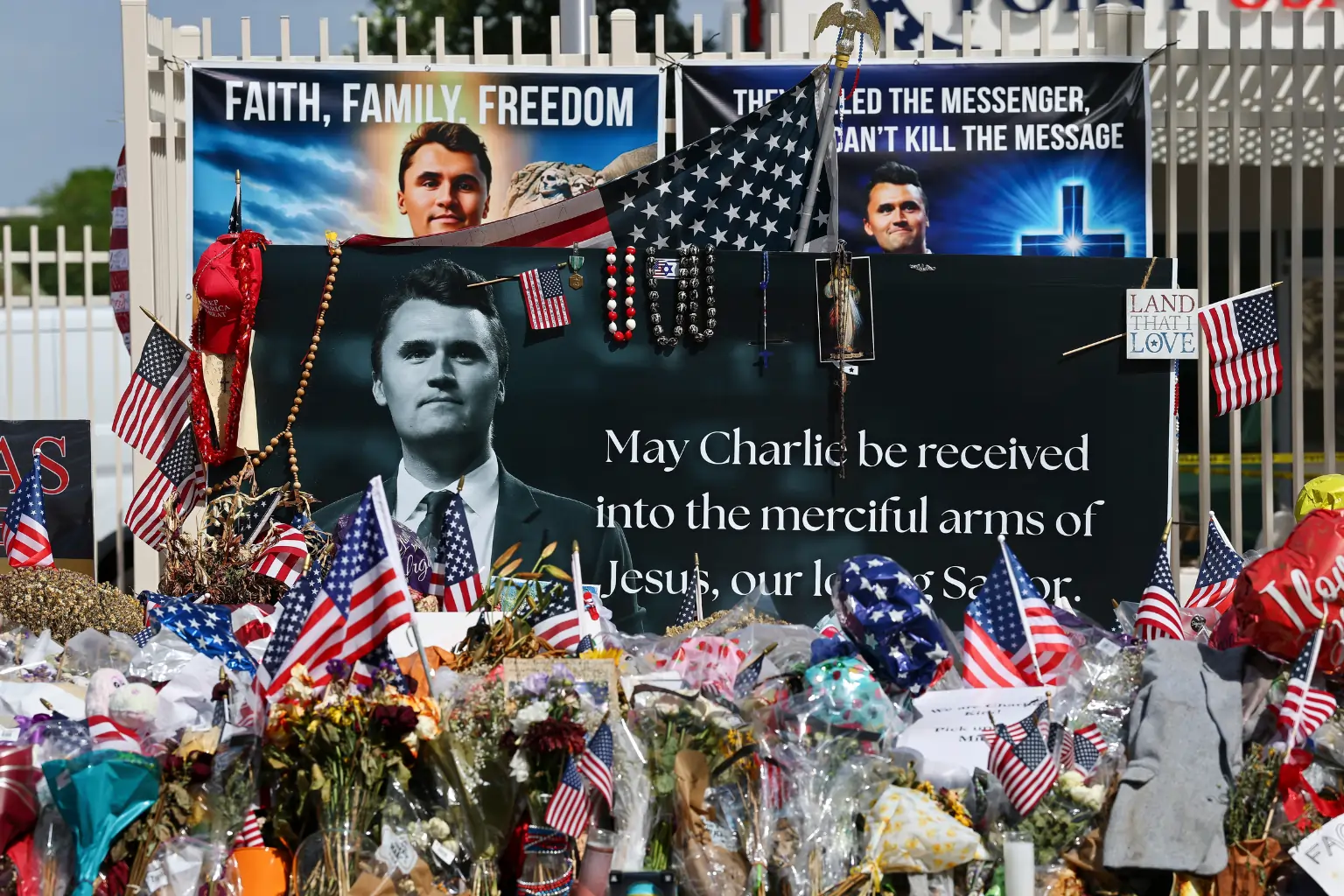
Flowers, candles, American Flags and other items fill a makeshift memorial for Charlie Kirk outside the Turning Point USA headquarters, Thursday, Sept. 25, 2025, in Phoenix. (Aaron M. Sprecher via AP)


It’s been nearly three months since Charlie Kirk was murdered at an outdoor rally in Utah. A remarkable spiritual movement was noted in the days and weeks following the tragedy.
But what about now?
According to a new Barna survey, “The data reveals his killing has sparked a wave of reflection and action, particularly among the younger generations he worked to reach and among practicing Christians.”
In total, one in four Americans said they have taken spiritual actions as a result of Charlie’s death. Among practicing Christians, the number is higher at 40 percent. And half of all Americans—including 71 percent of practicing Christians—believe his death will have a positive impact on Christianity among younger Americans, while only 19 percent disagree.
It’s hard to think of many events in recent years that have had such a positive effect on the spiritual health of our secularized culture. And yet, if you had known beforehand that a shooter was planning to assassinate Charlie Kirk, wouldn’t you have alerted authorities? Wouldn’t you want to spare Charlie’s life and his widow and children their grief?
The question may seem speculative, but the issue it raises is actually so significant that it deserves our consideration today.
A day that changed my father’s life
The US declared war on Japan on this day in 1941. My father’s life would change forever as a result. He enlisted in the US Army, fought the Japanese in the South Pacific, and experienced such horrors that he never attended church again.
More than 111,000 Americans died in the Pacific War; one of them was my wife’s uncle, who was killed by a kamikaze pilot when the war was nearly over. If the US had known about Pearl Harbor before it happened, wouldn’t we have done whatever was needed to prevent the attack and perhaps the world war that followed?
John Lennon was shot and killed on this day in 1980. If he had known of the threat to his life, wouldn’t he obviously have taken steps to prevent his death? I’m sure most people can similarly identify regrets or tragedies in their past they would have averted if they had known of them beforehand.
Here’s the problem: God did know of them before they occurred. He says of himself, “I am God, and there is none like me, declaring the end from the beginning and from ancient times things not yet done” (Isaiah 46:9–10). As the creator of time and space, he is unbound by either. He is the great “I AM,” the ever-present Lord (Exodus 3:14).
As C. S. Lewis explained, if we think of time as a line on a page, God is the page.
And yet the Bible also claims that “God is love” (1 John 4:8). How is it loving for this omniscient deity not to warn us of future suffering known to him but not to us?
This is not merely a question for a theology class—it has been an underlying issue in many of my faith struggles over the years. If God wasn’t going to prevent my father’s fatal heart attack at the age of fifty-five, why didn’t he alert us so we could take proactive steps to guard his health? I have the same questions toward our son’s and grandson’s cancers. And with the suffering other friends and family members have endured, including a tragedy a member of our ministry team is facing right now.
I’m sadly confident that you understand my question today.
My grandson and calculus
The Lord warned Joseph that King Herod would seek to destroy the baby Jesus (Matthew 2:13–15). But he did not warn James before he was beheaded by Herod’s grandson (Acts 12:1–2) or Paul before he was beaten and imprisoned in Philippi (Acts 16:16–24).
In this sense, there is the same mystery to God’s omniscience as there is to his omnipotence. He sometimes intervenes in our circumstances in miraculous ways, as when he freed Paul and Silas from their Philippian prison (vv. 25–26). But at other times he does not, as when he met John on the prison island of Patmos but did not then free him from his exile (Revelation 1:9–20).
The inability of our finite, fallen minds to understand God’s perfect nature and will should not surprise us any more than my seven-year-old grandson should be surprised that he does not understand calculus. But we can take heart in this fact: God’s ways are not only higher than ours (Isaiah 55:9)—they are better than ours.
Who would have imagined that God’s answer to the messianic yearning of his people under Roman oppression was for his Son to come into the world as a baby born in a cave in Bethlehem? Or that his answer to the subjugation of humanity under Satan’s oppression was for that Son to die on a Roman cross?
Few of Jesus’ miracles transpired in the way I would have done them if I had been Jesus. He touched leprous bodies when he could have healed them with a word. He spat on the ground and put the mud on blind eyes. He waited four days to raise Lazarus from the dead and healed the servant of the high priest who was arresting him in the Garden of Gethsemane.
But now, two thousand years on the other side of his earthly ministry, we should be nothing but grateful that he did what he did in the ways he did it. Now it befalls us to trust his will to be as perfect in the future as it has been across history.
“Born a child and yet a King”
The last stanza of one of my favorite Christmas hymns captures the mystery and majesty of the Incarnation when it prays:
Born thy people to deliver,
Born a child and yet a King,
Born to reign in us forever,
Now thy gracious kingdom bring.
By thine own eternal Spirit
Rule in all our hearts alone;
By thine all-sufficient merit,
Raise us to thy glorious throne.
Will you ask the “eternal Spirit” to “rule” in your heart today?
Quote for the day:
“When you go through a trial, the sovereignty of God is the pillow upon which you lay your head.” —Charles Spurgeon
Our latest website resources:
- What does the Bible say about Santa Claus? How to turn holidays into holy days
- When are kids old enough to have a smartphone?
- Why do we have Christmas trees? How a “pagan symbol” became an integral part of our Christmas traditions
- Ukraine, Hegseth, American work, box office booms & college-football chaos
- Managing holiday loneliness, controversial cloning, and the spiritual revival of Millennials and Gen Z











 Search