



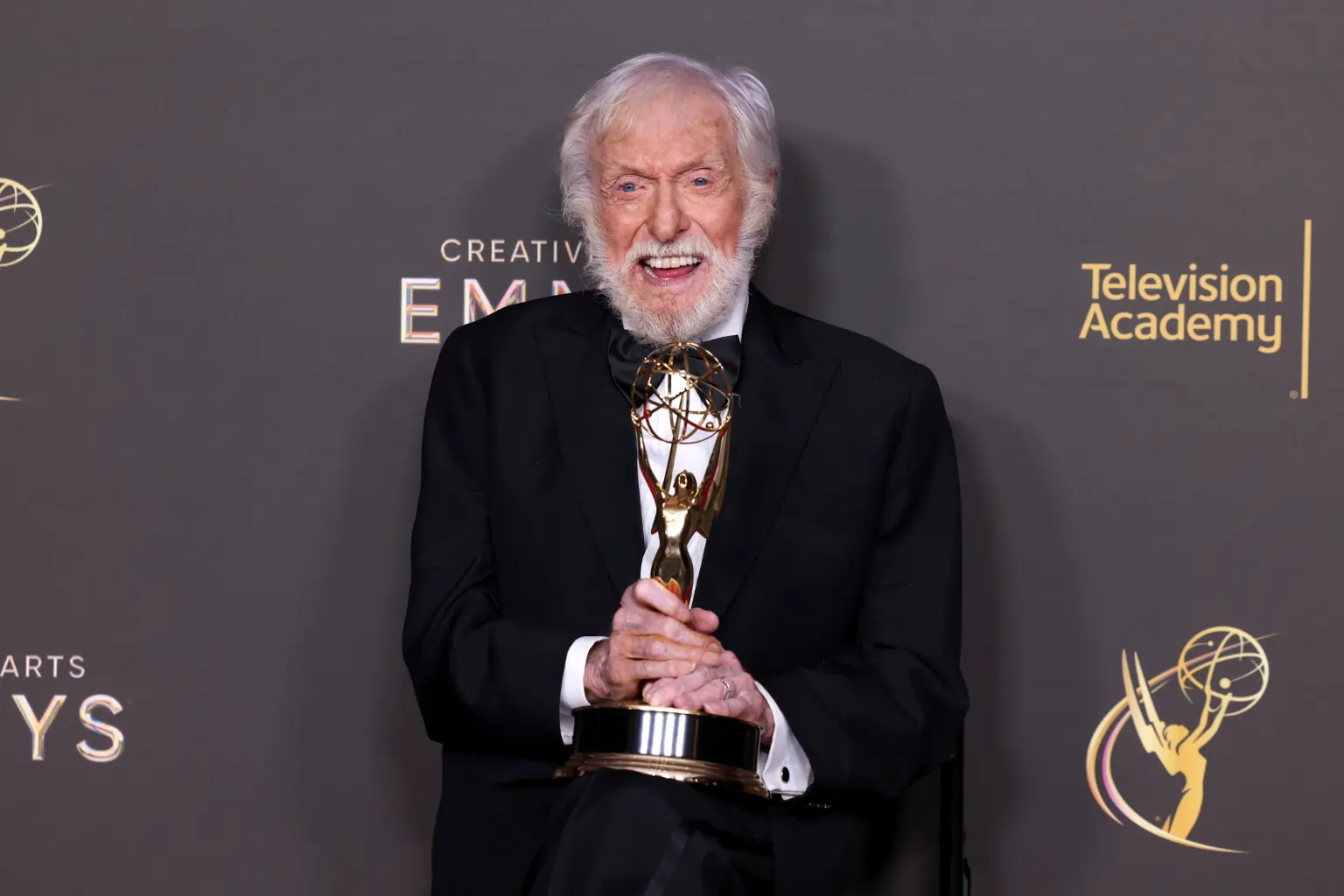
Dick Van Dyke poses with his Emmy for outstanding variety special (pre-recorded) for "Dick Van Dyke 98 Years of Magic" on Saturday, Sept. 7, 2024 in Los Angeles. (Photo by Mark Von Holden/Invision for the Television Academy/AP Content Services)


The legendary actor and comedian Dick Van Dyke turns one hundred on December 13. What explains his longevity? He recently told People magazine, “I’ve always thought that anger is one thing that eats up a person’s insides—and hate. And I never really was able to work up a feeling of hate. I think that is one of the chief things that kept me going.”
However, he knows that “the end of my life is so much closer.” What happens then? “When you expire, you expire,” he said. “I don’t have any fear of death for some reason. I can’t explain that but I don’t. I’ve had such a wonderfully full and exciting life that I can’t complain.”
He added, “What I left in the way of children’s entertainment and children’s music—that’s my legacy.” As long as children are singing the words or songs he made famous, he said, “the most important part of me will always be alive.”
“I don’t believe in Australia”
I have long been amazed by the assumption of so many people that their subjective beliefs about the afterlife will unquestionably correspond to what actually happens to them when they die. I remember a woman who confidently told me, “I don’t believe in hell,” as if hell must therefore not exist. This seems to me like saying “I don’t believe in Australia” and therefore assuming there is no such thing as Australia.
We don’t make such claims about any other reality that lies beyond our capacity.
Imagine assuming that a hotel will have a vacancy when we arrive and therefore choosing not to make a reservation. Or presuming that we will have a job for which we did not apply or a place on a team for which we did not attempt to qualify. Or believing that the road we choose will take us home upon no evidence except that we chose it.
And yet Dick Van Dyke can confidently assert, “When you expire, you expire,” and claim that “the most important part of me will always be alive” through the children’s music he made. He is convinced that his subjective opinion regarding his eternity must be true, even though he has no objective basis for it.
He is by no means alone in this.
According to a new Cultural Research Center survey, 25 percent of those who do not identify as Christians are certain they will “cease to exist in any form or place” when they die. Another 20 percent believe they will “join with the universe,” while 14 percent say they will “return to earth as another life form.”
Only 3 percent say they will “experience torment and punishment.” With regard to eternity, the others apparently believe that their unbelief is all they need to believe.
Proving I would be a good husband
At this point, we could have an apologetics discussion regarding the logical basis for the Christian faith. We could consider compelling rational arguments for God’s existence, overwhelming evidence for the veracity of Scripture, and remarkable historical confirmation for the life, death, and resurrection of Jesus.
But when you die (assuming the Lord tarries that long), these arguments will no longer be operative for you. When you cease to live, you will obviously have no capacity by which to decide or affect what happens to you next. By definition, your life after death will be entirely dependent on a Power that transcends death.
To have personal confidence that Jesus will bring us into life beyond this life (John 14:3), we can do what we do with all relational realities: we examine the evidence, then we step beyond it into an experience that becomes self-validating.
If I had been required to prove to Janet that I would be a good husband before we married, we would never have been married. Instead, she considered what she knew about me, then she took a step beyond such knowledge into a marital relationship with me. (Some would say this “step” was a very large leap, and I would not dispute them.) Over our forty-five years of marriage, I hope that her decision has (at least on my good days) been self-affirming.
We do the same with Jesus: We examine the evidence for his life, death, resurrection, and divine character. Then we step beyond it into a saving relationship with him by grace through faith (Ephesians 2:8–9). When we do, he promises that we are in his omnipotent hand forever (John 10:28), declaring that “everyone who lives and believes in me shall never die” (John 11:26).
And he offers us assurance that is based on biblical truth but becomes intuitively personal as well.
This is where Christmas comes in.
“If the presence of God is in the church”
As I noted yesterday, the fact that the omnipotent God of the universe could reduce himself to become a fetus and be born as a baby is among his most staggering miracles. Here’s my point: If he could live in his body, he can live in yours and mine by his indwelling Spirit (1 Corinthians 3:16). We can become the “body of Christ” as Jesus continues his earthly ministry in and through our lives (1 Corinthians 12:27).
And our experience of the living Lord Jesus in this life assures us that we will experience him in the next.
On the days I walk closely with Jesus, I sense his presence, peace, and joy in such transcendent and transforming ways that the question of my eternity with him never seems to come up. I am already experiencing the eternal life that becomes ours in the moment we trust him as Savior and Lord (John 3:16). And I can say with Paul, “For me to live is Christ, and to die is gain” (Philippians 1:21).
On the days I drift from intimacy with Jesus, in those hours and moments when I allow temptation, distraction, or deception to turn my heart from his, my relationship with him becomes more transactional and less transformational. I work for Jesus more than I walk with Jesus. And the joy of my eternal life begins to dim.
What Charles Finney said about the church is true of our hearts as well:
“If the presence of God is in the church, the church will draw the world in. If the presence of God is not in the church, the world will draw the church out.”
Which will be true for you today?
Quote for the day:
“The Christian life is to live all of your life in the presence of God.” —R. C. Sproul
Our latest website resources:
- Navigating faith and political discussions with Gen Z
- What does the Bible say about suicide?
- Why did Cloudflare and Amazon Web Services fail? What the outages can teach us about the spiritual realm
- Why are so many young people struggling to find hope—and how can we help?
- Epstein files, MAGA infighting, peace deals & Tom Cruise













 Search