




Young man in a wheelchair at the airport. By manaemedia/stock.adobe.com.


There are times when sinners seem to get away with their sins. For example, the Wall Street Journal tells us about the scourge of airline passengers claiming disabilities so they can board in wheelchairs and skip the lines. If no wheelchairs are available when they arrive, they are miraculously “healed” and disembark under their own power.
Skeptical observers call this the work of “Jetway Jesus.”
Then there are times when “private” sin becomes public overnight. For example, the New York Times is profiling the woman who was “shamed” at a Coldplay concert last July when she was caught on camera in the arms of her boss. When news broke that both were married to other people, the story caused an international furor. Both resigned from their positions; she has received death threats.
There are mistakes and failures in my past that I am glad were not broadcast to the world; I’m sure you can say the same. Here’s the practical question: What shortcomings in your life would you most like to improve today?
Do you struggle with what the Puritans called “besetting sins,” perennial temptations and failures? Are there things you wish you could do or stop doing if you only had the strength? Defeats you wish you could repair? Victories you wish you could claim?
The answer to all of the above is found in Christmas.
What was your favorite Christmas gift?
What was your favorite Christmas gift as a child? For me, it was the Mattel Stallion Bicycle (like this one) I received in elementary school.
Someone at my school had one and parked it where I passed by it each day. I thought it was the most amazing thing I’d ever seen. My parents, however, gave me no assurance that I would receive one. I was a “challenging” child (to put it mildly), constantly bringing home conduct slips generated by boredom at school and my belief that I should be able to amuse myself however I wished.
I did nothing to deserve that Stallion bike and had no reason to expect it, which made (and makes) the Christmas morning I found it beside our Christmas tree near-miraculous to my mind.
Of course, of all the gifts we did not deserve, the one for which Christmas exists stands above them all.
Jesus was not “born” when he was born at Christmas: before time began, he was “the Lamb who was slain from the creation of the world” (Revelation 13:8 NIV). It is therefore unsurprising that three chapters in Matthew, three in Mark, three in Luke, and six in John focus on the last twenty-four hours of his earthly life.
The reason is simple: he was born to die for us.
A second- or third-century work called The Letter to Diognetus notes that in response to our sins,
[Our Father] gave his own Son as the price of our redemption, the holy one to redeem the wicked, the sinless one to redeem sinners, the just one to redeem the unjust, the incorruptible one to redeem the corruptible, the immortal one to redeem mortals. For what else could have covered our sins but his sinlessness?
Across this Christmas week, I invite you to remember each day the greatest gift you have ever received.
The truest measure of our sincerity
How should we respond?
We often hear the question, What can you give the person who has everything? In Jesus’ case, it is literally true (Colossians 1:15–17). Ministers typically respond by encouraging us to give Jesus ourselves. This is good theology: our omnipotent Lord has chosen to honor the free will with which he made us in his image, so he stands at the door of our heart and knocks to gain admittance through our free choice (cf. Revelation 3:20).
The harder it is to open this door of obedience to him, the deeper the love we demonstrate when we do.
When God’s will obviously benefits us, we can respond as an employee who chooses to do what their employer asks in the transactional expectation of reward as a result. The price that obedience costs us is the degree to which we demonstrate the sincerity of our love for him.
I don’t know about you, but this is not entirely good news for me.
I’m as obedient as I want to be
I once heard the president of a once-Christian university say, “At our school, you can be as religious as you choose to be.” I’ll confess that the same often applies to me: I am as obedient to Jesus as I want to be. If my next step into serving him were easy or obviously beneficial to me, I would have already taken it. What remains in my journey to surrender and sanctification seems to cost more than it pays.
Perhaps you know what I mean. Perhaps you are also being called to do something you’re not doing or stop doing something you are doing. In fact, I would imagine that every Christian on the path to holiness faces such a step today.
As Oswald Chambers noted in today’s My Utmost for His Highest reading, “Every man is made to reach out beyond his grasp.”
Here’s the good news: the Christ who lives within us will empower us to fulfill the purpose of Christ for us.
In recent days, we have focused on the incarnational miracle that “Christ in you” is our “hope of glory” (Colossians 1:27). The One who came to live in our world at Christmas now lives in believers by his Spirit (1 Corinthians 3:16). Paul’s testimony is therefore true of every Christian: “It is no longer I who live, but Christ who lives in me” (Galatians 2:20).
Now the living Lord Jesus stands ready to help us step into the holistic obedience that is our best response to his holistic sacrifice for us.
If we ask, we will receive (Matthew 7:7).
“Majesty in the midst of mundane”
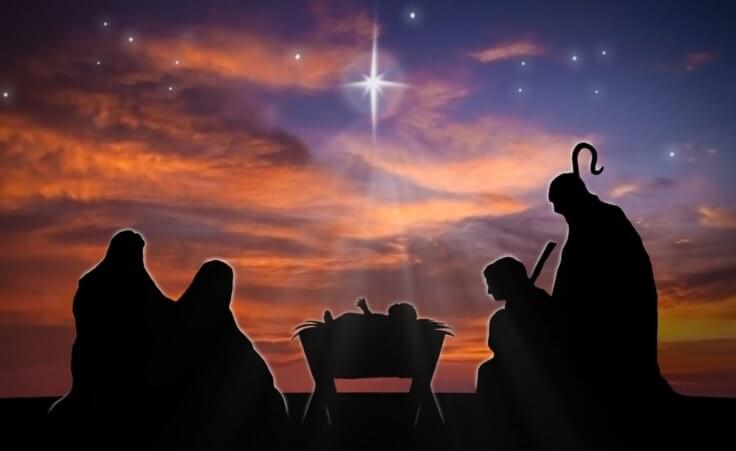
If you doubt that Jesus can work such a transforming miracle in your life today, think back to the transforming miracle by which he was born into our fallen world. Max Lucado describes the first Christmas:
Majesty in the midst of mundane. Holiness in the filth of sheep manure and sweat. Divinity entering the world on the floor of a stable, through the womb of a teenager and in the presence of a carpenter. God came near. And as Luke 1:33 says, “His kingdom will never end.”
In what new way will you make him your king today?
Quote for the day:
“People don’t resist change—they resist being changed.” —Peter Senge
Our latest website resources:
- What does Christmas say about God?
- Australia attack, Rob Reiner, Christmas movies, Candace Owens & football updates
- Do miracles still happen? A podcast interview with Lee Strobel
- A review of Lee Strobel’s “The Case for Miracles”
- What does Christmas have to do with bioethics?













 Search