


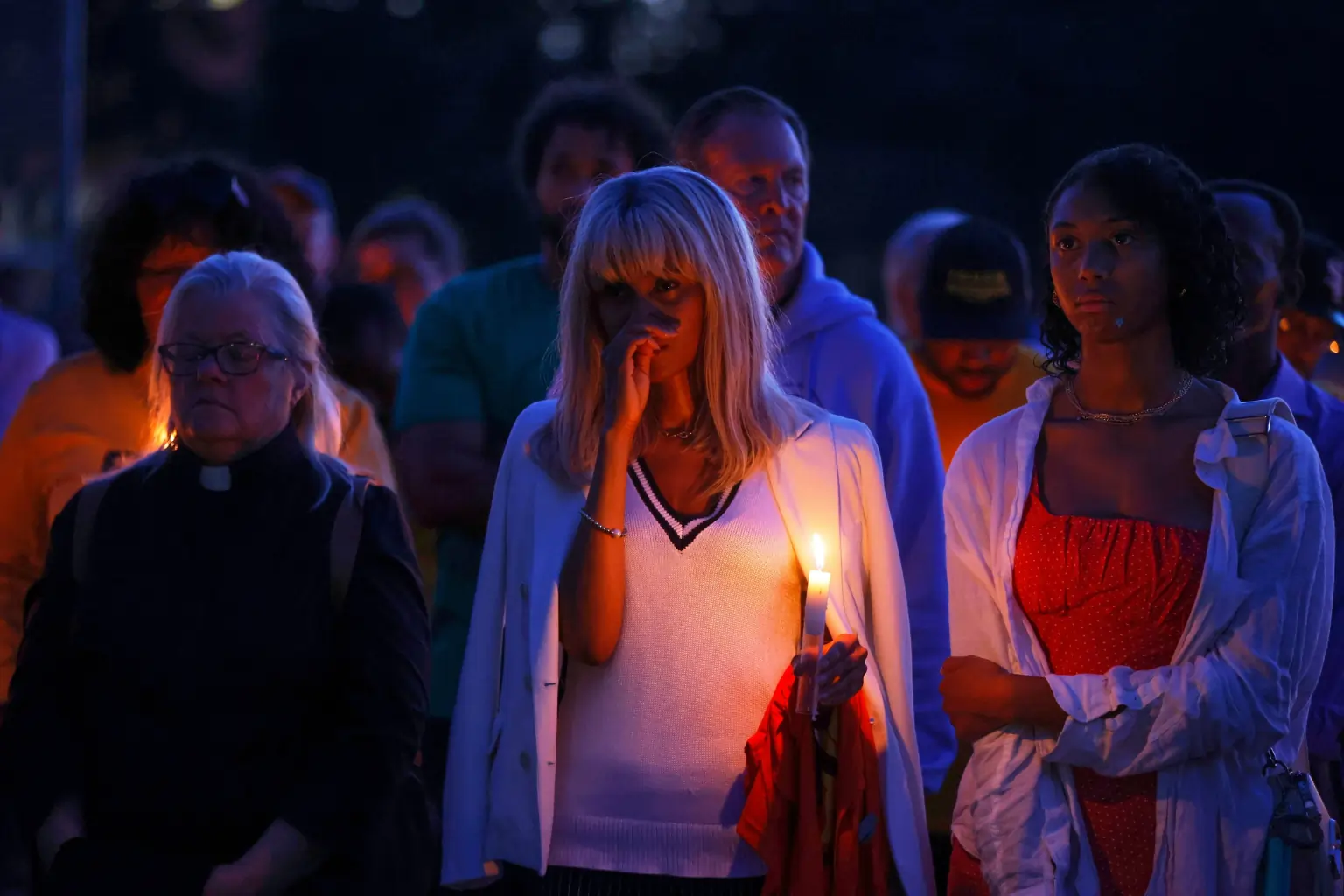
People gather at a vigil at Lynnhurst Park after a shooting at the Annunciation Catholic School Wednesday, Aug. 27, 2025, in Minneapolis. (AP Photo/Bruce Kluckhohn)


A gunman opened fire with a rifle through the windows of a Catholic school in Minneapolis yesterday, striking a group of children celebrating Mass during the first week of school. Two children, ages eight and ten, were killed. Fourteen children, ages six to fifteen, and three parishioners in their eighties were wounded by gunfire. Minneapolis Police Chief Brian O’Hara said, “The sheer cruelty and cowardice of firing into a church full of children is absolutely incomprehensible.”
Officials added that the shooter, identified as twenty-three-year-old Robin Westman, died from a self-inflicted gunshot wound. According to court records, Westman’s name was changed from Robert in 2020 on the grounds that Westman identified as female. FBI director Kash Patel said, “The FBI is investigating this shooting as an act of domestic terrorism and hate crime targeting Catholics.”
As a “mark of respect for the victims,” President Trump ordered American flags to be flown at half-staff until sunset, August 31. Pope Leo expressed his “heartfelt condolences” and stated that he “prays for the wounded as well as the first responders, medical personnel, and clergy who are caring for them and their loved ones.” We should all join him in such intercession today.
However, this horrific tragedy can cause us to overlook another shooting that occurred the day before, when a gunman sprayed dozens of rounds at a group standing on a sidewalk across from a Minneapolis high school, killing one and injuring six. It is a sign of our times that this attack is scarcely in the news because of the attack that followed it the next day.
When such atrocities involve children, my first thought is of our four school-age grandchildren. My second thought is to ask, What can I say in response to this tragedy that I have not said in response to similar tragedies that have plagued our nation in recent years?
As I prayed about the answer, I was led to an insight I had not considered before, one that I hope will be as helpful to you as it was to me.
Judging disappointment by success
As you know, the problem of innocent suffering is especially a challenge for Christians because we believe that our God is all-knowing, all-powerful, and all-loving. As a result, he knew about these shootings before they occurred, had the power to stop them, and loves the victims enough to want to do so. But he did not.
Here’s the paradoxical thought I’d like us to consider: When God does not do what we want him to do, our frustration is exacerbated by all the times he does.
If the Lord never intervened to prevent disease, disaster, and tragedy, we would have no right to expect him to do so this time. If he never answered our prayers for supernatural help, we would be foolish to continue making such requests. But he does sometimes perform miracles, sometimes in answer to our pleas. We do sometimes feel his undeniable presence in our pain, his strength in our suffering, his hope in our despair.
So, when we do not, we judge our disappointments by our successes. In other words, we measure his character through the prism of our experience.
Our evangelical faith can actually exacerbate this tendency. We emphasize the experience of salvation, insisting with Jesus that we “must be born again” (John 3:7). However, making experience the starting place for our faith can lead to making experience the criterion of our faith.
Then, when our personal experience seems to contradict biblical teaching, we can judge the latter by the former.
When surgery causes more pain
The solution is for us to measure our circumstances through the lens of God’s character as revealed by his word—not the reverse. Since we cannot know what our omniscient Father knows, using our fallen minds to measure his divine nature by our finite experience is clearly illogical.
When a mechanic takes apart my truck’s engine before repairing it, he seems to me to be making the problem worse rather than better. But that’s my fault, not his. When surgery causes me more initial pain than the problem the surgery was intended to remedy and I blame the surgeon, that’s my fault, not hers.
This week’s shootings in Minnesota, viewed through the prism of Scripture, reveal the fallenness and sinfulness of humans, not the weakness or unkindness of God. Even though our limited minds cannot understand how to reconcile the biblical fact that “God is love” (1 John 4:8) with the tragedies we see, our finitude does not change his character.
Here’s the practical point: When we choose to believe that God is still as powerful and loving as we believed him to be before tragedy struck, we are empowered to trust him for the power and love we need in the midst of our pain.
If we do not, we forfeit our Father’s strength and hope. Then, judging him by our experience of him, we exacerbate a vicious cycle of disappointment that leads to unbelief that leads to more disappointment that leads to further unbelief.
“Though he slay me”
I am not attempting to persuade you that faith in God is easy for suffering people to choose, just that it is essential. But I can assure you that even the desire to have such faith positions us to receive God’s help in trusting him. A father’s prayer in the face of his child’s suffering is recorded in Scripture so it can be ours: “I believe; help my unbelief!” (Mark 9:24).
When we say with Job, “Though he slay me, I will hope in him” (Job 13:15), our hope becomes the bridge his grace travels to our hearts.
Why do you need this bridge today?
Quote for the day:
“Hope can see heaven through the thickest clouds.” —Thomas Brooks (1608–80)
Our latest website resources:
- Cracker Barrel, US division, Taylor Swift–Travis Kelce engagement & college football returns!
- FOX broadcaster John Roberts has malaria: The transforming power of perseverance
- What role does faith play in building better communities? An interview with John Kasich
- Can a woman be a pastor? “40 Questions About Women in Ministry” offers many answers
- What does the Global Flourishing Study reveal about faith and well-being?












 Search