


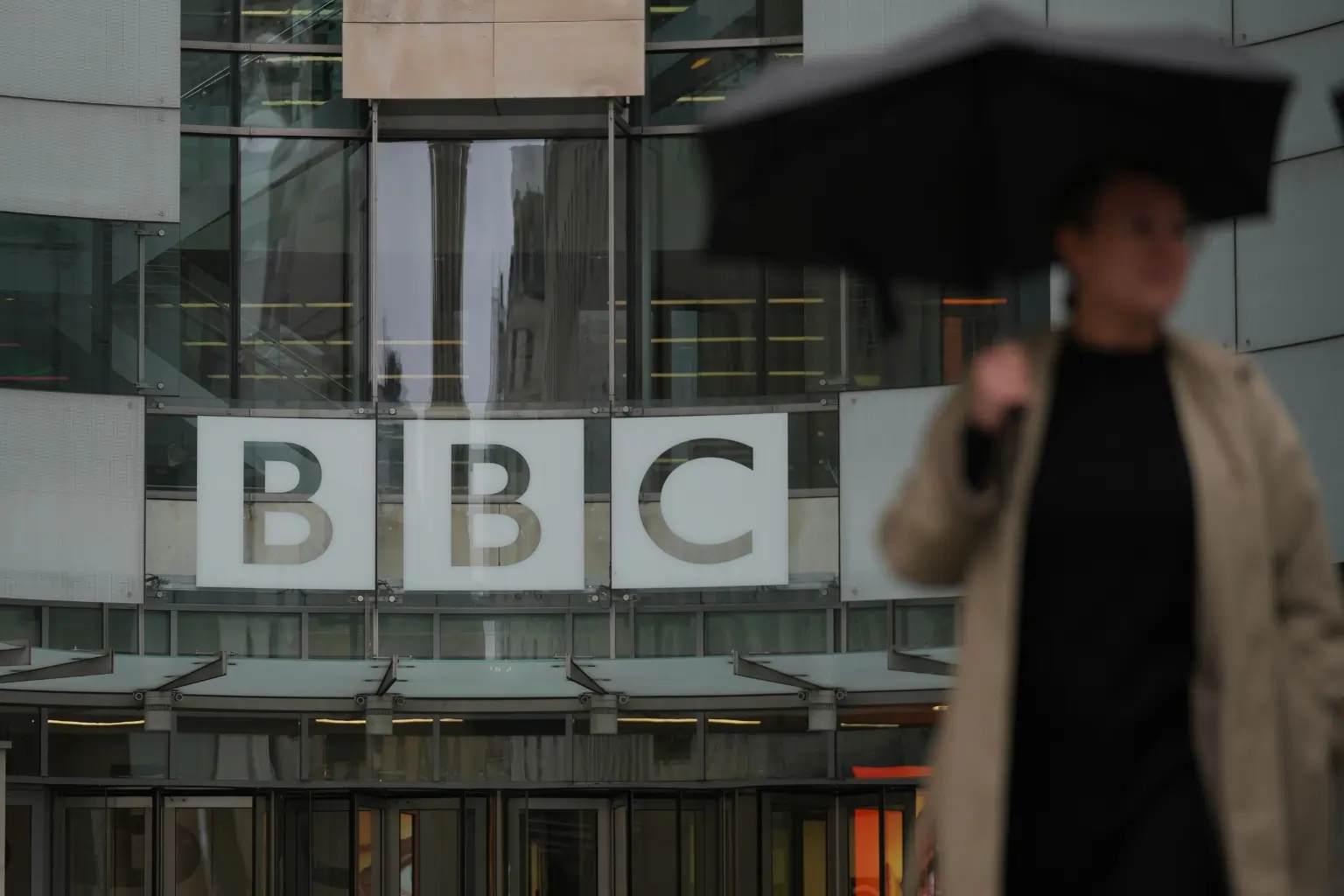
A man walks outside the BBC Headquarters in London, Monday, Nov. 10, 2025. (AP Photo/Kin Cheung)


Legislation that would reopen the US government advanced through the House Rules Committee early this morning; the full House of Representatives is expected to vote on the bill this evening. The eight Democratic senators who made this possible are being vilified or thanked, depending on the news outlet you happen to read.
In fact, the news is much in the news these days. Perhaps you have followed the controversy embroiling the British Broadcasting Corporation (BBC) after the Telegraph, a British media outlet, published an exclusive report showing that the BBC doctored a Donald Trump speech to make him appear to encourage the Capitol Hill riot on January 6. The version the BBC aired quoted Mr. Trump:
We’re gonna walk down to the Capitol and I’ll be with you and we fight. We fight like hell and if you don’t fight like hell, you’re not gonna have a country anymore.
However, the first sentence was spoken fifteen minutes into the speech, while the second sentence came fifty-four minutes later. In addition, the BBC edited out what Mr. Trump said following the first sentence: “I know that everyone here will soon be marching over to the Capitol building to peacefully and patriotically make your voices heard.”
The BBC has since apologized; two of its top executives have resigned; Mr. Trump has threatened legal action; there have been calls to defund the BBC; and the network’s future direction and government support could be in doubt.
In a day when the public’s trust in mass media is at an all-time low, this story is not likely to encourage our faith but to reinforce our skepticism.
However, our doubts about the media are themselves reflective of even more foundational doubts that affect all of us, all of the time.
Welcome to the “Polycene” era
According to The New York Times columnist Thomas Friedman, we are now in the “Polycene” era. His in-depth article is a fascinating recap of recent years in technology and culture.
- With regard to computer and AI, the “silicon foundation” for the Polycene is “multiple intelligences, seamlessly networked, co-improving and co-evolving in real time.”
- With regard to natural disasters and geopolitics, we’re in an era of “poly-crisis.”
- With regard to global migration, immigration, and sexual and gender distinctions, we’re in an era of “polymorphic communities.”
- With regard to global trade and interconnected commerce, we’re in an era of “poly-economic networks.”
In a Polycene world, Mr. Friedman concludes, “most of the problems we face do not have ‘either/or’ answers: they have ‘both/and’ answers.” As a result, “Key actors must be able to occupy multiple states, and hold competing ideas in tension, at the same time.”
In a sense, Christians have been living in a Polycene worldview for twenty centuries. We believe that God is three persons in one essence; the incarnate Christ was fully God and fully man; God is sovereign while humans are free; the Bible is divinely inspired and humanly written. My first theology professor in seminary assured our class that if we cannot live with theological tension, we cannot do good theology.
But unlike our postmodern, relativistic culture, we “hold competing ideas in tension” on a foundation of authoritative biblical truth:
- We believe God is both three and one because the Bible declares him to be so (cf. Matthew 28:19; John 14:26).
- We believe Jesus came as fully God and fully man because the Bible demonstrates both to be true (Colossians 2:9; Hebrews 4:15).
- We believe the Bible is divinely inspired and humanly written because it tells us so (2 Timothy 3:16; 2 Peter 1:21).
- We believe God is sovereign while we are free because Scripture teaches both (Psalm 115:3; Acts 3:19).
And we are commissioned to declare the unchanging truth of Scripture to our fallen culture (2 Timothy 4:2), to “contend for the faith that was once for all delivered to the saints” (Jude 3).
“Those who call evil good and good evil”
This week, we have discussed the necessity of faith in Christ and the importance of encouraging others to embrace such faith. Both stand on the foundation of biblical revelation, the absolute truth declared by God in his word.
Such truth is no more popular today than it has ever been.
Seven centuries before Christ, the prophet declared, “Woe to those who call evil good and good evil, who put darkness for light and light for darkness, who put bitter for sweet and sweet for bitter! Woe to those who are wise in their own eyes, and shrewd in their own sight!” (Isaiah 5:20–21).
Long before postmodern philosophers convinced our culture that “truth” is the result of our subjective interpretation of our subjective experiences, Jesus explained the root of the problem: “This is the judgment: the light has come into the world, and the people loved darkness rather than the light because their works were evil” (John 3:19).
I am no different.
I want to focus on the parts of the Bible that reinforce what I want to do while ignoring the parts that do not. I can easily declare biblical truth concerning same-sex attraction, for example, because I do not struggle with this temptation. But there are other temptations with which I do struggle, sins about which the Bible is just as clear but subjects which I am prone to look past.
Here’s the good news: when I submit these temptations to the truth of Scripture and ask the Spirit to empower my obedience, I experience a victory that verifies the veracity of God’s word and empowers me to share its transforming truth with my fellow strugglers on the road.
“During times of universal deceit”
The more our “post-truth” culture rejects biblical truth, the more it needs it.
Paul warned that for some, “Their end is destruction, their god is their belly, and they glory in their shame” because they have “minds set on earthly things” (Philippians 3:19, my emphasis). For believers, by contrast, “our citizenship is in heaven, and from it we await a Savior, the Lord Jesus Christ, who will transform our lowly body to be like his glorious body, by the power that enables him even to subject all things to himself” (vv. 20–21).
Now we are commissioned to “proclaim the excellencies of him who called you out of darkness into his marvelous light” (1 Peter 2:9) so that all may experience the transforming grace of Christ. The English novelist George Orwell warned:
“During times of universal deceit, telling the truth becomes a revolutionary act.”
Let’s be revolutionaries together today, to the glory of God.
Quote for the day:
“If the world is against the truth, then I am against the world.” —Athanasius (d. AD 373)
Our latest website resources:
- A Veterans Day reflection on a debt we can never repay
- If spreading the gospel was as easy as ‘67’
- Tariffs on trial, Nigerian Christian persecution, Dick Cheney, Mamdani and Dems win big & NFL trades
- How can Christians respond to persecution and defend religious freedom?
- Trade deals, East Wing destroyed, NBA gambling scandal, election day preview & scented stamps











 Search