




Courtesy: Lobster Nativity Scene, www.lobsternativityscene.com.


As soon as Thanksgiving is over, Christmas decorating begins at my house. My wife is the expert; I am the hired help. You can know this by examining our nativity scenes.
One is simpler, featuring the baby Jesus surrounded by adoring parents and a worshiping angel. The other is more complex, with animals, shepherds, and three Magi. I have pointed out over the years that the Wise Men were not present at the first Christmas, but since my theological observations have fallen annually on deaf ears, I have learned to keep my objections to myself.
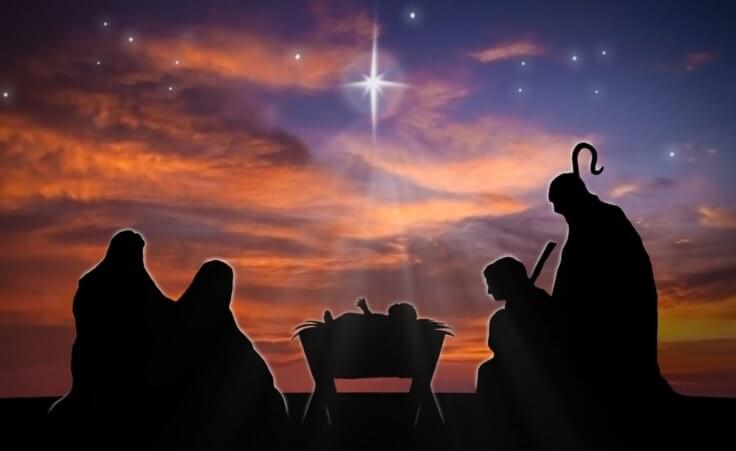
However, here’s a nativity set I must protest: a Cape Cod artist has created what Axios calls “New England’s newest unlikely holiday sensation: the Lobster nativity scene.” Jesus is depicted as a baby lobster in a bed of seaweed inside a crab shell cradle. The stable is a lobster trap. The other figures are various versions of lobsters as well.
When I read the story, I was viscerally bothered by the crass commercialization of Christmas. Is there nothing someone won’t do to sell something in the season we celebrate our Savior’s birth?
But then I remembered C. S. Lewis’s poignant description of the Christmas miracle:
The Second Person in God, the Son, became human himself: was born into the world as an actual man—a real man of a particular height, with hair of a particular color, speaking a particular language, weighing so many stone. The Eternal Being, who knows everything and who created the whole universe, became not only a man but (before that) a baby, and before that a fetus inside a woman’s body.
If you want to get the hang of it, think how you would like to become a slug or a crab.
Or a lobster.
“We hold these truths to be sacred”
Over the weekend, I read famed historian Walter Isaacson’s new book, The Greatest Sentence Ever Written. It is a word-by-word analysis of the Declaration of Independence’s central assertion:
We hold these truths to be self-evident, that all men are created equal, that they are endowed by their Creator with certain unalienable Rights, that among these are Life, Liberty, and the pursuit of Happiness.
The book tells the fascinating story of the Declaration’s evolution from Thomas Jefferson’s initial draft to the document’s final version. For example, we learn that Mr. Jefferson, despite his deistic misgivings regarding the supernatural, originally wrote, “We hold these truths to be sacred . . .” However, Isaacson reports that Benjamin Franklin crossed out “sacred” and wrote “self-evident” in its place.
This is unsurprising, given Franklin’s worldview.
As Isaacson notes, the famous Founder spent more than a month in late 1771 with the famous Scottish philosopher David Hume. Here, he learned Hume’s maxim that self-evident truths are “discoverable by the mere operation of thought” rather than upon empirical observation. As a result of Franklin’s edit, our threefold right to “life, liberty, and the pursuit of happiness” is a “truth” in the sense that we assent logically and rationally to it.
The famed triad’s nature is defined in the same manner: the Founders created a secular republic and therefore offered no biblical or spiritual definitions for life or liberty. In his comment on the third phrase, Isaacson writes that the pursuit of happiness is also “your right—and your opportunity—to seek fulfillment, meaning, and well-being however you personally see fit.”
Christmas is proof that Jesus disagrees.
The only baby who chose to be born
The observable universe is currently estimated to be about ninety-two billion light-years across. Traveling at 186,232 miles per second, it would take you that long to travel from one edge to the other. If your mind can grasp such expansive immensity, it is more capable than mine.
And yet the Creator measures all of that “between his thumb and little finger” (Isaiah 40:12, MSG). Furthermore, it was by Jesus that “all things were created, in heaven and on earth, visible and invisible” (Colossians 1:16). It is also in him that “all things hold together” (v. 17).
When Jesus unveiled even a glimpse of his heavenly divinity to his best friend John on Patmos, the apostle “fell at his feet as though dead” (Revelation 1:17). Christ is so majestic that when he returns, “on his robe and on his thigh he has a name written, King of kings and Lord of lords” (Revelation 19:16).
And yet he voluntarily “emptied himself” of his indescribable immensity (Philippians 2:7) to become a fertilized egg the size of a pinhead in the womb of a peasant teenage girl. He grew as a fetus and was born as a helpless baby who was then laid in a stone feed trough and worshiped by dirty field hands. He was the only baby in human history to choose to be born and to choose the manner of his birth—and this is what he chose.
Three decades later, he made another fateful choice, again humbling himself “by becoming obedient to the point of death, even death on a cross” (v. 8). He could have been executed by stoning at the hands of a Jewish mob (John 8:59), but he chose to die for our sins by Roman crucifixion, the most painful, tortured manner of execution ever devised.
If your friend became a lobster
In short, our Savior chose to sacrifice his “life, liberty, and the pursuit of happiness” for us. Nothing about his decision was “self-evident” in Hume’s sense of rational operation. Finite human minds cannot comprehend such divine reasoning (cf. Isaiah 55:8–9).
But let’s try.
Imagine that it would somehow benefit you for a friend to come back to life as a lobster, a slug, or a crab. This is a fair analogy for the incarnation of Jesus, since the biological distance between humans and such creatures is infinitesimal compared with the infinite distance between God and us.
Here’s my question: If your friend were to make this decision, then die in your place so you could live eternally, would you ever again doubt their love for you?
Quote for the day:
“Because of his boundless love, Jesus became what we are that he might make us to be what he is.” —St. Irenaeus
Our latest website resources:
- Navigating faith and political discussions with Gen Z
- What does the Bible say about suicide?
- Why did Cloudflare and Amazon Web Services fail? What the outages can teach us about the spiritual realm
- Why are so many young people struggling to find hope—and how can we help?
- Epstein files, MAGA infighting, peace deals & Tom Cruise













 Search