



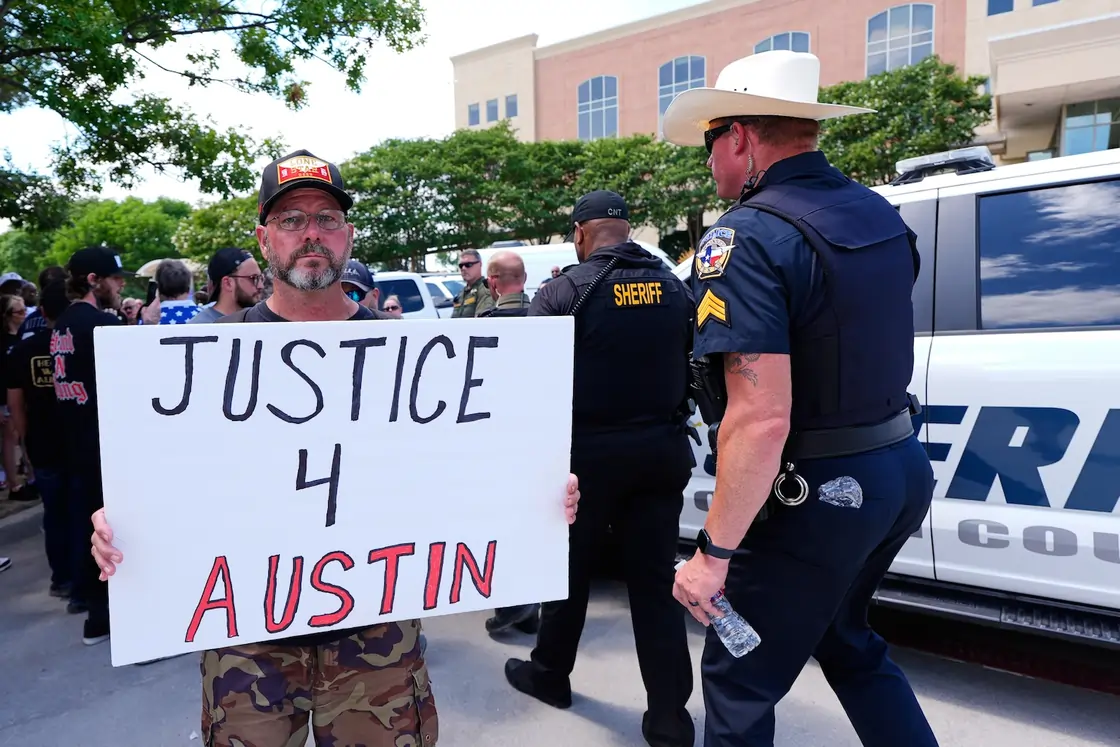
AP Photo/Tony Gutierrez
Two racially-charged stabbings from last year have made headlines in recent weeks as the assailants were convicted of murder. While neither stabbing appears to have been racially motivated, the public conversation around both murders has focused extensively on race, sparking vitriolic tirades online and violence on the ground.
The first stabbing, the murder of 17-year-old Austin Metcalf at a Frisco, Texas, high school track meet, took place last April. Karmelo Anthony, also 17 at the time and a student at a different Frisco high school, was convicted of stabbing Metcalf during an altercation after Metcalf asked him to leave his team’s tent. Witnesses testified that Anthony reached into his bag and said, “Touch me and see what happens,” before Metcalf attempted to physically remove him.
Despite efforts by coaches and athletic trainers to perform CPR, Metcalf died in his twin brother’s arms. Anthony admitted to the stabbing and claimed self-defense. On June 10, he was sentenced to 35 years in prison with the possibility of parole after 17 years.
Immediately following the stabbing, people took note of the races of the victim and attacker—Metcalf was white, while Anthony is Black. While Metcalf’s family, prosecutors, and Anthony’s defense attorneys insisted that the stabbing had nothing to do with race, racist comments directed at both Anthony and Metcalf proliferated on social media. Both families have been targets of death threats, doxxing, and “swatting,” a form of harassment involving a phony 911 call.
“Two-tier policing”
The second stabbing took place in Southampton, England, in December, when Vickrum Digwa, 23, attacked 18-year-old university student Henry Nowak.
Digwa, who is a Sikh of Indian descent, stabbed Nowak, who was white, with an 8-inch ceremonial blade called a kirpan. The kirpans carried by most Sikhs are smaller, with the larger knife traditionally carried by Nihang Sikhs. Both of Digwa’s kirpans were carried under a religious exemption to Britain’s strict knife laws.
Digwa was convicted of murder on May 28 and sentenced to life in prison with a minimum sentence of 21 years.
The case first generated headlines because British police responding to the scene had at first arrested the dying Nowak. Digwa falsely claimed Nowak had punched him, pulled off his turban, and called him a racial slur. Disturbing video of Nowak’s arrest shows police reading him his rights as he loses consciousness.
Although police realized their mistake and arrested Digwa, and evidence at trial showed that Nowak would not have survived even if they had helped him immediately, the police’s readiness to believe Digwa touched off a firestorm.
Some public figures asserted that the stabbing was an instance of “two-tier policing,” the belief that British police treat minority citizens better than white citizens. Reform UK leader Nigel Farage called on the public to react to the treatment of Nowak with “pure cold rage.” Nowak’s father Mark, lamented the racialization of his son’s murder, while the Digwa family apologized to the Nowaks and to the Sikh community for the way that their son’s actions sparked so much violence.
The anger and heartache in both communities has only deepened since the trials concluded. The harassment of the Metcalf and Anthony families has continued, and Anthony’s family believes that racial prejudice played a role in his conviction. Many who share their view have expressed ugly sentiments toward the Metcalfs, including a Texas parole officer who was fired for making an expletive-laced post declaring, “let them [white families] bury more of [their sons] for a change.”
In the days following Digwa’s sentencing, a riot in Southampton injured eleven police officers who were trying to stop the mob from reaching the Digwa family home. Digwa’s grandmother reported that the family fled their home after the riot.
Three principles for Christians to remember
What do we, as believers, make of all this? Two young men are dead. Two more face decades in prison as a consequence of their actions. Four families have been torn apart, and many in their communities are responding with anger, racial prejudice, and violence.
As we prayerfully consider our response to events like these, both globally and in our own communities, there are three scriptural principles we ought to consider.
First, Christians are called to “mourn with those who mourn” (Romans 12:15).
One of our strongest witnesses to a hurting world is responding with compassion for those who suffer. As we pray for God’s healing hand to comfort these hurting families, we should ask the Holy Spirit to show us ways we can be a tangible blessing to them, or to families grieving the loss of loved ones in our own community.
John wrote that we should “love not in word or talk but in deed and in truth,” letting our actions communicate our compassion for those who suffer (1 John 3:18).
Secondly, we must remember that “the anger of man does not produce the righteousness of God” (James 1:20).
James warns us to be “slow to anger” for this very reason (James 1:19). Although it is natural for us to be righteously indignant about injustice, and God himself hates “robbery and wrong” (Isaiah 61:8), no Christian should ever respond with the “pure cold rage” of the world.
If we are angry about something the Lord hates, we are commanded to do so without sinning, giving “no opportunity to the devil” through unrighteous rage (Ephesians 4:26-27). When we face injustice, we must bring our anger as well as our grief before the Lord, allowing him to have the final word. God is both just and merciful, and will restore all things in time.
Lastly, we should ask the Holy Spirit to show us how we can use our words to heal rather than hurt.
James compares our tongues to fire, able to “set ablaze” one’s whole life by the words we speak (James 3:5-6). An unbridled tongue is “set on fire by hell” (James 3:6), capable of causing immense destruction, as the events surrounding these cases painfully illustrate. However, Proverbs reminds us that “death and life are in the power of the tongue” (18:21), and that “a word fitly spoken” is of incomparable value, “like apples of gold in settings of silver” (25:11).
Rather than responding with the same kind of vitriol as the world, we must use our tongues to bring life, healing, and the hope of the Gospel to our hurting neighbors, becoming, in the words of the Prayer of St. Francis, “instruments of peace” rather than agents of destruction.
How can you be an instrument of God’s peace today?













 Search