


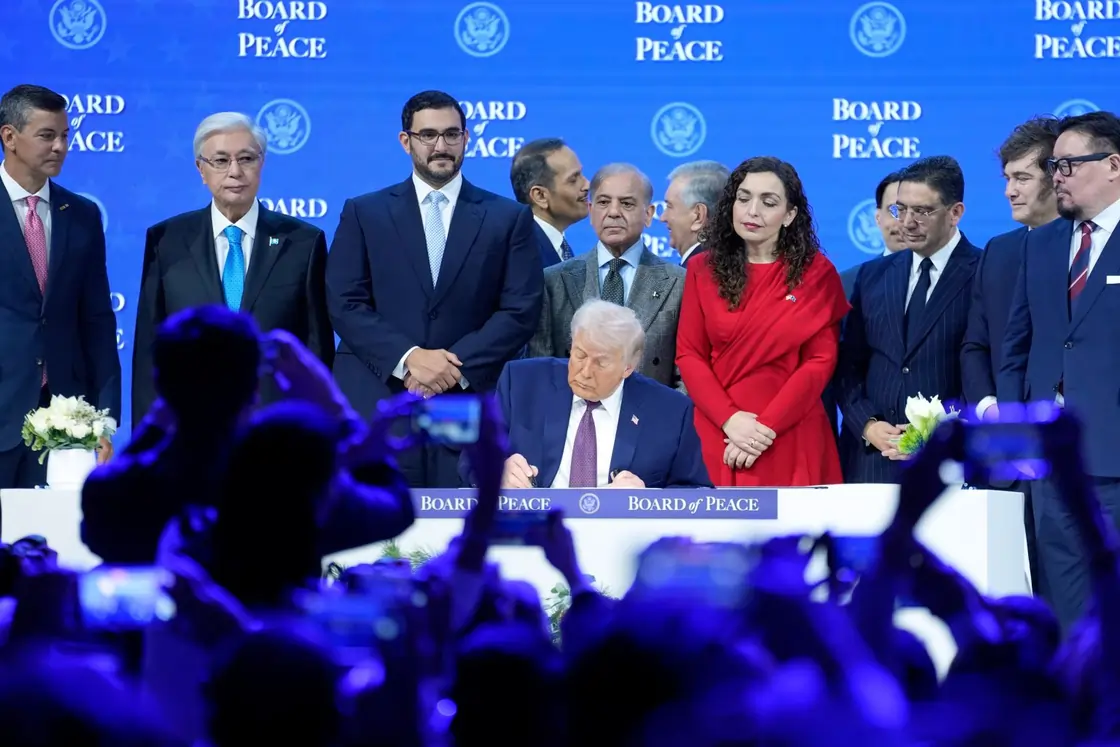
US President Donald Trump signs the charter of his Board of Peace initiative at the Annual Meeting of the World Economic Forum in Davos, Switzerland, Thursday, Jan. 22, 2026. (AP Photo/Markus Schreiber)
Leaders from seventeen countries were called to the stage in Davos, Switzerland, on Thursday during the Gaza Board of Peace signing. They included prime ministers, presidents, and other senior government officials from Southeast Asia, the Middle East, Europe, and Latin America.
The purpose of the board is to oversee the next phase of President Trump’s peace plan for the Gaza Strip, but its broader mandate “seeks to promote stability, restore dependable and lawful governance, and secure enduring peace in areas affected or threatened by conflict.”
The news raises a question: In a world as fraught as ours, is it appropriate for countries to seek influence beyond their borders? With all the challenges we face at home, would you rather our government spent its time and resources on our issues rather than those abroad?
Geopolitics and partisan politics aside, this is a question that is actually of enormous relevance to each of us and to our eternal significance today.
How Esther influenced the Magi
I began reading the book of Esther this morning in my personal Bible study. It is one of the most paradoxical books in Scripture: it never names God anywhere in the narrative, yet the entire narrative illustrates his providence.
It is set in the “days of Ahasuerus” (Esther 1:1), which historians date to 485–464 BC. This is decades after many of the Jews returned from Persia to the promised land (cf. Ezra 1) around 538 BC. They had been captured by the Babylonians in 586 BC, but were liberated when Cyrus and the Persians overthrew the Babylonian empire and replaced it with their own.
From this point forward, most of us think of the Jews as repopulating Israel, rebuilding its walls under Nehemiah, and essentially recreating the nation that they had been under Joshua and King David. But as the book of Esther shows, this was only true for some of them.
Many others did not return to their ancestral homeland, choosing to continue living in Persia. Nothing in the book of Esther indicates that God took issue with this. To the contrary, he works in supernatural (though unnamed) ways to preserve his people in this “foreign” land.
Many historians believe that this presence and the biblical literature it preserved in Persia played a significant role in the later emergence of the Magi in God’s providential narrative.
The Magi appeared centuries before Esther as a tribe within the Median nation. But they somehow knew that a “king of the Jews” was to be born (Matthew 2:2) and that they should come to Jerusalem to find him. It is plausible, if not likely, that their exposure to biblical prophecy was the result of the abiding Jewish presence in the land, a presence made possible by Esther’s faithfulness and God’s intervention.
“No man is an island, Entire of itself”
This conversation illustrates a statement I often make: You cannot measure the eternal significance of present faithfulness. You and I have no way of knowing why or how God is using us in our current circumstances. But it only makes sense that an all-knowing, all-loving, all-powerful Father would do just that with and through his children.
However, there is another principle at work here as well.
What happened in ancient Persia led directly to events surrounding the birth of our Savior. The gifts brought by the Magi helped fund the flight of the Holy Family to Egypt, protecting Jesus from Herod’s murderous rampage (Matthew 2:13–23).
But these gifts were likely the product of their theological understanding of Jesus’ royal identity, which itself was likely the product of their interaction with Jewish Scripture and prophecy, which itself was likely the product of the continuing Jewish presence in Persia, which itself was the product of Esther’s courageous faithfulness.
I say all of that to say this: You and I are interconnected in God’s global and eternal economy in ways we cannot understand but should embrace.
John Donne (1572–1631) famously wrote,
No man is an island,
Entire of itself;
Every man is a piece of the continent,
A part of the main.
If a clod be washed away by the sea,
Europe is the less,
As well as if a promontory were:
As well as if a manor of thy friend’s
Or of thine own were.
Any man’s death diminishes me,
Because I am involved in mankind.
And therefore never send to know for whom the bell tolls:
It tolls for thee.
It is therefore understandable that nations would want to be involved with other nations, since they know that what happens there affects us here.
Japanese and German imperialism in the 1930s led to Pearl Harbor and our involvement in World War II. The rise of jihadism in the Middle East in the 1980s led to 9/11. If China invades Taiwan, microchip manufacturing that is vital to our technology and economy would be imperiled.
A family of two billion people
The same is true on a spiritual plane. If you and I pray for the nations to come to Christ, God uses our intercession to empower and use his people on the ground where we are not. If we support them financially, God uses our faithfulness to reach people we cannot.
In turn, when we share Christ with our neighbors, we reach people our “foreign” partners cannot. God’s kingdom is an intertwined global family of two billion people, a “body” with many members (1 Corinthians 12:27), each of which is vital to the health and advance of the whole.
So, do not let your circumstances limit your eternal impact. Your obedience where you are makes a kingdom difference where you are not.
Your culture measures your success by your popularity, possessions, and performance. God measures it by your faithfulness.
When Esther became queen of Persia (Esther 2:17), she had no way to know that I would be writing about her twenty-four centuries later. As you read these words, you have no way to know how your response to this call to obedience will mark lives and influence souls for eternity.
But as John Donne noted, the “bell” of “mankind” tolls for us all.
Ring yours faithfully today.











 Search