



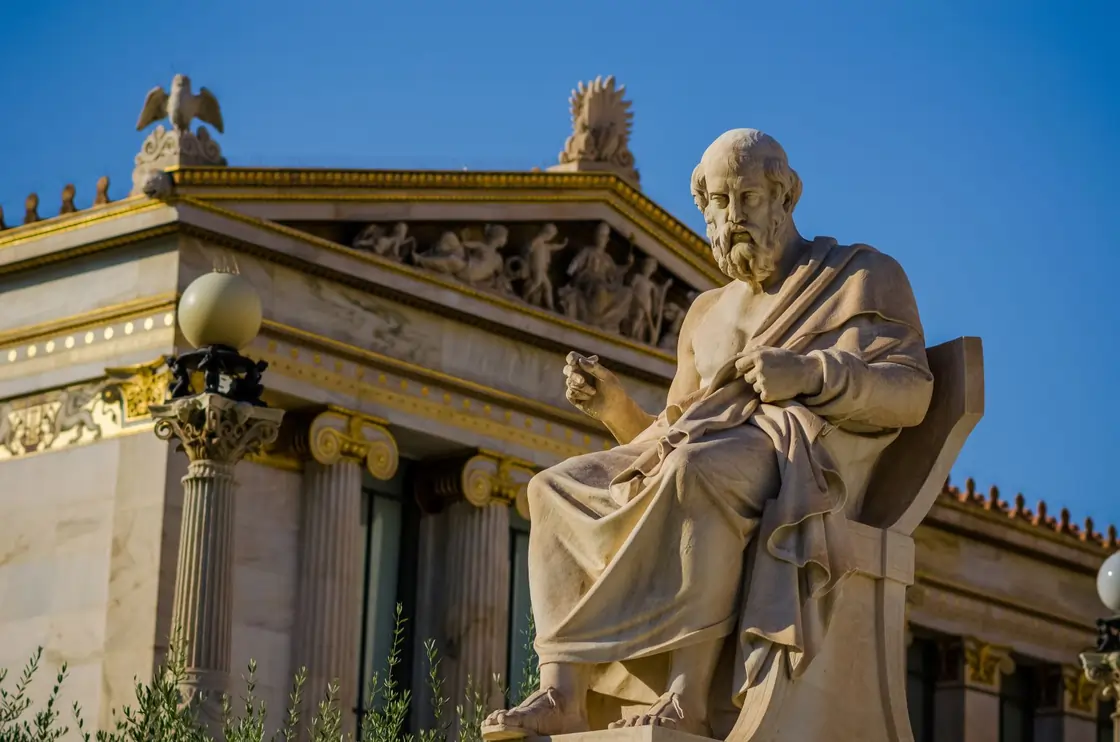
Marble statue of the philosopher Plato on the background of Greek Academy By Nice/stock.adobe.com
The US Capitol building displays a beautiful fresco called The Apotheosis of Washington, in which George Washington sits among gods and figures from Roman mythology. These Roman gods, in turn, were often derived from or influenced by the Greek pantheon. It’s no secret that Western culture traces its roots back to Christianity, yes, but also Greek and Roman culture and thinking.
It’s therefore surprising, perhaps, that Texas A&M recently told a philosophy professor to remove a reading from Plato’s Symposium from an introductory course on contemporary moral issues. Does this mean Plato, the leading Greek thinker and perhaps the most influential Western philosopher of all time, was “cancelled” at A&M?
What is Texas SB 37? Did it lead to Plato being cancelled?
Last year, Texas passed Senate Bill 37. It went into full effect on January 1 of this year. Among other things, the bill gives the Texas Higher Education Coordinating Board greater authority over university curriculum and course content. It requires public universities to submit to a review process every few years.
According to supporters, the review will help lawmakers keep universities accountable for offering courses taken by too few students, helping cut waste, for example. There’s also a political element. The bill enshrines the following warning, that teachers and courses will “not require or attempt to require a student to adopt a belief that any race, sex, or ethnicity or social, political, or religious belief is inherently superior to any other race, sex, or ethnicity or social, political, or religious belief, or to adopt any other similar ideology.”
The legislature has progressive ideologies in mind here, like Critical Race Theory or LGBTQ studies. A conservative columnist from the National Review writes, “It is the professors and their fundamental disconnect from reality that are leading higher education astray. By freeing Texas schools from the grip of zealous faculty members, S.B. 37 can serve as a model for other states facing left-wing radicalism.”
Last week, faculty reported, “At least 200 courses in the Texas A&M University College of Arts and Sciences have been flagged or cancelled by university leaders for gender- or race-related content as the university undertakes its review of all course syllabi.”
Here’s where the removal of Plato comes in.
Why A&M removed Plato from a philosophy course
The philosophy professor, an impressive academic, Dr Martin Peterson, was slated to teach a class on contemporary moral issues. According to InsiderEducation, the department chair, Kristi Sweet, gave Peterson two options: “either remove ‘modules on race and gender ideology, and the Plato readings that may include these,’ or be reassigned to teach a different philosophy course.”
What Plato readings could deal with gender ideology? Apparently, passages from The Symposium, Plato’s book about a dinner party featuring Socrates.
Symposiums were a staple of Greek citizen life, in which men debated philosophy, recited poetry, and discussed life while eating and drinking. The subject of this Symposium is love, in addition to topics of the human condition and gender. It includes homoerotic content, such as describing how Socrates is said to be immune to the flirtation and beauty of one of the men.
However, one of the primary offending passages is the following, a myth delivered by an interlocutor of Socrates: “First, you should learn the nature of humanity . . . for in the first place there were three kinds of human being and not two as nowadays, male and female. No, there was also a third kind, a combination of both genders. [This third gender of both subsequently split into men and women.]”
This poetic myth is dissected and discussed in the book.
Dr. Martin Peterson decided to remove the module. Instead, he’ll teach an extra module about free speech and what he considers censorship—including what happened in his class.
Teaching how to think, not what
With a master’s in philosophy, I have some familiarity with the academic world. The best professors, especially in philosophy, don’t teach students what to think, but how. I don’t know if Dr. Martin is a good professor, but by removing content about gender ideology, the course is deprived of an opportunity to think critically about the issue.
Even if you don’t trust professors to teach contemporary moral issues well, given their frequent progressive bias, is the solution to forbid the teaching and discussion of such moral issues?
Or consider it this way: Do you want the State (under guidance from the federal government) to have the ability to control and remove the content of courses and syllabi—especially removing the discussion of classical texts?
If we can’t discuss racism, gender, and politics in philosophy classrooms, where should we? Can we not think critically about moral issues through the lens of classical texts in a philosophy course?
There are levels to this thorny issue: the university level, the Constitutional level, the State law level, and the individual classroom level. But the headline doesn’t give the best impression.
“The best ideas are worth challenging”
A client recently told me, “The best ideas are worth challenging.” If we truly believe that the Bible is the best collection of ideas—truth from the creator God for our lives—then it’s worth pondering. It’s also worth challenging.
I believe that the Bible’s teachings on race and gender can hold up under such a challenge if given the opportunity. That’s why I disagree with Texas A&M’s approach.
I hope universities can become a renewed institution, not captive to cancel culture and progressive ideologies and not hollowed out of meaningful discussions by conservative ideologies. I hope, instead, they would become places for students to test their ideas, learn to think critically, and fuel a love of truth. Not apolitical, but depoliticised.
The earliest universities in Europe were Christian. Let’s follow the biblical invitation to study—“come, let us reason together” (Isaiah 1:18)—and Christ’s command to worship in “spirit and truth” (John 4:24). Paul showed us how in his eloquent philosophical defense of Christianity, in the Greek style, on Mars Hill (Acts 17:22-31).
Whatever your political views or ideas about this issue, will you pray for wisdom and discernment for our leaders? How can you practice the pursuit of truth in your life, now?














 Search