



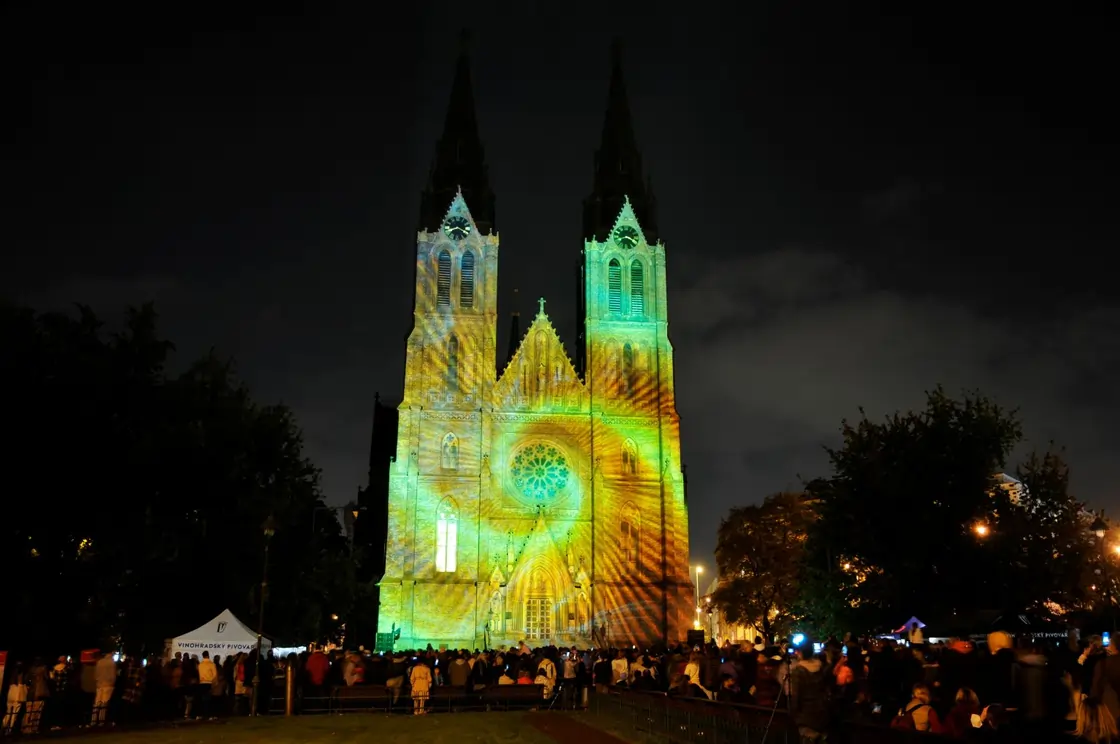
10th Signal Festival with video-mapping starts to present 15 installations and accompanying programme, runs through Oct 16. Pictured installation Light for Europe of Jeremie Bellot on the church of St. Ludmila in Prague, Czech Republic, October 13, 2022. Photo/Martin Hurin (CTK via AP Images)
Most churches today, especially those in the West, rely on technologies that were unimaginable in the days of the New Testament church. While the introduction of those technologies over the century–electricity, screens, sound systems, digital Bibles, virtual reality worship experiences–has come with its own share of divisiveness, the active integration of artificial intelligence into daily norms presents a whole new challenge for the church.
A June 2025 Gallup poll found that 27 percent of white-collar workers in America use AI regularly for their jobs, more than doubling the 13 percent from a 2023 poll. 40 percent of the total workforce has used AI for their jobs in some capacity, up from 21 percent in 2023. These numbers are virtually guaranteed to continue their climb. For better or worse, our economy has become dependent on AI’s unmatched efficiency.
The reach of artificial intelligence does not end with secular occupations, though. A December report found that 61 percent of pastors use AI weekly or daily, up from 43 percent in 2024. What does all this mean for our churches? For pastors? What are the dangers, and are they worth the risk? Can churches redeem AI usage for the glory of God without compromising their ministry?
AI and Efficiency
The answer to these questions is complicated, and perspectives vary, but it is clear that not everything about the intersection of AI and ministry is bad. For example, the average Lead Pastor wears several hats in leading his church. If artificial intelligence can assist with administrative needs, a pastor could be freed up to spend more valuable time with the flock he shepherds, or with his family.
Artificial intelligence can also be a highly effective retrieval tool, aiding pastors in searching through church history, commentaries, sermons, and systematic theologies to find specific information. Such a role benefits not only pastors, but lay leaders who desire to learn but have lean bookshelves.
For example, AI can function as a highly efficient super search engine, locating and compiling quotes, pages, and documents much quicker than a series of Google searches or dedicating time to sifting through a physical library.
Perhaps AI can be useful for generating small-group questions based on the sermon or for searching through a collection of hymns to assist with song selection for Sunday night service. AI can compare texts or translations on the same screen, or generate charts and tables to show which Old Testament prophets correspond to which kings. AI has also proven to be a valuable tool for graphic design, which may benefit churches lacking resources or personnel.
AI companies have found a niche in the church and are banking on it. Several sites, including pastors.ai and gloo.us, are made for the church world.
For a monthly fee of $75, pastors.ai allows 20 sermon uploads per month. With each sermon, it can produce 20 sermon clips in a fraction of the time it would take a video editor to do so. It will also generate daily devotionals and summaries based on the sermon, and it can serve as a chatbot for your church website.
aiforchurchleaders.com offers courses and monthly workshops for pastors to help them integrate artificial intelligence into their rhythms. They warn about being left behind or missing growth opportunities.
Wycliffe, the world’s leading Bible translation ministry, utilizes AI in a variety of ways, including to supplement their manual translation process. Translation teams are not dependent on AI but have found ways to implement it, while remaining keenly aware of associated risks.
Bible translation is an essential ministry for reaching the world with the gospel. If AI can assist in doing this faster, without compromising the accuracy of the work, does this minimize all the objections?
The Warning Label for Churches
If I could summarize the objections to AI usage for churches and pastors with a singular phrase, it would be this: Don’t be pastored by artificial intelligence.
The first point of caution appears when AI’s inherent biases come into view. You can contextualize your prompts to an AI chatbot to match your church’s style, theological tradition, and audience, but that will not completely remove its own perspective on the world, which has been instilled in it by human creators. Even in our own personal study of Scripture, we should remain wary of relying on AI to assist us in biblical interpretation or application.
Christian academia is still gaining its footing on the subject, but Dr. Derek Schuurman at Calvin University is one researcher who has covered the topic at length. In a 2024 interview, he warned that chatbots are programmed with a worldview, evidenced by what’s called “latent persuasion.”
In other words, “Ask Copilot a question, and it will suggest further questions. Over time, such nudging can shape your opinions without you realizing it.”
The downstream effect of latent persuasion could be a pastor preaching a sermon with a different tilt, or tracing a different theme, than what is best (or maybe even what is true) for his congregation. What might seem like a simple shortcut on the surface actually has the capability of bringing you to a completely different destination than you intended.
Engaging Scripture prompts questions, and AI seems to have the answer to everything, but commentaries and study Bible notes are more reliable interpretation tools and already exist in great numbers. Websites like gotquestions.org or desiringgod.org have tackled most of the pressing Bible questions that are too comprehensive for a commentary or study Bible.
In writing for the pastoral training organization 9Marks, Swiss Pastor Benjamin Egger argues against the use of AI for pastors altogether. He asks several critical and ethical questions, leading to the conclusion that handing off even a sliver of pastoral duties to AI creates a dilemma. After all, AI—a soulless machine—was not installed to be the pastor.
Egger makes the case that sermon preparation, in particular, should be completed independently of AI because the long and prayerful process matters. Though AI could summarize commentaries, conduct original-language word studies, and generate witty illustrations, all of that is part of a pastor’s own spiritual formation as he puts in hours of preparation.
Whether you see the conversation around AI and the church as a battle or a balancing act, reality has to set in that AI companies will eventually want their share of the faith “industry.” 23 percent of Super Bowl ads this year were prominently AI-generated or promoting AI companies. Its dystopian presence is ever growing, and it is altering nearly everything we watch or listen to–is the pulpit next?
What does all this mean?
The implications of artificial intelligence may differ from church to church and pastor to pastor, but Christians can have supreme confidence that AI is of no threat to the global church, which God has preserved for 2000 years and counting. He will continue to raise up devoted leaders to preach his Word and disciple his children.
Be prayerful for your church leadership as they navigate these challenging questions and conversations. Find redemptive uses for AI in your own life. We do not need to be fearful of it, but we do need to be faithful with it.
Note: AI is here to stay, and the conversation about where things are headed is far more convoluted than we have space for here. For a deeper look into AI’s capabilities, check out this Gospel Coalition article from AI architect Clayton Chancey.











 Search