


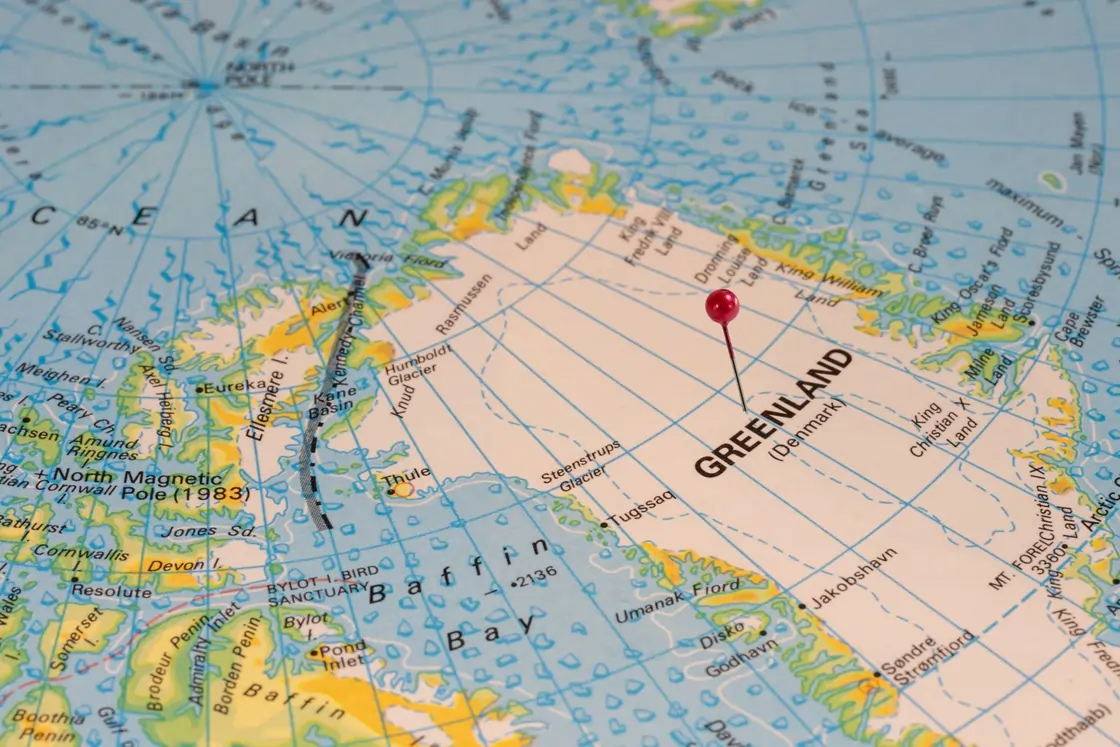
Colorful location map with red stick pin at Greenland, Denmark and the surrounding area By Craig Taylor Photo/stock.adobe.com
The controversy over Greenland has captured headlines for much of the past week. Even though the US has wide latitude to establish and operate military bases there, President Trump stated that America needs to “own” Greenland to prevent Russia and China from doing so.
“Countries have to have ownership and you defend ownership, you don’t defend leases. And we’ll have to defend Greenland,” he told reporters. However, further negotiations eventually led to the “framework of a future deal” on Arctic security that apparently does not require such ownership.
Geopolitical concerns aside, why do humans so often seek to “own” what can never really be ours?
How long did Abraham own his burial cave?
In Genesis 23, Abraham seeks to use the “cave of Machpelah” to bury his deceased wife Sarah (v. 9). Its current owner offers to give him the cave (v. 11), but Abraham insists, “If you will, hear me: I give the price of the field. Accept it from me, that I may bury my dead there” (v. 13). Ephron then claims that the price of the field is “four hundred shekels of silver” (v. 15), which might be a high valuation (cf. 1 Kings 16:24; Jeremiah 32:9), depending on the value of “shekels” at the time.
Nonetheless, “Abraham weighed out for Ephron the silver that he had named in the hearing of the Hittites, four hundred shekels of silver, according to the weight current among the merchants” (v. 16), then he buried Sarah there (v. 19).
The Cave of Machpelah is today known as the Tomb of the Patriarchs. It is located in the city of Hebron in the Palestinian territory of the West Bank, where it is owned and operated under an arrangement between the State of Israel and the Palestinian Authority.
That is to say, the cave belonged to Abraham only until his death, then presumably to his descendants (cf. Genesis 25:8–10). Between 31 and 4 BC, Herod the Great built a large enclosure over the cave. The area eventually became an important Christian pilgrimage site, then came under the authority of Muslims, Crusaders, Muslims again, the British, the Israelis, and now joint control with the Palestinians.
A U-Haul attached to a hearse
Our first home was in Arlington, Texas. We “owned” it for a few years, then leased it to a friend before selling it to a young couple. I have no idea who owns it now, but I do know that they will one day die or sell it to someone else. Since it was built in the 1950s, I presume it will be torn down and replaced with a newer structure someday.
In other words, “our” home was a legal fiction. We “owned” it only for a few years. Even then, because we were financing it with a local bank, they actually owned it and would have repossessed it if we had defaulted on our loan.
A similar reality pertains to “owning” other possessions.
Some years ago, my parents-in-law purchased a large acreage in Arkansas upon which to retire. Their home and barn occupied only a small part of the area that was legally “theirs.” However, the deer, beavers, and other wildlife that populated the land never got the memo. The deer tried to eat their garden; the beavers dammed up their creek; other wildlife were a persistent reality and occasional nuisance.
Even material goods that we clearly own, such as our clothes and furnishings, are only ours so long as we are alive. Even the clothing in which we are buried one day is not really ours—our family could obviously remove it after our funeral or do whatever they wish with it.
As the saying goes, you never see a U-Haul attached to a hearse.
“How much money is enough?”
So I’ll ask the question again: Why this persistent drive to “own” what is never truly ours?
Aside from the obvious fact that owning material goods enables us to use and control them (you wouldn’t want a stranger to move into your bedroom tonight on the premise that they have as much right to it as you), I think there is a positive and a negative answer to the question, both of which are relevant to far more than this discussion.
On the negative side: The “will to power” is basic to human nature and has been so since the Fall. Our first temptation to “be like God” (Genesis 3:5) is still the only temptation we face. Every other sin is a variation on this theme: Be your own God by lying to this person, stealing from that person, and so on. We have a fallen desire to be the king of our own kingdom, the lord of our own universe.
This explains why our possessions are never enough for long. A new car is sufficient only until a newer car is manufactured. A home is all we need until we decide that we need more room. Clothes don’t just wear out—they change styles and no longer aid in our cultural conformity and popularity.
Someone supposedly asked one of the Rockefellers, “How much money is enough?” to which he replied, “Just a little more.”
On the positive side: We are made in our Creator’s “image” (Genesis 1:27). In addition, we are commissioned by him to “work” and “keep” his creation (Genesis 2:15).
The two Hebrew words mean to advance and protect what is entrusted to us. Consequently, we have a God-given impulse to partner with him in “owning” and advancing the material world for his glory and our good.
A farmer who turns untamed wilderness into productive farmland is doing what our first ancestors were charged by God with doing. With proper theology in mind, he will see himself as the “steward” or manager of this property rather than its owner, but he will function as the Creator’s “agent,” representing his interests through legal “ownership” that fulfills God’s purposes.
A man spent years cultivating a tract of land into a beautiful garden and landscape. His pastor stopped by for a visit and remarked, “What a beautiful work God created here.” To which the man replied, “Yes, but you should have seen it when God had it all to himself.”
What “land” has God entrusted to you?
Let’s close with three practical observations:
One: Identify the “land” God intends for you, the part of his Creation that is your stewardship and kingdom assignment.
Every one of us has an area of influence, a set of gifts and capacities, a platform for promoting the gospel and glorifying God. What is yours?
Two: Partner with God in cultivating what you have been assigned.
He knows the future better than you know the present and will lead you into his best. He will empower and enable your efforts for his omniscient purposes. At the same time, he wants and deserves your best, your “utmost for his highest,” as Oswald Chambers would say. As we work, God works.
Three: Use the present for the eternal.
Scripture reminds us, “The world is passing away along with its desires, but whoever does the will of God abides forever” (1 John 2:17). When we use our material possessions and cultural influence to honor Jesus and draw others to him, we “plant trees we’ll never sit under” and advance God’s kingdom in ways that echo in paradise. As I often say, you cannot measure the eternal significance of present faithfulness.
The famed philanthropist Andrew Carnegie noted,
“Surplus wealth is a sacred trust which its possessor is bound to administer in his lifetime for the good of the community.”
I would amend his statement to note that no “wealth” is “surplus” in God’s economy. But I agree that all such “wealth” is indeed a “sacred trust.”
How will you “administer” yours today?











 Search