


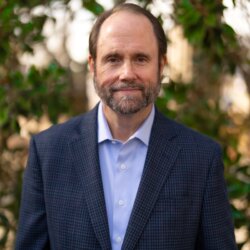

President Donald Trump is joined on stage with Turning Point USA Founder Charlie Kirk as he finishes speaking at Turning Point USA Teen Student Action Summit at the Marriott Marquis in Washington, Tuesday, July 23, 2019. (AP Photo/Andrew Harnik)
One of the common responses we heard after Donald Trump was nearly killed by an assassin in July 2024 was that God had providentially spared his life. The facts surrounding the shooting seemed to back up such a claim: if Mr. Trump had not unexpectedly turned his head to the right at just the right moment, the bullet that grazed his ear would have struck him in the head, likely killing him.
One expert interviewed said, “God must have been watching down on the president.”
By contrast, one of the common responses we’re hearing after Charlie Kirk’s assassination on September 10, 2025, has been that he is a martyr for his faith. One pastor said at a Sunday morning church service, “Today, we celebrate the life of Charlie Kirk, a thirty-one-year-old God-fearing Christian man, a husband, father of two, a patriot, a civil rights activist, and now a Christian martyr.”
Without going into detail, the bullet that killed Mr. Kirk struck him in the left side of his neck. If he had moved his head an inch or two, he would likely have been spared.
The conjunction of the two shootings raises a difficult theological question: If God spared Donald Trump, why did he not also spare Charlie Kirk?
Why Peter but not James?
In Acts 12, we read,
About that time Herod the king laid violent hands on some who belonged to the church. He killed James the brother of John with the sword, and when he saw that it pleased the Jews, he proceeded to arrest Peter also. This was during the days of Unleavened Bread. And when he had seized him, he put him in prison, delivering him over to four squads of soldiers to guard him, intending after the Passover to bring him out to the people (vv. 1–4).
At this point, anyone reading the narrative for the first time would assume that Peter was about to die. If Herod could execute James, he obviously could execute Peter. There was a time lapse involved, since Peter was arrested “during the days of Unleavened Bread,” the seven days following the Passover meal. They were considered holy by the Jewish people and not to be desecrated by an execution.
But they would soon be over, and Herod would “bring him out to the people” to be condemned and killed. In the meantime, he secured the prisoner with “four squads of soldiers,” one squad of four soldiers for each of the four three-hour watches of the night. There was no reason to believe that Peter would not soon face the same fate as befell James.
Of course, we know that in response to the church’s fervent intercession (v. 5), the Lord sent an angel who liberated Peter from prison and set him free (vv. 6–11). But that was in the future. If we stop at verse 4, we are forced to assume that Peter’s death will come shortly.
And we have no theological reason to expect otherwise. The Lord obviously allowed Herod to kill James, the brother of John and one of the three disciples closest to Jesus. Why would he not allow Herod to kill Peter as well?
All the benefits of death for a believer that accrued to James would accrue to Peter. Both would step immediately from physical death into eternal paradise. Both would be welcomed by their Lord and rewarded for their faithfulness.
All this to say, when God miraculously saved Peter’s life, it is understandable to wonder why he did not save James as well.
Two logical answers
Applying our narrative to Donald Trump and Charlie Kirk, I can think of two logical answers to the question of why he spared the former but not the latter, though I want to preface them by saying that I don’t think either proves fully satisfactory to the question at hand.
One: Because God did not spare Charlie Kirk, we are wrong in thinking that he spared Donald Trump.
One could argue that the former was as vital as the latter, if not more so. Presumably, because Mr. Kirk was only thirty-one years old, he had many decades of service and impact ahead. Mr. Trump is in the final term he can serve as president, and it was by no means guaranteed that he would win that final term at the time of the shooting.
By this logic, if God spared either of them, he would have chosen Mr. Kirk. Because he did not, we can conclude that he did not spare Mr. Trump, either, and that the fact that he turned his head when he did was an astounding and fortuitous coincidence but not a miracle.
To be clear, I am not saying that this is what I believe; I am just saying that it is one logical answer to our question.
Two: Because God did not spare Charlie Kirk, there must be a positive outcome to his death that explains the Lord’s decision.
I am seeing speculation that the overwhelming response to Mr. Kirk’s death indicates an impact on the world greater than he could have made if he had not died. Some have offered similar speculation with regard to the assassinations of John F. Kennedy and Dr. Martin Luther King Jr., suggesting that the cause of civil rights was advanced more by their martyrdoms than it would have been by their continued leadership.
I do believe that our Father redeems all he allows, and I am praying for him to redeem Mr. Kirk’s death in ways that benefit God’s kingdom and our nation. But beyond such prayer, I am unwilling to be specific or speculative. And I am loath to conclude that the cultural impact of Charlie Kirk’s death justifies the fact that his widow will raise their three-year-old daughter and one-year-old son without him.
“We see in a mirror dimly, but then face to face”
Here’s the bottom line for me: some theological questions are better left unanswered, because the resolution creates greater problems than it solves.
I can resolve the logical issue of the Trinity, for example, by invoking modalism: God is the Father in the Old Testament, the Son in the Gospels, and the Spirit in Acts. But how do we explain Jesus’ baptism, during which the Father spoke as the Spirit descended (Matthew 3:16–17)?
We can resolve the tension of divine sovereignty and human wisdom by deciding that humans have no free will or that their free will trumps God’s sovereignty. However, either “solution” creates a greater problem than the tension itself.
It is the same with human declarations that purport to explain the mind of God. Until we are with the Lord in heaven, “we see in a mirror dimly, but then face to face” (1 Corinthians 13:12). In the meantime, our finite and fallen minds by definition cannot comprehend God’s thoughts (cf. Isaiah 55:9).
For us to draw conclusions that transcend what we can know about God and his ways leads too easily to speculation that does far more harm than good. It is better for us to admit that we cannot know all we want to know about the mysteries of God’s will and be grateful for what we do know of his omniscient, omnibenevolent, omnipresent, omnipotent nature.
The good news is that we don’t have to understand God’s providence to trust in him, any more than we have to understand medicine to benefit from it.
“A wonder, the source of which is beyond all reason”
Here’s what we can know: God’s providential presence is the source of our joy, strength, and hope, whether we understand him fully or not.
Dag Hammarkskjöld died on this day in 1961. He taught economics at the University of Stockholm before becoming president of the board of the Bank of Sweden, Minister of State, head of the Swedish delegation to the United Nations, and finally Secretary General of the United Nations. He was on his way to the Belgian Congo (now Zaire) to negotiate a cease-fire when he was killed in a plane crash in Zambia. He was awarded the Nobel Peace Prize posthumously in 1961.
For years, he kept a private journal on his thoughts regarding Christ and the meaning of life. Two years after his death, the journal was published under the title Markings. Here we find this profound reflection:
God does not die on the day when we cease to believe in a personal deity, but we die on the day when our lives cease to be illumined by the steady radiance, renewed daily, of a wonder, the source of which is beyond all reason.
We can be “illumined” even in hard days by the “steady radiance” of our Father’s love and grace as by no other source.
This is the invitation and the promise of God.











 Search