


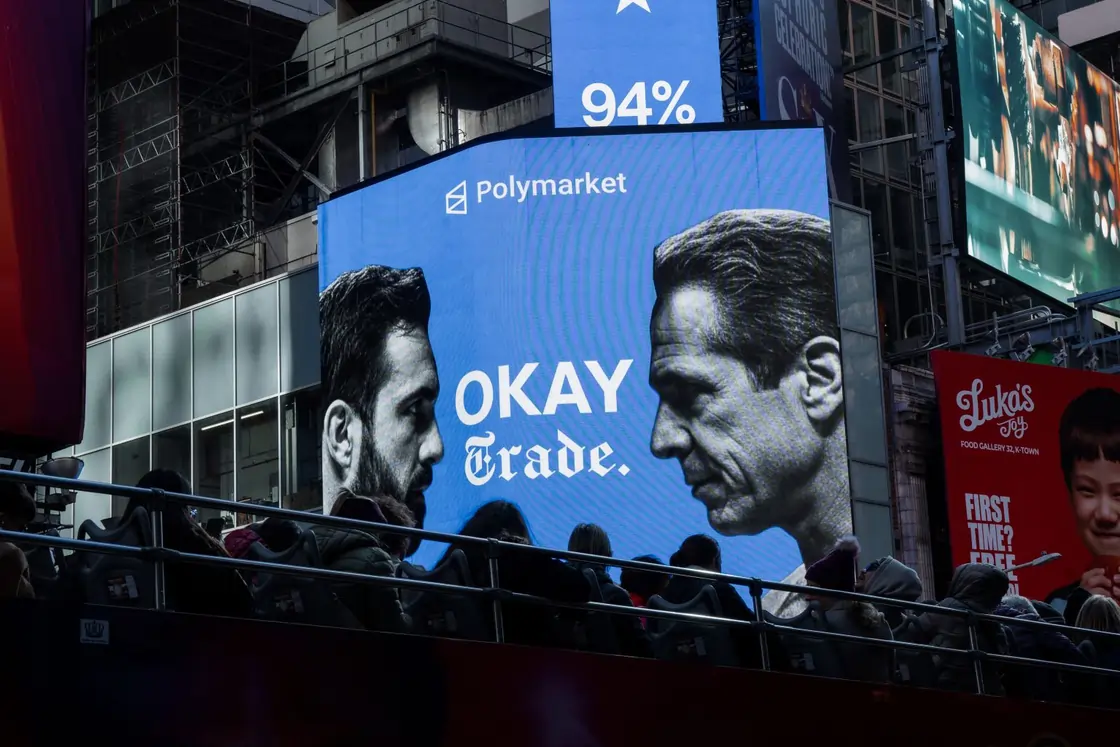
An advertisement by the American company Polymarket show Zohran Mamdani and Andrew Cuomo ahead of the New York City mayoral election on Tuesday, Nov. 4, 2025, in New York. (AP Photo/Olga Fedorova)
Casting lots over a dying man’s garments was considered a scandal in my biblical upbringing. Today, we call it a prediction market—and Wall Street calls it innovation.
The rapid growth and expansion of prediction markets have flooded the public marketplace, making it feel as if all of this is supposed to be business as usual, another opportunity to grow your financial portfolio like day trading or other, edgier ways to expand investment opportunities. We’re not yet two months into the new year, and major prediction market companies like Polymarket and Kalshi have dominated the headlines.
Polymarket opened up a pop-up “free grocery store” in New York’s Greenwich Village this past week, following a similar publicity stunt from fellow prediction market rival, Kalshi, which offered patrons $50 groceries in early February. Providing free/discounted food appears, on its face, to benefit a community, but there is a dark reality behind these goodwill efforts.
Many have heard of these companies, but few understand how they actually work. The mechanics are simple. A prediction market poses a question with a defined outcome, often binary, like “Will Candidate X win?” Traders buy shares that pay $1 if the answer is yes and $0 if it’s no. If those shares trade at $0.65, the market is implying roughly a 65% chance of a yes outcome.
As people trade, buying when they think the chance is higher and selling when they think it’s lower, the price updates in real time. The idea is that anyone who has a better read (new information, sharper analysis, faster synthesis) can profit by pushing the price toward a more accurate forecast. In that sense, the market becomes a living estimate shaped by incentives rather than expert judgment.
That’s how these groups present themselves. The problem is that they skirt the question of what happens when we move beyond predicting what Wall Street might do next into betting on humanity itself.
How do prediction markets work?
The same mechanism that prices the earnings calls of a Fortune 500 company can just as easily price a war, a famine, or other natural disaster. The platform and the algorithm do not care or distinguish. And disturbingly and increasingly, neither do the users.
Proponents reach for flattering comparisons. Prediction markets are said to be like insurance (rational pricing of risk), like the stock market (efficient allocation), or like polling (the wisdom of crowds).
Yet insurance protects what you already have a stake in. Stocks fund something real and productive. Polls do not profit from the outcome.
Prediction markets do none of these things. At their core, they are a zero-sum wager on reality itself, fashioned in the vocabulary of the legitimate institutions they intentionally shape themselves to resemble.
We can now, in a very concerning way, bet on anything and everything. It begs the question, what is that doing to our humanity?
The moral crisis of prediction markets
The Bible clearly and consistently teaches us that how we handle money reveals what we believe about each other and, ultimately, about God. Biblical teaching and prohibitions against usury weren’t arbitrary religious rules; they were God-given guardrails against a particular kind of exploitation, where someone enriches themselves through the vulnerability of another rather than through mutual flourishing. The suffering of your neighbor should never be reduced to an economic opportunity.
The moral crisis of prediction markets lies in their industrialization of the human experience. When you buy shares betting that a war will escalate, a pandemic will worsen, or a public figure will die, you are financially incentivized to bet on catastrophe. Your profit requires someone else’s loss, not in the abstract sense of a stock trade, but in the most literal sense imaginable: the widow, the orphan, the refugee reduced to a line item.
This is a moral tragedy.
For Christians, there is no distinction between the sanctity of human life and human dignity. Rooted in Genesis 1, the idea of humanity made in God’s image sets the framework for how we understand one another and engage with our neighbors.
The Old Testament prohibitions against exploitation were not about what an appropriate interest rate might be; they were about preserving and protecting basic human dignity, even in economic exchanges; the recognition that your neighbor’s crisis is not your windfall.
Prediction markets turn a blind eye to this fundamental humanitarian principle. They don’t just permit profiting from suffering; they create sophisticated instruments specifically designed to do so and call it “information aggregation.”
And God’s word is quite clear that he has a problem with seeing people through that lens.
What does the Bible say about prediction markets?
Contrast this framework with Scripture:
- “If you lend money to one of my people among you who is needy, do not treat it like a business deal; charge no interest” (Exodus 22:25).
- “If any of your fellow Israelites become poor and are unable to support themselves among you, help them as you would a foreigner and stranger, so they can continue to live among you. Do not take interest or any profit from them, but fear your God, so that they may continue to live among you” (Leviticus 25:35-36).
- “Do not charge a fellow Israelite interest” (Deuteronomy 23:19).
The New Testament sharpens the warning. The often cited Scripture, “For the love of money is a root of all kinds of evil” (1 Timothy 6:10), teaches us that money itself is not innately evil, but rather the love of it, the reordering of our care and affection around its acquisition.
Jesus is even more direct: “No one can serve two masters. Either you will hate the one and love the other, or you will be devoted to the one and despise the other. You cannot serve both God and money” (Matthew 6:24). The word translated as “money” is “mammon,” and it’s personified deliberately. Jesus teaches us that money can become a rival deity, one that makes rival claims on our allegiance and reshapes us in its image.
The biblical teaching is clear. When someone is vulnerable, you do not position yourself to gain from their vulnerability.
The relationship between God’s children and their neighbor is not economic. It is covenantal. The poor man is your brother. His survival is bound up with yours. To profit from his distress is to betray the image of God in him.
Should Christians use prediction markets?
Kalshi, Polymarket, and other groups may come offering free groceries and promises of economic flourishing, but as the adage goes, “All that glitters is not gold.” What prediction markets offer is a kind of liturgical practice in service of mammon: every trade is a small act of worship at its altar, every refresh of the odds is a petition, and every payout is a sacrament.
The question before us is not whether prediction markets are efficient or whether they aggregate information correctly. In many circumstances, they are quite efficient and are accurate predictions of world events. The question is whether we will allow this market to exploit every corner of the human experience.
Scripture gives us the answer. We are called to bear one another’s burdens, not to profit from them. We are called to weep with those who weep, not to bet on their tears.
The God who walks with us through the valley of the shadow of death would never make a side bet on whether we’ll make it to the other side (Psalm 23:4). Neither should we.













 Search