



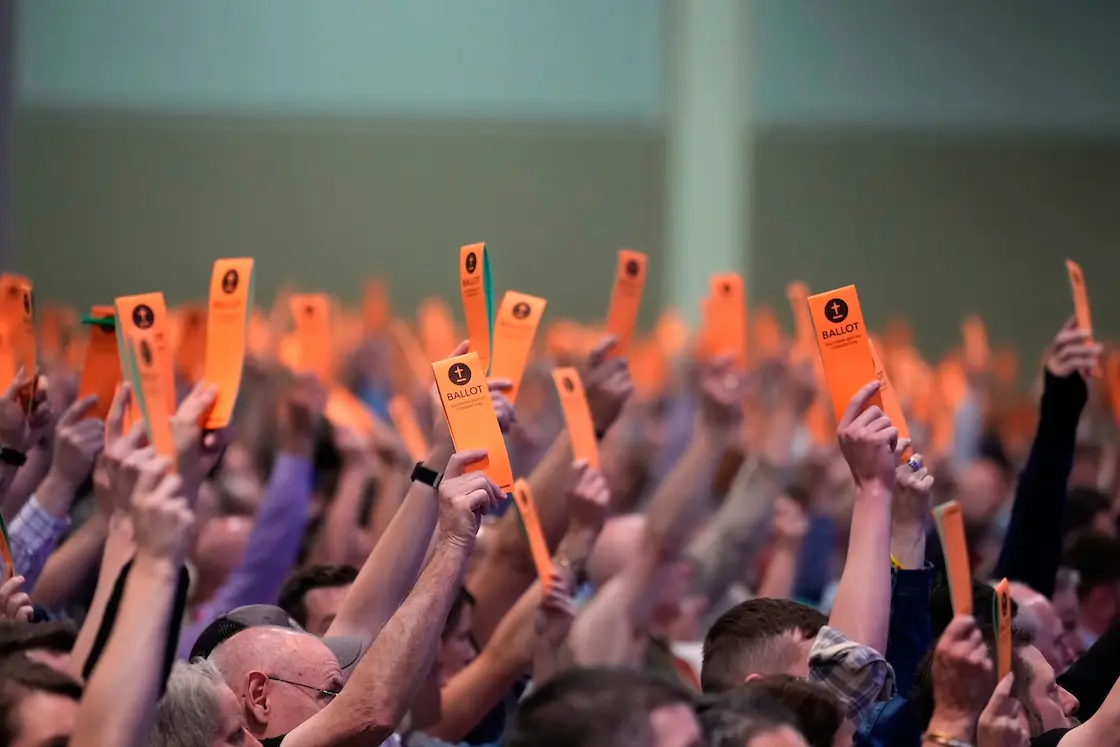
Messengers vote at the 2024 Souther Baptist Convention Annual Meeting in Indianapolis, Monday, July 15, 2024. (AJ Mast via AP Images)
What Happened
Every year, Southern Baptists from all across the United States gather together for an annual meeting to evaluate the budget, elect officers to oversee Southern Baptist Convention (SBC) ministries, receive reports, pass resolutions, and vote on recommendations for Convention action. This year, the Annual Meeting’s agenda included a highly anticipated topic for recommendation, proposed by Al Mohler, the President of The Southern Baptist Theological Seminary, a month before the Convention’s meeting.
Mohler’s proposal was campaigned as the “Truth and Unity Amendment,” and it sought to amend Article 3, paragraph 1 of the Constitution of the SBC by adding an enumerated sixth item regarding the Composition of Churches affirmed by the SBC. More specifically, Mohler proposed the following language be included to make clear that a cooperating Southern Baptist Church:
“Does not act to affirm, appoint, or endorse a woman serving in the office or function of a pastor/elder/overseer, such as preaching to the assembled congregation.”
Since 2023, the topic of women serving as senior pastors has permeated discussions at the Annual SBC Meeting. Mohler argued that his proposed amendment would help eradicate these conversations, making way for other items to be addressed at the Annual Meeting.
He equated this movement to that of the decision made by the SBC over a generation ago to add language to the Constitution regarding LGBTQ lifestyles as they related to the Cooperation of Churches in the Convention (see Article 3, Paragraph 1, enumerated item 1). Mohler stated that this prior decision to clarify language has served the SBC well, and it “is not an issue of open debate at the SBC year by year.”
In addition to the Truth and Unity Amendment, Mohler petitioned for the suspension of a rule requiring proposals involving the Constitution, Bylaws, or Baptist Faith and Message to be sent to the Executive Committee for review before being taken to the floor for a vote. The suspension of this rule was passed, allowing Mohler’s motion to skip the standard waiting period, which paved the way for the Truth and Unity Amendment to be debated and considered this year rather than waiting until the 2027 Annual Session.
As a result, the amendment passed with an overwhelming two-thirds majority vote. The amendment will be added to next year’s agenda, where it must be approved by another two-thirds vote before it is formally passed.
Where Does That Leave Us?
While many Southern Baptists may well agree with Mohler on this issue, SBC churches have always had the autonomy to address this matter on their own. Additionally, the Baptist Faith and Message 2000 already states, “While both men and women are gifted for service in the church, the office of pastor/elder/overseer is limited to men as qualified by Scripture.”
I cannot and will not speak for all women on this issue; however, I know that for many, the injunction of this amendment and its passing has created a lot of tension. Though well-meaning, an unintended side effect of this amendment and surrounding conversations is that women can feel as if they are a threat to ministry, rather than a help to it.
In the age of social media, conversations surrounding this year’s SBC Annual Meeting were louder than ever. As I scrolled through people’s mixed reactions, I found myself growing frustrated. As a woman who was raised in a Baptist church and who has now worked for a few different Baptist churches, I often find myself wondering, “Where is my place in all this? I know what God has called me to, but how do I go about fulfilling this call?”
All of this led me to take a step back and evaluate. I had a choice to make: Was I going to allow the voices of man to speak louder than God? Or was I going to turn to Scripture and ruminate on what God himself has said, as directed by Colossians 3:23-24.
When I look at Scripture, I see the way God cared for women and used them in mighty ways. Against cultural norms, God chose to speak to women and use them to evangelize and advance his kingdom. So, why would it be any different today?
A Call for Unity
Whether you consider yourself a Southern Baptist or serve God in a different tradition, we must remember that the call and the work remain the same. Regardless if you’re employed as a church staff member or serving as a lay leader, we are all called to make disciples (Matthew 28:19-20).
At the same time, everyone’s call is unique, so how this is lived out will look different for each person. That’s the beauty of the body of Christ at work!
What was the last thing God called you to do? Be faithful to that. Trust that he who called you has equipped you for the work at hand and will see it to completion (Philippians 1:6). This is true for every believer, both male and female.
I believe the heart of the SBC affirms Galatians 3:26-29 and the idea that all men and women are created in the image of God (Genesis 1:27). Yet, in practice, it can be messy, as are most things in this life.
No denomination has it all figured out. There are areas that we’re all still trying to navigate in order to interpret Scripture in a God-honoring way. Thus, we must cling tightly to the closed-handed issue of the gospel truth and hold loosely the items that are not essential to salvation.
For at the end of the day, all we can do is keep our gaze fixed on Jesus, holding fast to his word, and extending grace toward one another as we work together to fulfill the Great Commission. Because the reality is, we’re all sinners stumbling forward in the grace God’s extended toward us, and we want to see his kingdom advanced above all else.
Note: Below are more resources on what the Bible says about women in various roles of leadership in the church:
- Dr. Jim Denison: “Should women be pastors? Or church leaders, deacons, or teachers?”
- Janet Denison: Should women preach?
- How to disagree better on the role of women in ministry











 Search