


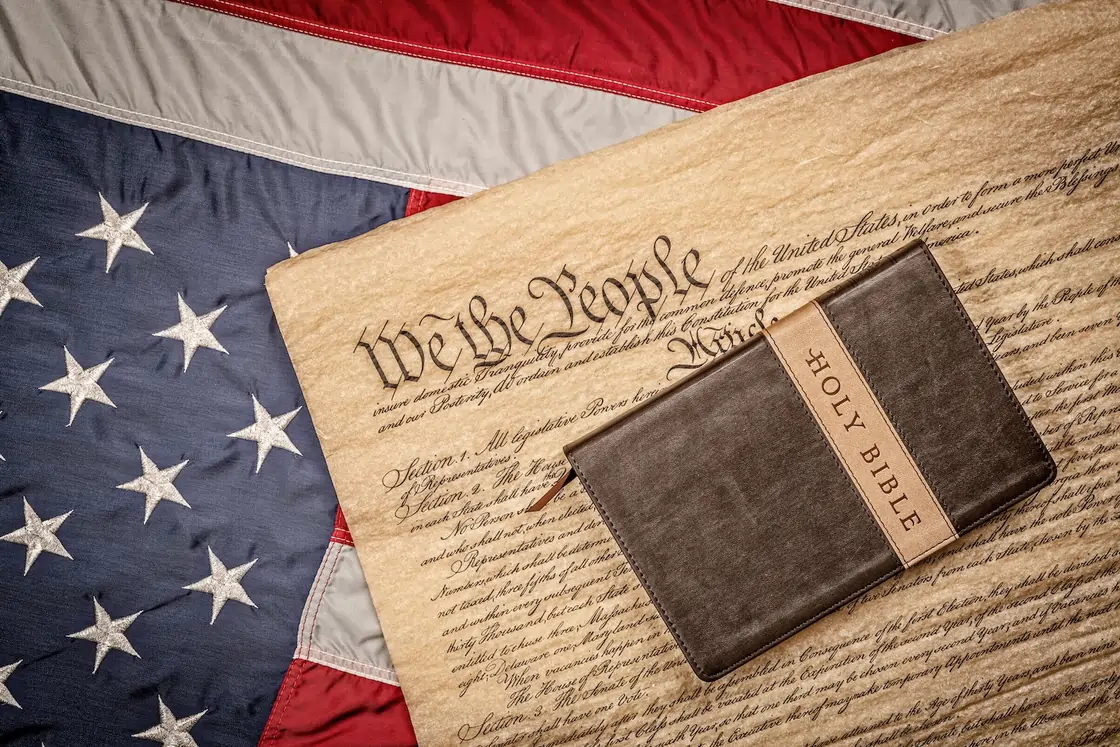
Holy bible on constitution and American Flag By cherylvb/stock.adobe.com
As we discussed last week, Scripture lists several reasons why God judges nations that are of particular relevance to America. However, each is also tied closely with a reason why the Lord might bless our nation as well. Today, we’re going to look at the first of those reasons: Our response to God’s word.
Disobedience to God’s word is a “blanket” sin that covers all that follows. Those who are disobedient to his word must face his judgment, since he cannot be a holy God while rewarding sin or a loving Father while blessing that which harms his children.
For example, God upbraided Israel prior to the death of Joshua: “You have not obeyed my voice. What is this you have done?” (Judges 2:2). Accordingly, he warned that he would not “drive out” the nations before them, but “they shall become thorns in your sides” (v. 3).
The Lord similarly revealed to Zechariah:
They made their hearts diamond-hard lest they should hear the law and the words that the Lord of hosts had sent by his Spirit through the former prophets. Therefore great anger came from the Lord of hosts . . . “and I scattered them with a whirlwind among all the nations that they had not known. Thus the land they left was desolate.” (Zechariah 7:12, 14)
The creator and author of all life has given us clear instructions on the best way to use that life, so it is only natural that rejecting those instructions will lead to calamity. And, throughout history, we see examples of God’s active and—far more often—passive judgment demonstrating the foolishness of choosing to follow our word over his.
Yet when we choose obedience instead, we open pathways to blessing that are otherwise closed. So how do we do that?
Think biblically to act redemptively
Practically speaking, to live a life God can bless, we must choose to think and live biblically.
As with each of the commitments we will discuss, there are hundreds of books to be written here. For a short introduction, I invite you to read my website article, “How can I study the Bible?” For a longer study, you might consider my book, The Bible—You Can Believe It.
For our purposes, let me encourage you to adopt this mantra with me: Think biblically to act redemptively.
Paul urges us: “Whatever is true, whatever is honorable, whatever is just, whatever is pure, whatever is lovely, whatever is commendable, if there is any excellence, if there is anything worthy of praise, think about these things” (Philippians 4:8). To think with “excellence,” we must “destroy arguments and every lofty opinion raised against the knowledge of God, and take every thought captive to obey Christ” (2 Corinthians 10:5).
Such biblical thinking begins with the desire to think biblically. If it is not your goal to make every thought biblical, ask God to help you make it your goal. Then begin each day with time in God’s word, asking the Spirit to speak from Scripture into your mind and heart.
Now go through the day seeking to think biblically about all you experience. Ask the Spirit to bring to mind biblical truth relevant to the decisions, temptations, and opportunities you encounter. Seek to align your life with what you know.
When you do, you will find that God’s word is indeed “living and active, sharper than any two-edged sword, piercing to the division of soul and spirit, of joints and marrow, and discerning the thoughts and intentions of the heart” (Hebrews 4:12). And God will guide your mind in ways that share his redemptive love and advance his kingdom in our world.
Unfortunately, choosing to advance God’s kingdom rather than our own has never been easy for humanity, and we seem particularly bad at it in America.
Choosing the right freedom
The same spirit of independence that drove the first generations of colonists to cross the Atlantic in search of a better life, and then led them to start a nation founded upon that same ethos, can make it difficult for us to submit to God and his word today. But such submission is essential if we’re going to live a life that the Lord can truly bless.
As CS Lewis wrote:
To have faith in Christ means, of course, trying to do all that he says. There would be no sense in saying you trusted a person if you would not take his advice. Thus if you have really handed yourself over to him, it must follow that you are trying to obey him.
For many Christians, especially here in America, fully handing ourselves over to God remains a difficult challenge. Our natural temptation is to figure out the least we can give and then draw the line at that point. But that’s not what the Lord asks of us, and he can’t fully bless a life that is only partially surrendered to him.
God’s calling for each of us today is to demonstrate what it looks like to embrace the freedom found in a right relationship with the Lord rather than relying on the freedoms we can win for ourselves.
A nation whose people humbly submit to God’s Spirit and rely on the Lord’s leadership rather than trusting in ourselves and our own prideful machinations is positioned to experience the blessings he longs to give. And the Lord has given us the chance to help the lost around us do just that.
Will you embrace such a vision today?
Faith of the Founders
Elias Boudinot and the Urgency of Biblical Truth
Of all the individuals instrumental to the founding of our nation, Elias Boudinot (1740–1821) may be the most significant of those who are least known to most of us (For a good introduction, see David L. Holmes’s The Faiths of the Founding Fathers).
- During the Revolutionary War, he was an intelligence officer under General Washington.
- He served as president of the Continental Congress, the first governing body of the American colonies.
- As the principal civil officer of the new United States, he signed the Treaty of Paris, which ended the Revolutionary War.
- He served three terms in Congress, then served as director of the National Mint from 1795 to 1805.
- An advocate for women’s rights, he led a campaign in the early 1790s to encourage women to become active in politics.
- He spoke out frequently against slavery, both as a member of Congress and as a private citizen, and argued for the rights of black and American Indian citizens.
Boudinot was a child of the Great Awakening, influenced by the ministries of George Whitefield and Jonathan Edwards. A devout Presbyterian, he helped found the American Bible Society in 1816 and served as its first president.
He was especially known for his book The Age of Revelation, a refutation of Thomas Paine’s skeptical The Age of Reason. In it, Boudinot responded to objectors who “find it difficult to submit to the faith of the gospel.” In his view, this is
because many things are above their reason; while they continually exercise the same principal in temporal things . . . they will mount the horse, recommended by its owner; or enter a public carriage provided for passengers, without doubting of their safety. . . . Does any person refuse to swallow his victuals, before he fully understands the method of digestion, or the manner in which the food will turn to his nourishment? . . . In short, innumerable important facts, the causes of which, with their modes of operation, we cannot comprehend, being perfectly mysterious and unaccountable, are yet firmly believed; and, in the course of life, acted upon by us.
Boudinot was personally convinced of the truth of the Bible and of its significance for his new nation:
For near half a century, have I anxiously and critically studied that invaluable treasure; and I still scarcely ever take it up, that I do not find something new—that I do not receive some valuable addition to my stock of knowledge; or perceive some instructive fact, never observed before. In short, were you to ask me to recommend the most valuable book in the world, I should fix on the Bible as the most instructive, both to the wise and ignorant. Were you to ask me for one, affording the most rational and pleasing entertainment to the inquiring mind, I should repeat, it is the Bible: and should you renew the inquiry for the best philosophy or the most interesting history, I should still urge you to look into your Bible. I would make it, in short, the Alpha and Omega of knowledge.
Let us join him today, to the glory of God.


