




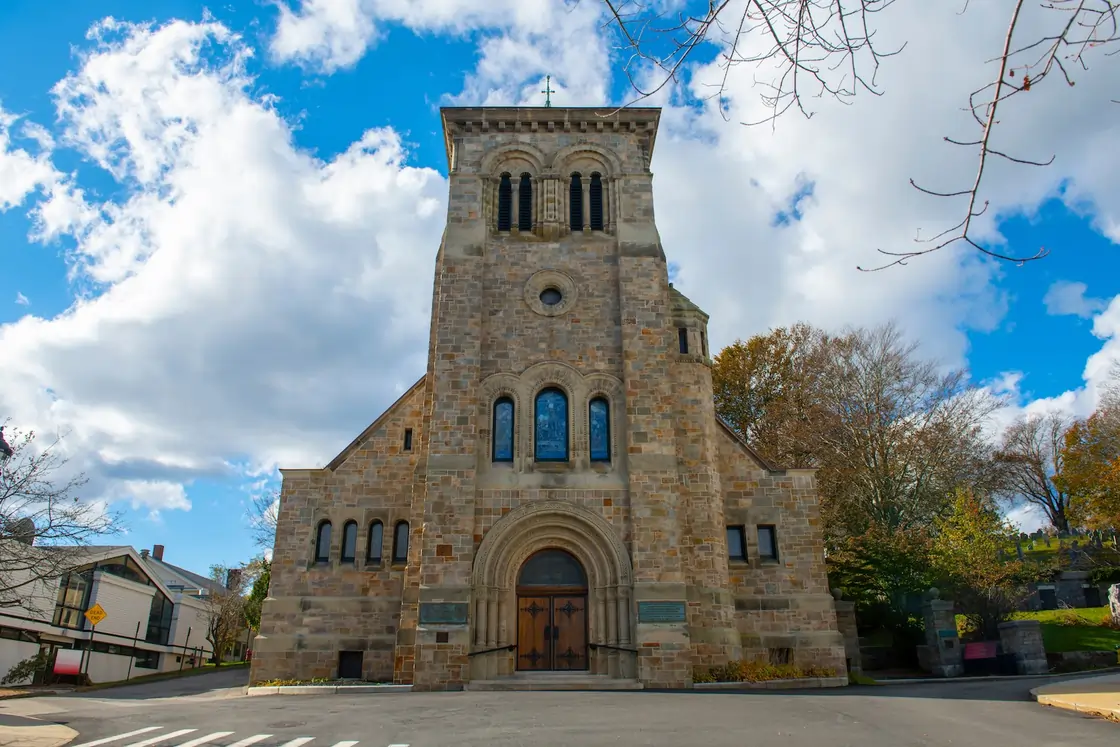
Mayflower Meeting House was built in 1621 at 19 Town Square in historic town center of Plymouth, Massachusetts MA, USA. by Wangkun Jia/stock.adobe.com
Around AD 1000, Norsemen (Germanic peoples from modern-day Denmark, Norway, and Sweden) settled briefly in Newfoundland, making them the first Europeans to colonize North America. Five centuries later, Christopher Columbus famously reached the Bahamas, Cuba, and Hispaniola; in 1496, the first European permanent settlement was built in Santo Domingo, part of what is today the Dominican Republic. Across the next century, the Spanish and Portuguese established significant settlements across what we call Central and South America.
Together, these efforts reveal three distinct purposes behind America’s founding, each of which is important to understanding the nation’s past as well as its future.
Launching evangelistic missions: St. Augustine, Florida
In 1565, the Spanish founded Saint Augustine, Florida, the oldest continuously inhabited European-established settlement in what is today the contiguous United States. The English and French tried but failed to establish settlements in the New World at that time as well.
St. Augustine was established by the Spanish for two reasons: to serve as a military outpost for the defense of Florida, and as a base for Catholic missionary settlements throughout the southeastern part of North America. Numerous missions were established across the region; by the middle of the seventeenth century, their efforts had expanded northward to the Carolinas and westward to present day Tallahassee.
Building a secular economic venture: Jamestown, Virginia
In 1607, the English famously established Jamestown on the Atlantic coast of what is now the state of Virginia. This was their first permanent settlement in America. Across the seventeenth century, the French, Spanish, Scottish, and Dutch built numerous other settlements along the Atlantic coast, efforts that continued in the eighteenth century until shortly before American independence.
In contrast to St. Augustine, Jamestown served a secular purpose. The Virginia Company of London established the colony as an economic venture to generate profit for investors, search for gold, and find a water route to the Pacific Ocean. In 1612, tobacco became the long-awaited cash crop for the Virginia Company. Tragically, Africans were forcibly captured seven years later and brought to work the tobacco fields. The year 1619 marked the introduction of slavery to the New World and the beginning of what has often been called America’s “original sin.”
It is true that colonists brought the Church of England with them as their established religion and that they required attendance at services within the churches they built. And the First Virginia Charter of 1606 states their desire to:
tende to the glorie of His Divine Majestie in propagating of Christian religion to suche people as yet live in darkenesse and miserable ignorance of the true knowledge and worshippe of God and may in tyme bring the infidels and savages living in those parts to humane civilitie and to a setled and quiet governmente.
However, these efforts were in significant part an attempt to counter the advances of the Spanish in the New World and the Roman Catholicism their missionaries promoted. And the colony’s embrace of slavery to further its economic ambitions is a clear indication of how superficial their religious commitments were in reality.
Establishing Christian community: Pilgrims and Puritans
Alongside Catholic missionary expansion in Florida and a secularized colonial establishment in Virginia, a third purpose for settlement in the New World was embraced by the groups we know as Pilgrims and Puritans.
The Pilgrims: “Advancement of the Christian Faith”
The Pilgrims made their famous 1620 voyage aboard the ship Mayflower, founding Plymouth Colony in present-day southeastern Massachusetts along the shores of Cape Cod Bay south of Boston. They were Christians who believed the Church of England was too corrupt to be reformed, so they demanded the formation of new, separate church congregations and thus were known as Separatists.
Since it was illegal at the time to belong to any church other than the Church of England, they chose to flee to the Netherlands. Some years later, fearing the loss of their English identity and another war between the Dutch and Spanish, the congregation chose to leave Holland for the New World.
Upon arriving in New England on November 11, 1620, most of the adult men on the Mayflower signed a document we know as the Mayflower Compact. It laid out the foundation of the new community’s government. In it, the group explained their purpose: “Having undertaken for the Glory of God, and Advancement of the Christian Faith, and the Honour of our King and Country, a Voyage to plant the first Colony in the northern Parts of Virginia.” Weather drove them from their intended destination of Virginia to Massachusetts, and the rest is history.
The Puritans: “Wee shall be as a city upon a hill”
Unlike the Separatists who formed the Pilgrims, the Puritans wanted to purify the Church of England rather than abandon it. But they also met religious persecution, refused to compromise their convictions, and fled to America, where they established the New England colonies of New Jersey, Pennsylvania, and Maryland as “plantations of religion.” Some came for secular motives, but the great majority left Europe to worship God according to their beliefs.
Their most notable leader was John Winthrop, who led a group of colonists to New England in 1630 and remained in the Massachusetts Bay Colony for the rest of his life. He was elected governor of the colony twelve times.
Before the group embarked on the ship Arabella, Winthrop delivered a lecture titled “A Model of Christian Charity.” (It is often reported that this was a sermon he preached aboard the ship in Boston Harbor, but this is an error introduced by a cover letter to an early manuscript when the sermon was published.)
The manuscript is long and complex, comprising more than four thousand words. In it, Winthrop famously states:
Wee must consider that wee shall be as a citty upon a hill. The eies of all people are uppon us. Soe that if wee shall deale falsely with our God in this worke wee haue undertaken, and soe cause him to withdrawe his present help from us, wee shall be made a story and a by-word through the world.
It was his vision to establish a civil society where they could worship freely, spread the gospel, and enjoy just, equitable, moral civil laws. Winthrop and his fellow Puritans sought to create a new Bible-centered commonwealth united by Christian brotherly love, peace, and unity, with a community based on covenants and godly moral laws.
God works through flawed people
So, there were at least three different visions at work when Europeans established what became the United States of America: to build a base for efforts to evangelize indigenous peoples, to foster a secular economic venture, and to construct Christian communities centered on biblical morality. All three are still operative in America today.
Next week, we’ll talk about how this brief history relates to God’s judgment and blessing upon our nation, but for now, let’s take a moment to reflect on how the Lord worked through all three groups to advance his kingdom and bring the lost to salvation. It’s important for us to understand, though, that he often accomplished that goal in spite of those first groups of settlers as much as through them.
- The Catholic missionaries often established their monasteries and schools at the tip of the sword, and while the church stood as a check against the unbridled greed of the conquistadors, death was still dealt far too often in the name of God.
- Slavery was similarly justified under religious auspices in Jamestown and beyond under the guise that the people forcibly brought from Africa were better off in the fields than back home because it gave them the chance to hear the gospel.
- Both the Pilgrims and Puritans were so demanding in their spiritual practices that the next generation often wanted nothing to do with the faith of their fathers.
And yet, God still worked through these flawed people to further his kingdom and save countless souls. And if he could use them, he can use us.
All of us have sins in our lives that we wish were not part of our story. But, if we’ll let him, God can take our failures and use them to shape our testimony into a witness that can help others experience his grace and forgiveness in their own lives.
So, what sins could be part of your story? Have you sought God’s forgiveness yet? If so, have you asked him to use those mistakes to help others know him?
Scripture is filled with examples of people who have helped countless generations draw closer to the Lord, as much for their failures as their successes. And the same God that redeemed them can redeem each of us as well.
Will you let him?
Faith of the Founders
John Witherspoon and the Significance of Legacy
John Witherspoon (1723–94) was the only active clergyman and college president to sign the Declaration of Independence.
John was born in Yester, Scotland. His mother taught him to read, and by the age of four, he could read from the Bible and he went on to eventually memorize most of the New Testament. He became a precocious young man, enrolling in college at the age of thirteen and earning a Master of Arts at the University of Edinburgh soon after his sixteenth birthday (writing his thesis in Latin). By the age of twenty, he was a Doctor of Theology.
A devoted Protestant, he served as a minister in several Presbyterian churches in Scotland. His reputation led political leaders in New Jersey to recruit him to be president of the College of New Jersey (now Princeton University) when he was forty-five. He accepted their invitation and emigrated to America in 1768.
In addition to his administrative duties, Witherspoon taught courses in literature, history, divinity, and moral philosophy. The college was originally focused on producing clergymen, but he broadened its purpose to include potential political and cultural leaders. In total, twenty-eight senators, forty-nine congressmen, and ten cabinet officers studied at the college under his leadership. Included in their number was James Madison, the primary author of the US Constitution and America’s fourth president.
By 1770, the college’s students were openly advocating for liberty. Witherspoon was elected to serve in the Second Continental Congress, remaining from June 1777 until November 1784. He was a member of more than one hundred committees, spoke often during debates, and helped draft the Articles of Confederation, our first constitution.
In a May 1776 sermon at Princeton on the cause of independence, Witherspoon stated:
There is not a single instance in history in which civil liberty was lost, and religious liberty preserved entire. If, therefore, we yield up our temporal property, we at the same time deliver the conscience into bondage.
Some historians consider him “the most influential teacher in the entire history of American higher education,” and the most important college president the US has ever known. In this context, we do well to recognize in his example the priority of personal legacy.
According to Witherspoon, the best way to serve others is to help them serve God, as he declared:
He is the best friend to American liberty, who is most sincere and active in promoting true and undefiled religion, and who sets himself with the greatest firmness to bear down profanity and immorality of every kind. Whoever is an avowed enemy of God, I scruple not to call him an enemy of his country.
This is because, as Witherspoon warned, “The fear of God is the only effectual means to deliver us from the fear of man.” He dedicated his life to teaching the fear of God to generations of students who went on to serve our nation and the world. It was his adamant purpose that they would “apply their talents to the service of the public and the good of mankind.”
Let’s join their number today.












 Search