



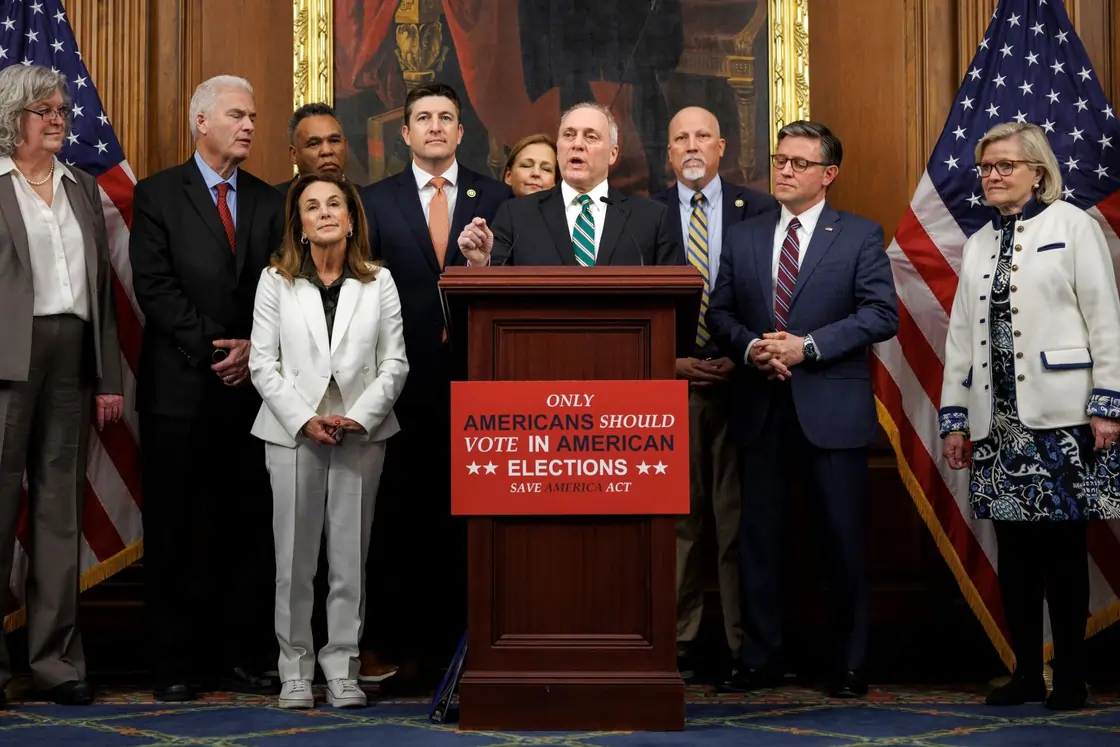
House Majority Leader Steve Scalise, R-La., speaks to reporters on the SAVE America Act alongside Republican leadership and supporters on Capitol Hill in Washington, Wednesday, Feb. 11, 2026, in Washington. (AP Photo/Tom Brenner)
Republicans have been trying to pass some version of voter ID laws for years, with the latest attempt set for a vote in the Senate coming soon. Few expect the bill to pass, though, despite overwhelming popular support. And the reasons why have less to do with the ID requirements than with the rest of what the law is trying to change.
Why it matters: Election integrity remains a focal point for the Trump administration and many in the Republican Party. If Democrats continue to oppose the SAVE America Act, it could prompt Republicans to remove or alter the filibuster in ways that would have a profound impact on how laws are passed down the line. Or, if the bill stalls, President Trump has promised to push it through via executive order, even though a similar attempt was already deemed illegal last year. Either way, the issue doesn’t appear to be headed toward a resolution anytime soon.
The backstory: Third time’s a charm?
For the third consecutive year, the House of Representatives has passed a version of the Safeguard American Voter Eligibility Act, or the SAVE Act for short. So far, it has died in the Senate each time without even getting a vote. Senate Majority Leader John Thune promised that it would not happen again, given that he now has the support necessary to bring it to the floor and force representatives to go on record as either supporting or rejecting it.
Still, few expect the law to pass. It would need sixty votes unless Republicans either get rid of the filibuster—a step leadership has repeatedly said they will not take—or change the requirements to oppose the bill. There’s a lot of risk either way, though, and it’s unclear if Thune will be willing to take that step.
But why should he need to? After all, roughly 95 percent of Republicans and 71 percent of Democrats favor requiring voters to show some form of government-issued identification in order to cast a ballot. And those numbers hold up across demographics as well, with at least 76 percent of Asian, Black, Hispanic, and White ethnicities saying that they would favor requiring everyone to show a government-issued ID to vote.
At a time when our culture appears to agree on very little, voter ID laws stand as a rare bit of common ground. So, what is it about this Law that has so many on the political left up in arms?
“Jim Crow 2.0?”
Let’s begin by taking a look at what the SAVE America Act does before moving on to what it might lack.
For starters, the new legislation would require people to present a government-issued photo ID when they show up to vote. While some have complained that this rule will have an outsized impact on minorities or the impoverished, a similar law was passed on the state level in Georgia back in 2021, when it became one of the first to require voter ID for mail-in ballots.
Accusations of “Jim Crow 2.0” were a common refrain, and Major League Baseball even went so far as to relocate the All-Star Game that year from Atlanta to Denver. However, the state broke turnout records in the 2022 midterm elections, and it has continued to rise since.
Moreover, a government-issued ID is already required to get a credit card, buy or rent a home, get welfare benefits, travel by plane, or open a bank account. If a large number of Americans lack the necessary ID to do those things, then it seems like the time and energy of those who oppose the bill would be better spent on trying to smooth out the process of obtaining that kind of identification.
So, for the vast majority of Americans, so far so good. And, if showing an ID on election day was all the bill required, then it would probably have a pretty decent chance of becoming law. However, that’s not where it stops, and the more controversial elements pertain to changes that would occur long before someone gets to the voting booth.
A “ready access” problem
You see, in addition to showing a picture ID to vote, the SAVE America Act also includes provisions that greatly amplify the requirements to prove you are a citizen when you register to vote.
Currently, registration simply requires you to check a box stating that they are an American citizen. The computers and local leaders are then supposed to verify that what the person checked is actually true, which is not an ideal system to say the least.
The problem—or at least a difficulty—with the proof of citizenship requirement is that as much as 9 percent of Americans don’t have “ready access” to proof of citizenship. “Ready access” is the key term there, though. Just because you don’t have your birth certificate, a passport, or any of the other forms of accepted documentation doesn’t mean you can’t get them.
Now, gaining access to those documents can be difficult—particularly if you live a long way from a registration office—but it shouldn’t be a deal breaker. So, again, why is this legislation so controversial?
Why the SAVE America Act may not work
Ultimately, the strongest arguments against the SAVE America Act revolve around three complaints.
First, many of the law’s opponents argue that it’s simply unnecessary. While President Trump, others in his administration, and a number of prominent Republicans have echoed claims that illegal immigrants or non-citizens are voting in the elections, there’s not much data to substantiate those accusations. And to the extent that such a problem exists, they often argue there are less intrusive ways of solving it.
Second, there’s a decent chance that the courts may find the bill unconstitutional on the grounds that the federal government does not have the authority to regulate how states manage elections. The citizenship requirement portion of a similar law was struck down in Kansas back in 2018, while a US District Judge ruled last April that President Trump exceeded his authority when he sought to require such documentation to register to vote. Generally speaking, it’s often—though not always—taken a constitutional amendment rather than a simple law to make these kinds of changes, though it would most likely fall to the Supreme Court to decide.
Finally, while the bill dramatically increases the burden placed on states to manage the voter registration process, it does not provide additional funding or any phase-in period for the new regulations. It’s expected that states would need at least a year to implement the new policy, yet they would likely be expected to have it in place in time for November’s midterms. That simply does not seem realistic and is likely to lead to far more errors than if the current system was allowed to endure.
However, with federal elections every two years, there’s never going to be a good time to make these kinds of sweeping changes. Carveouts that would exclude this year’s midterms or that might provide additional funding would help a lot but, at some point, if the changes are truly necessary then they are worth whatever discomfort and problems arise in their implementation. It’s just important to go into it knowing that, at least to start, there are going to be some pretty significant bumps along the way.
And that truth is relevant to far more than just our electoral process.
Spiritual application: From a dark room to a dark tomb
Nicodemus is one of my favorite people in the Gospels. As John describes, he was a Pharisee who first came to Jesus at night because he was curious to know more about his teachings. We get the story in John 3, and some of the most profound and important verses in the Gospel happen in Christ’s conversation with this “ruler of the Jews” (John 3:1).
For example, this passage is where Jesus tells him about his need to be born again of the Spirit and of the promise that God loved the world so much that he sent his Son to die so that whoever believes in him can have eternal life (3:3–16). While they take some liberties, I love the way The Chosen captures this interaction and depicts Nicodemus’s inner struggle between the desire to believe and the fear of losing the life he has built.
Chapter 3 is not the only time we see Nicodemus in this Gospel, though.
In Chapter 7, he speaks up for Jesus when the religious leaders condemned him, though he appears to wilt under their response (John 7:50–52). But by the end of the Gospel, he goes against his fellow Pharisees to join Joseph of Arimathea in burying Jesus, providing seventy-five pounds of myrrh and aloes to anoint Christ’s body (John 19:38–40).
I bring his story up today because he demonstrates that progress, particularly when it comes to maturing in our faith, is rarely smooth or predictable. There are often bumps along the way, and that’s fine. The end goal of a closer relationship with the Lord is worth whatever struggles we must endure to get there, and God will be patient with us so long as we continue to try.
The problem for a lot of believers, though, is that they stop somewhere on the way.
Maybe it’s a hard teaching, or when obedience demands more than we’re willing to pay. Or perhaps it’s when standing strong in our faith means losing a friendship or getting passed over at work.
Ultimately, your road from a dark room to a dark tomb will have some rough patches. What matters most is that you don’t give up when they come. God promises that the bumps and bruises will be worth it in the end.
News worth knowing
1. US–Iran peace talks made “good progress” today in Geneva
American envoys Steve Witkoff and Jared Kushner met in Geneva earlier today with Iranian officials for another round of talks to ease tensions between the two countries. The Iranians asked for two weeks to formulate a more detailed proposal to bridge the remaining gaps between the two countries.
Why it matters
Iranian foreign minister Abbas Araghchi said that the sides reached a “general understanding on a set of guiding principles” for further negotiations. To this point, though, Iran has been unwilling to discuss more than its nuclear program. While that program is certainly a concern, America and Israel have also prioritized paring back Iran’s ballistic missile program, and Iran has been unwilling to consider doing so to this point.
What to watch
A second aircraft carrier group is headed to the region to strengthen America’s ability to both attack Iran and defend against any counterattacks. The mounting military pressure, coupled with a continually collapsing economy, should mean a quick resolution to these negotiations. However, will Iran’s leaders accept an agreement that keeps them in power but weakens their standing in the region? America has little incentive to accept anything less than that, but the cost of exacting that price may still be high enough to buy the Iranian regime more time to negotiate.
The New York Times has more on the story
2. An update on Venezuela
It’s been more than a month since American forces captured former Venezuelan President Nicolás Maduro and his wife. The latest polling shows that nearly 75 percent of Venezuelans believe that their country is now moving in the right direction. Nearly 60 percent supported the US selling Venezuela’s oil overseas as well, with nearly that many also in favor of no longer selling sanctioned oil to China, Cuba, and other US adversaries.
Why it matters
While a number of questions regarding the future of Venezuela remain, signs that the people are adapting to the new normal are interesting given that Maduro’s second in command is still in power and new elections have yet to be held. With the next election not technically scheduled to take place until 2030—although Trump administration officials have hinted it could happen sooner—finding some sense of stability in the interim is important.
What to watch
As the US begins reinfusing the money from oil sales back into Venezuela, will that sense of hope that conditions have improved be further validated, or will the corruption that defined much of Maduro’s time in power continue to be the norm?
Yahoo! News has more on the story
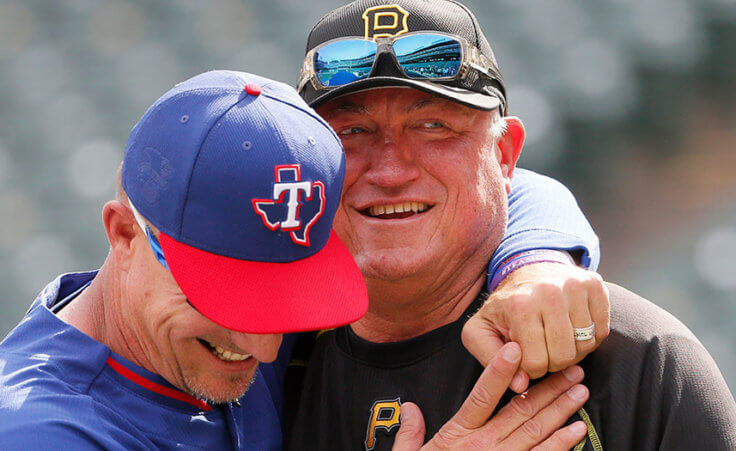
3. How will robo-umps work in baseball this season?
As Spring Training for Major League Baseball gets underway, one of the biggest changes for this season is the introduction of the automatic balls and strikes system. MLB has tinkered with it in the minors for years, but this will be the first time it reaches the big leagues. Bob Nightengale has all the details at the link below, but the basics are that teams will get two failed challenges per nine innings when they disagree with a ball-or-strike call, with only the pitchers, catchers, and hitters able to ask for a replay.
Why it matters
The human element will still be the primary means by which balls and strikes are called, but this system should allow teams the chance to make sure the right call is made in the game’s most crucial moments. It’s expected to add about a minute to each game, which seems worth the cost if used well.
What to watch
There’s already been some humorous exchanges as teams try to figure out which of their players will be allowed to object to a call. As Diamondbacks manager Torey Lovullo noted, “Pitchers at times get a little emotional. Hitters can be that way sometimes, too. I think we’re going to rely on the catchers.” Will other teams follow suit, and if so, what will happen when a player goes rogue and costs his team a challenge?
God is good
The Prince George’s County Department of Corrections in Maryland recently held its first baptism service at the jail in Upper Marlboro. More than fifty inmates were baptized in what’s being hailed as a “paradigm shift” for the corrections facility. Public safety officials, dozens of community clergy, and even the State’s Attorney—who prosecuted many of the inmates—were there to witness and participate in the service.
Kingdom impact
Inmates who are part of the prison ministry at Prince George’s jail are not only shown how to receive new life in Christ, but are also given the chance to serve as well. The church there includes deacons, a choir, and other opportunities to start participating in the community of faith in ways that help give them a sense of ownership and purpose in the ministry.
Prayer point
Will you pray for the church at Prince George’s and for the inmates whose lives are being transformed? Will you pray that they stay strong in their faith and that God is able to use them to help others find new life in Christ as well?
The Washington Post has more on the story






 Search