



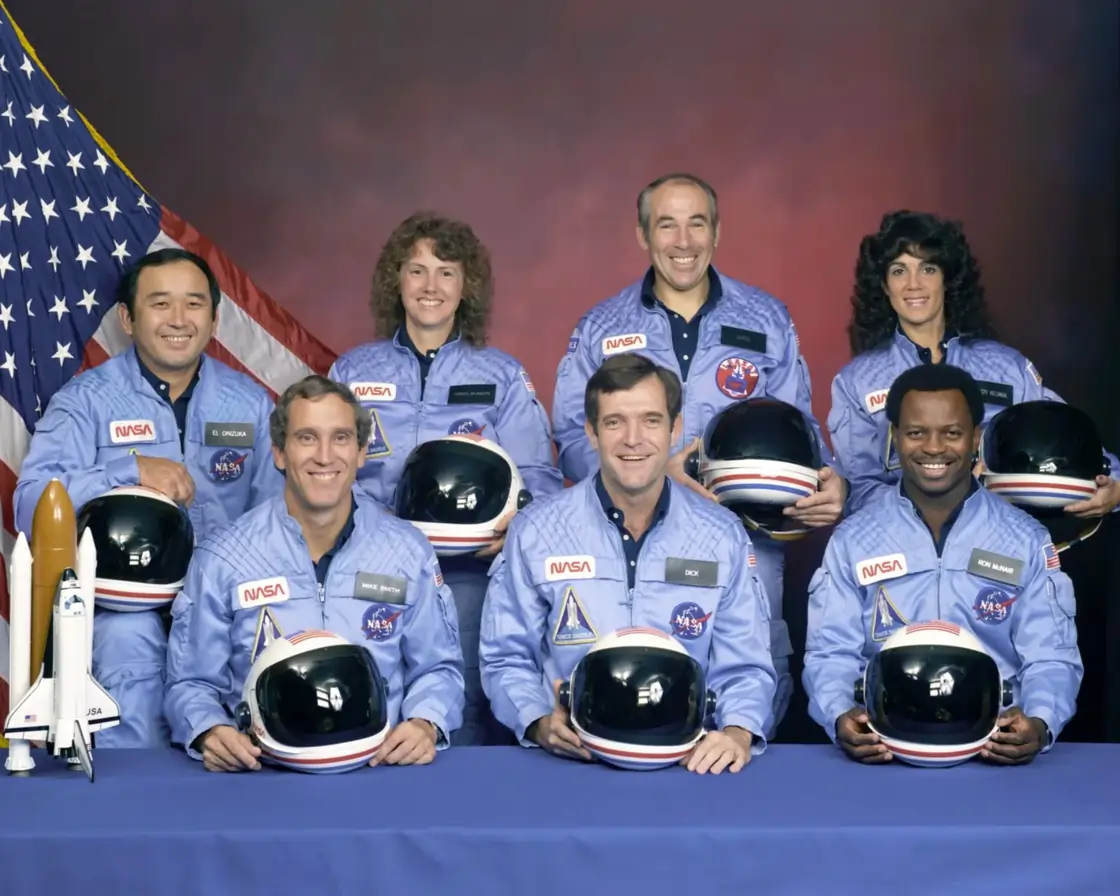
This undated file photo provided by NASA shows the crew of the Space Shuttle Challenger mission 51L. All seven members of the crew were killed when the shuttle exploded during launch on Jan. 28, 1986. From front left, are: Pilot Michael J. Smith, Commander Francis R. (Dick) Scobee, and mission specialist Ronald E. McNair. Rear left are: mission specialist Ellison Onizuka, teacher Christa McAuliffe, payload specialist Gregory Jarvis, and mission specialist Judith Resnik. (NASA via AP, File)
It was seventy-three seconds that will be suspended in our memories for all our lives. Those of us who witnessed the Challenger disaster forty years ago today will never forget the shock, horror, and grief that rose almost instantly in our collective hearts.
The moment we realized what had happened, that realization would stay with us forever. The seven brave astronauts who died, the families who grieve them still today, the nation that mourned—it is all as vivid as if it happened yesterday.
President Reagan postponed his State of the Union address scheduled for that night and spoke instead to our collective pain. He closed one of the most moving speeches of his eloquent career by stating:
The crew of the space shuttle Challenger honored us by the manner in which they lived their lives. We will never forget them, nor the last time we saw them, this morning, as they prepared for their journey and waved goodbye and “slipped the surly bonds of earth” to “touch the face of God.”
Explaining tragedy to second-graders
They didn’t have to die.
The investigation that ensued diagnosed the problem: O-rings connecting the solid rocket boosters failed due to the extreme cold that day. These rings were only a quarter-inch thick and were wrapped around the rocket sections at a circumference of thirty-seven feet. Because engineers knew that the slightest leak in a ring could be catastrophic, a second seal was added for redundancy.
But redundancy was not enough. Warnings from engineers that temperatures were too cold to be safe apparently went unheeded. Modifications were made in future flights to ensure that such a disaster could not happen again.
But seven of our best and bravest lost their lives that fateful day. And millions of Americans were marked by the tragedy.
Christa McAuliffe, chosen to be the first “teacher in space,” was so popular that school children around the country watched the launch on televisions in their classrooms. My wife was a second-grade teacher and had to try to explain to her children what happened.
It’s no easier today than it was on that day.
How a king’s insomnia changed history
As an apologist, my contribution, if any, would be to help us think theologically about a world where a providential God allows such tragedy.
I am reading the book of Esther in my personal Bible study these days, and was impressed today with this verse: “On that night the king could not sleep. And he gave orders to bring the book of memorable deeds, the chronicles, and they were read before the king” (Esther 6:1).
His royal insomnia would change history. Here’s the familiar back story:
- Mordecai, the uncle of Queen Esther, uncovered a plot against the king (Esther 2:19–23a), and his actions were “recorded in the book of the chronicles in the presence of the king” (v. 23b).
- Haman, the wicked adviser to the king, became enraged that Mordecai would not bow in his presence and plotted the destruction of the entire Jewish race in Persia, enlisting the king’s support (Esther 3).
- Esther agreed to help her people at the peril of her life (Esther 4), so she invited the king and Haman to a banquet she hosted (Esther 5:1–6), followed by an invitation to a second banquet (vv. 7–8).
- In between the two, Haman became so angry with Mordecai that he ordered a tall gallows to be constructed on which to hang him the next day (vv. 9–14).
If the king had not had insomnia and asked that the “chronicles” be read to him, Mordecai would have been executed before Esther’s intercession at the second banquet could save him. But the king’s chronicles reminded him of Mordecai’s bravery, so the king ordered Haman to honor him (Esther 6:2–11). After Esther revealed her connection to the Jewish people, Haman was hanged on the gallows he had built for Mordecai (Esther 7:7–10).
The king then issued a second edict permitting the Jewish people to defend themselves, and they subsequently destroyed their enemies (Esther 8–9:28). The feast of Purim, celebrated by Jews the world over to this day, commemorates this miraculous event (vv. 29–32). I have been in Jerusalem during Purim and can attest personally to the joy and celebration it brings the people each year.
Five “answers” that aren’t really answers
Of course, this narrative forces us to ask why a God who could act so providentially to protect innocent life in ancient Persia did not do the same on this day forty years ago.
Sadly, I will not be able to resolve this age-old challenge in this website article, or in any article, for that matter. I used to warn my seminary students that if we think our class will solve theological dilemmas that have perplexed the greatest minds across twenty centuries of Christian history, we’re much more likely to commit heresy than to prevent it.
Even the logical “answers” aren’t really answers. I can summarize what I spent semesters teaching seminary students and wrote books to explain:
The “free will” approach popularized by St. Augustine notes that when we misuse our God-given free will, the consequences are not his fault but ours. This is true, of course: if a student fails to study and then fails the test, he ought not blame his teacher. But a loving God would presumably help his child not make such a choice or help to mitigate its consequences. We do this for our children regularly and rightly wonder why God does not do the same.
The soul-building model of St Irenaeus notes that some suffering grows us in ways we would not otherwise grow. This also makes sense: we must diet and exercise to get in better shape, study to pass tests, and so on.
But does the good always outweigh the bad? Has the good that presumably came from the Challenger disaster with regard to the safety of future flights conclusively outweighed the tragedy and its horrific suffering?
The future-hope model assures us that we will understand one day what we do not understand today, that “we see in a mirror dimly, but then face to face” (1 Corinthians 13:12). Again, this is obviously true. But does knowing that we will one day understand what we cannot understand today help to ease our pain?
The present-help approach reminds us that God suffers as we suffer, promising that “when you pass through the waters, I will be with you” (Isaiah 43:2). As Jesus wept over Lazarus’ grave (John 11:35), so he weeps over our pain today.
Again, we can and should embrace this fact with enormous gratitude. But wouldn’t you rather have someone prevent your suffering than suffer with you? Why doesn’t God?
I often suggest a fifth, related approach: the assertion that God redeems all he allows. I believe this with all my heart and am convinced that he is redeeming even the Challenger disaster in ways that express his omnibenevolence and omnipotence. Though we may not understand such redemption on this side of eternity, one day we will.
But still, I would rather he had prevented the Challenger disaster than redeem it. You probably feel the same about your suffering today.
If God is God and I am not
So I’m left on this grief-filled anniversary with a binary choice: I can trust God even though I don’t fully (or sometimes even partially) understand his providence, or I can reject him for that reason.
We make the latter choice regularly in life: if we come to believe that a doctor, plumber, or electrician will not do what we need them to do, we will look for another doctor, plumber, or electrician. It only makes sense not to trust someone we fear to be untrustworthy.
But here’s the difference: God is God, and I am not.
If he is the Supreme Being that the Bible and Christian faith describe him to be, I have no logical right to expect to understand his providence any better than I do. If he can see the future better than I can see the present, how can I judge his present actions in light of future outcomes? If I cannot see the ways he is working in billions of lives around the planet today, how can I judge the ways he is working to impact their lives through mine? If my heart is “deceitful above all things, and desperately sick” (Jeremiah 17:9), how can I presume to know what is best for me or to choose it if I do?
In short, if God is God and I am not, I should expect to understand his providence precisely as well (and poorly) as I do. In addition, the more I need his providence, the less likely I am to understand it, since circumstances that call for his help are likely to be so difficult as to call into question his love.
If I reject his help because I do not understand his ways, I hurt the heart of the Father who loves me. But I hurt myself as well, since I refuse the provision an omnipotent Lord can give me. Like a patient who rejects a doctor’s help because he doesn’t understand medicine, my sickness is then more my fault than his.
So, I will say with Job, a man whose innocence and suffering far transcend mine, “Though he slay me, yet will I trust in him” (Job 13:15 KJV). All the while knowing that one day my suffering will be done and my questions will be unnecessary, for one day I too will have “put out my hand, and touched the face of God.”
Will you trust our Father with me today?













 Search