



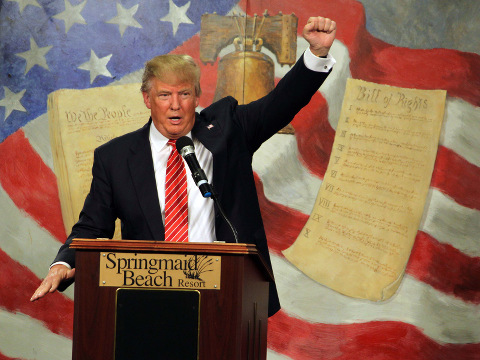
President Donald Trump arrives for a campaign rally at the Pinnacle Bank Expo Center, Monday, Oct. 5, 2026, in Grand Island, Neb. (AP Photo/Charlie Riedel)
The US Supreme Court has begun its new term, with cases involving President Trump’s immigration policies, climate change, and the Second Amendment among the most high-profile disputes the justices will hear in the coming months.
For example, amid the president’s push for a federal proof-of-citizenship requirement to register to vote, the justices will weigh on December 8 an Arizona rule requiring would-be voters to provide proof of citizenship when registering to vote using a state form. The next day, the court will consider whether the administration’s policy of removing illegal immigrants to countries they do not come from is legal.
Mr. Trump has already expressed his severe disapproval of three justices he nominated to the court during his first presidency. Justices Neil Gorsuch, Brett Kavanaugh, and Amy Coney Barrett have cast deciding votes blocking the president’s attempts to limit mail-in voting, birthright citizenship, and the independence of the Federal Reserve.
“These are not the people I interviewed to serve on the United States Supreme Court, they are merely a shell of their original selves,” he posted on his Truth Social platform last month. He added that the court’s legacy has been tarnished by “some of the most destructive, hurtful, and damaging decisions in our Country’s history.”
According to Harvard law professor Noah Feldman, however, the justices did not conceive of their job as “doing the bidding of a president.” He added, “And thank goodness, because that’s not the job.”
Carving a judge out of a banana
Mr. Trump is only the latest president to be frustrated by justices he nominated to the nation’s highest court. President Harry Truman called Justice Tom Clark the “biggest mistake” of his presidency. President Dwight D. Eisenhower felt the same about Justices Earl Warren and William Brennan.
President Ronald Reagan thought Sandra Day O’Connor would guarantee the fifth, and decisive, vote to overturn Roe v. Way. He was equally disappointed in Anthony Kennedy for the same reason. When Justice Oliver Wendell Holmes voted against President Theodore Roosevelt’s anti-trust policies, the president told a press conference that he “could carve out of a banana a judge with more backbone than that.”
Of course, the Founders intended the judiciary to be an equal third branch of government alongside the executive and the legislative. In their view, the nation needs an unelected body of judicial experts to ensure that laws passed by Congress and approved by presidents are, in fact, constitutional.
This does not mean that the justices always get it right, of course. The Court ruled in Dred Scott V. Sandford (1857) that African Americans could not be US citizens and that Congress could not ban slavery in federal territories. In 1896, its Plessy v. Ferguson ruling upheld racial segregation under the “separate but equal” doctrine. In 1927, its Buck v. Bell ruling permitted the forced sterilization of persons deemed “manifestly unfit,” providing a legal foundation for eugenics programs that victimized tens of thousands of people.
And of course, its horrific Roe v. Wade ruling in 1973 discovered a constitutional right to abortion that led to the deaths of more than sixty-three million preborn babies. And its Obergefell v. Hodges ruling in 2015 discovered a constitutional right to same-sex marriage, threatening the familial foundations of American society.
“The thing that David had done displeased the Lᴏʀᴅ”
I say all of that to say this: Christians must sometimes speak truth to power even at great risk to ourselves. There will be times in our secularized republic when our presidents, congressional representatives, and courts violate the truth of Scripture. It then falls to us to be the salt and light of society, declaring biblical truth with courage and compassion.
Let’s close with an example to encourage us.
2 Samuel 11 records David’s affair with Bathsheba, sexual sin that resulted in her pregnancy while her noble husband Uriah was away fighting in the king’s wars. So David summoned him and sent him home, assuming he would have relations with his wife and the world would think her child was his. He refused, noting that soldiers at a time of war do not properly engage in such activities while their fellow warriors are at war (v. 11). David then got him drunk, hoping he would return home to his wife, but Uriah refused (v. 13).
So the king sent his faithful warrior back to battle with a message for the general Joab: he was to position Uriah at the “forefront of the hardest fighting,” where he was likely to die (v. 15). It is a testimony to Uriah’s character that he did not open these instructions, which led to his own death. After he was killed, David brought the grieving widow Bathsheba into his house as his wife, and she “bore him a son” (v. 27a).
Presumably, no one but Bathsheba knew that the father was David. Others would see the king as acting nobly on behalf of the widow of his faithful warrior. But “the thing that David had done displeased the Lᴏʀᴅ” (v. 27b).
An example of courageous faithfulness
So he “sent Nathan to David” (2 Samuel 12:1). The prophet delivered God’s judgment against the king for his horrific sins (vv. 7–12), to which David responded, “I have sinned against the Lord” (v. 13). His repentance is given voice in Psalm 51 as a model for all time.
But it didn’t have to go that way. Nathan was presumably the only person who knew the full scope of the king’s sins. Even Bathsheba would not necessarily know that David had arranged for her husband’s death. If David could have Uriah killed, he certainly had the capacity to have Nathan executed as well, continuing the cover-up of his transgressions.
Nathan knew all of this, of course. But he chose obedience to God’s call at the risk of his life and became an example of courageous faithfulness from his day to ours.
One other fact comes to mind: God knew that Nathan would be faithful, which is why he called him to such faithfulness. The Father knows our minds and hearts and never asks us to do what he has not prepared and empowered us to do.
The Lord used one man to speak truth to the greatest power in his nation. What he did then, he still does today.
Who will be his Nathan today?
Will you?











 Search